The last day of a month with not a drop of rain and the parched conditions seem to be keeping insect numbers depressed. Apart from butterflies and the prominent pollinators, bees and hoverflies, there is little to be seen other than ladybirds and aphids.
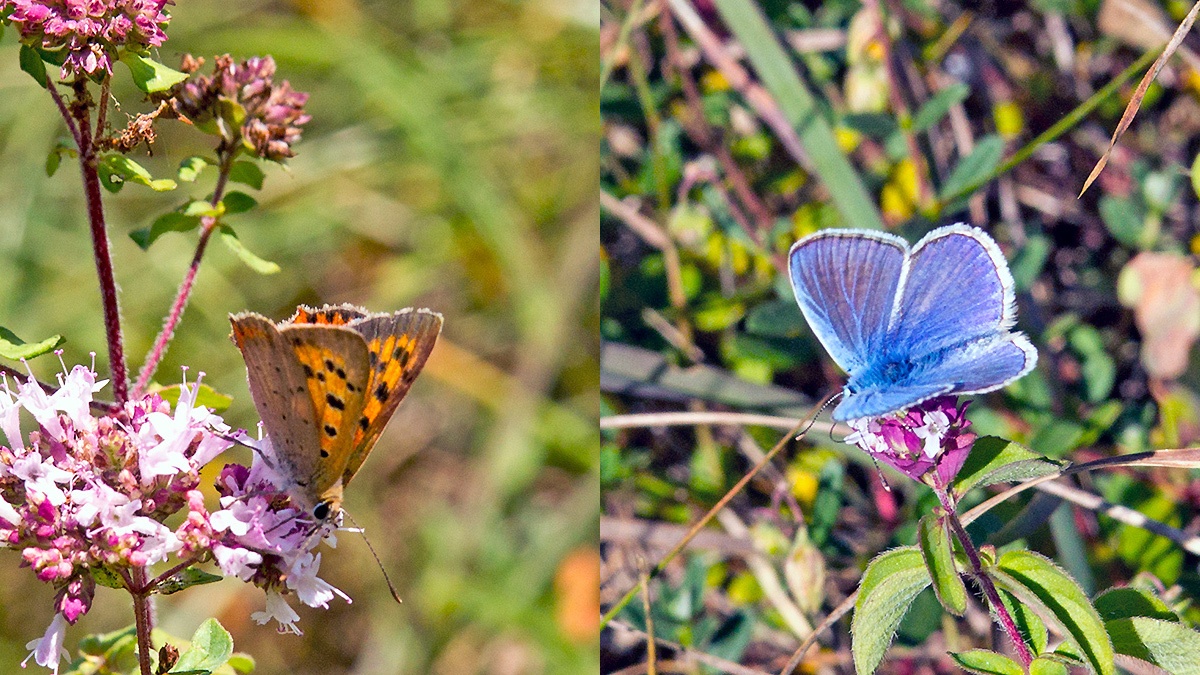
There are still good numbers of butterflies with Gatekeeper and Chalk Hill Blue still dominating. Meadow Brown are next in numbers, and a surprise today with 12 Painted Lady (Vanessa cardui). I have rarely seen more than 1 or 2 of this one on any given day. A few Small White and Common Blue (Polyommatus icarus), with single Small Heath, Small Copper (Lycaena phlaeas), Brimstone and Red Admiral making up the numbers, for a total of 10 species for the day.
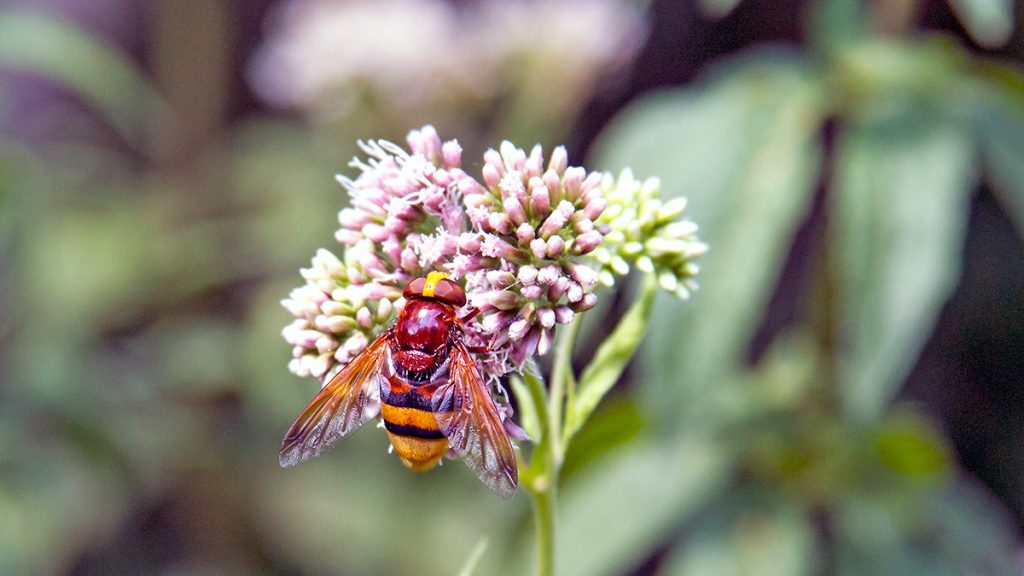
Many of the butterfly species can be seen resting or feeding on Common Knapweed and Wild Marjoram, while other insects seem to favour two of the other very prominent flowers right now, Hemp-agrimony and Wild Parsnip. On the former I found a Hornet Hoverfly (Volucella zonaria) and many Western Honey Bee (Apis mellifera).
Check any stand of Wild Parsnip and you will find aphids, but don’t look for the aphids, look for ladybirds. Where there are ladybirds, their major food source, aphids, won’t be too far away on the same stem or among the flowers of the same plant. Chances are that if there is not a ladybird on a particular plant it won’t have any aphids. My last post was accompanied by an image of a Harlequin Ladybird of the melanistic form of the form spectabilis on Wild Parsnip, today I found a Harlequin Ladybird of the form conspicua that appears to have caught an aphid.
My last post also had an image of aphids that I believed to be Willow-umbellifer Aphid (Cavariella pastinacae), although the photo resolution was not good enough to be certain. Today, however, I acquired much better images and I am much more confident of that ID of Willow-umbellifer Aphid.
![Painted Lady [Vanessa cardui]](https://downsdiary.uk/wp-content/gallery/jul_2026/NG9_1511_EOS-1D_TheDowns_31Jul2026.jpg "Painted Lady [Vanessa cardui]")
![Hornet Hoverfly [Volucella zonaria]](https://downsdiary.uk/wp-content/gallery/jul_2026/NG9_1515_EOS-1D_TheDowns_31Jul2026.jpg "Hornet Hoverfly [Volucella zonaria]")
![Western Honey Bee [Apis mellifera]](https://downsdiary.uk/wp-content/gallery/jul_2026/NG9_1510_EOS-1D_TheDowns_31Jul2026.jpg "Western Honey Bee [Apis mellifera]")
![Harlequin Ladybird [Harmonia axyridis f. conspicua]](https://downsdiary.uk/wp-content/gallery/jul_2026/NG9_1540_EOS-1D_TheDowns_31Jul2026.jpg "Harlequin Ladybird [Harmonia axyridis f. conspicua]")
![Willow-umbellifer Aphid [Cavariella pastinacae]](https://downsdiary.uk/wp-content/gallery/jul_2026/BD2_6291-5_7D_TheDowns_31Jul2026.jpg "Willow-umbellifer Aphid [Cavariella pastinacae]")
Latest wildflower image is of Burnet-saxifrage (Pimpinella saxifraga), which is in the family Apiaceae (also called Umbelliferae) that includes Hogweed, Wild Parsley, Cow Parsley and Wild Carrot. If one sees Burnet-saxifrage growing together with Wild Carrot (Daucus carota) – and this is quite common – it is easy to overlook and dismiss as being yet more Wild Carrot. However, a closer inspection of the clustered umbels that form the inflorescences of each plant will reveal the difference. Wild Carrot has more densely packed umbels and the outer petals of the outer flowers making up the outermost umbels are much larger than the other petals. These flowers are said to exhibit bilateral symmetry (they are zygomorphic) and can only be divided into equal halves along a single vertical plane. Conversely the petals of the individual flowers of Burnet-saxifrage are all the same size and are said to exhibit radial symmetry (they are actinomorphic), which means that they can be divided into two equal, mirror-image halves on multiple planes passing through the centre of the flower. So just remember that Wild Carrot is the one with the ‘raggy edges’.
![Burnet-saxifrage [Pimpinella saxifraga]](https://downsdiary.uk/wp-content/gallery/jul_2026/NG9_1497_EOS-1D_TheDowns_31Jul2026.jpg "Burnet-saxifrage [Pimpinella saxifraga]")
![Burnet-saxifrage [Pimpinella saxifraga]](https://downsdiary.uk/wp-content/gallery/jul_2026/NG9_1493_EOS-1D_TheDowns_31Jul2026.jpg "Burnet-saxifrage [Pimpinella saxifraga]")
![Burnet-saxifrage [Pimpinella saxifraga]](https://downsdiary.uk/wp-content/gallery/jul_2026/NG9_1494-7_EOS-1D_TheDowns_31Jul2026.jpg "Burnet-saxifrage [Pimpinella saxifraga]")
<<<< Previous page | Next Page >>>>