Another 11 species of butterfly seen today, a somewhat different mix to Monday, though Gatekeeper and Chalk Hill Blue (Lysandra coridon) still dominate numbers. A few each of Meadow Brown, Ringlet, Speckled Wood, Small Blue and Common Blue were noted, with single Green-veined White, Painted Lady (Vanessa cardui) and two surprises.
The first was a species that usually does not fly in July, but in exceptional years has a partial second brood. This must be one of the years with favourable conditions as there are now some more Dingy Skipper (Erynnis tages) about.
The second was a migrant species, most arrivals being from the near Continent. In some years there are major influxes of Clouded Yellow (Colias croceus). Whatever the numbers this year this is the first one I have ever seen anywhere, not just on Banstead Downs.
Moth of the day was a Silver Y (Autographa gamma).
![Chalk Hill Blue [Lysandra coridon]](https://downsdiary.uk/wp-content/gallery/jul_2026/NG9_1250_EOS-1D_TheDowns_22Jul2026.jpg "Chalk Hill Blue [Lysandra coridon]")
![Painted Lady [Vanessa cardui]](https://downsdiary.uk/wp-content/gallery/jul_2026/NG9_1248_EOS-1D_TheDowns_22Jul2026.jpg "Painted Lady [Vanessa cardui]")
![Dingy Skipper [Erynnis tages]](https://downsdiary.uk/wp-content/gallery/jul_2026/NG9_1242_EOS-1D_TheDowns_22Jul2026-2.jpg "Dingy Skipper [Erynnis tages]")
![Clouded Yellow [Colias croceus]](https://downsdiary.uk/wp-content/gallery/jul_2026/NG9_1270_EOS-1D_TheDowns_22Jul2026.jpg "Clouded Yellow [Colias croceus]")
![Silver Y [Autographa gamma]](https://downsdiary.uk/wp-content/gallery/jul_2026/NG9_1237_EOS-1D_TheDowns_22Jul2026.jpg "Silver Y [Autographa gamma]")
Another migrant species seen today was a dragonfly, a female Red-veined Darter (Sympetrum fonscolombii), which I was unable to photograph properly, but managed a couple of images that I hope show enough of the features that can definitively ID this species. This is a fairly frequent migrant from the Continent to southern Britain, seen from May – November, but peaking in numbers from June – August.
It was also a day for bee photos.
I came across a large red-tailed bee moving from one Common Knapweed flower to another. From the size (>20mm) I believed this must be a queen but thought that it was the wrong time of year to be seeing a queen. It seems that it is most likely a brand-new virgin queen (gyne) Red-tailed Bumblebee (Bombus lapidarius) that has just left her natal nest and is stocking up on energy from nectar-rich flowers to prepare for mating and her long winter hibernation. This process starts around mid-July. Knapweed is an absolute magnet for this species. Because queen bumblebees are so heavy, they struggle to balance on delicate, tubular flowers and prefer landing on flat, robust composite flower heads, like knapweed and thistles, because the sturdy platform easily holds their weight while they feed.
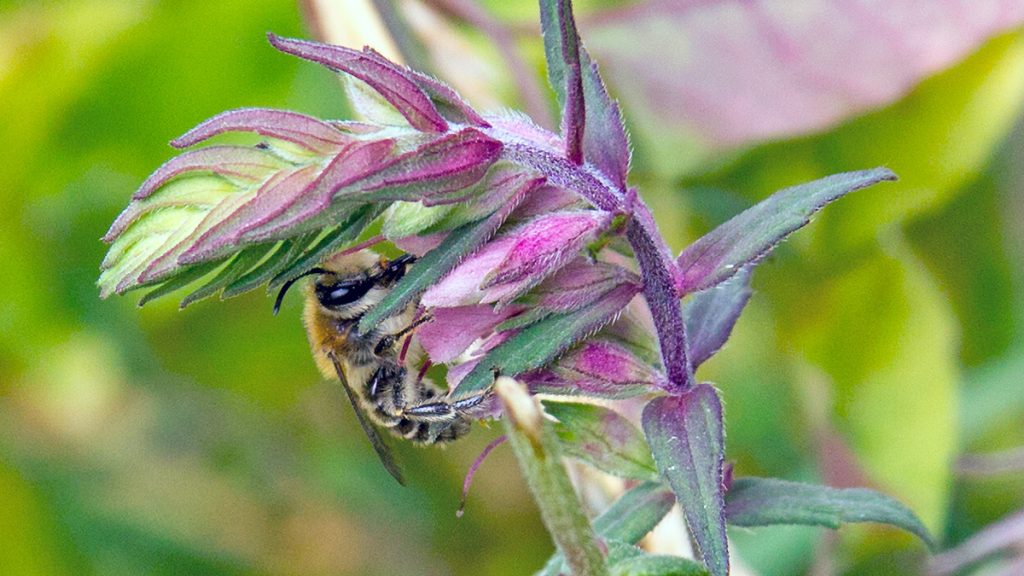
It is one of the UK’s rarest solitary bees and last year I struggled to get a good image of a Red Bartsia Bee (Melitta tricincta), staking out a suitable spot of Red Bartsia (Odontites vernus) on several days before achieving success. Today it took me all of 1 minute after noticing a bee on a large area of Red Bartsia. As the bee’s name suggests it collects pollen almost exclusively from the Red Bartsia flower. Adult bees are active from late July to early September, coinciding perfectly with the blooming period of Red Bartsia. As the average height of Red Bartsia plants is about 30cm, with flowers that droop, making the bees hang underneath the flowers most of the time to collect the pollen, it makes for a rather awkward position to adopt to get a decent photo. At my age straightening up again afterwards is a major issue!
A third bee was found in good numbers on the flowers of several adjacent Wild Parsnip (Pastinaca sativa) plants. This was a Lasioglossum furrow bee, possibly a dark/black form male of the Common Furrow Bee (Lasioglossum calceatum).
In the same stand of Wild Parsnip I found a female ichneumon wasp, probably Ichneumon suspiciosus, and a large number of scurrying Common Red Ant (Myrmica rubra).
![Red-tailed Bumblebee [Bombus lapidarius]](https://downsdiary.uk/wp-content/gallery/jul_2026/NG9_1257_EOS-1D_TheDowns_22Jul2026.jpg "Red-tailed Bumblebee [Bombus lapidarius]")
![Red Bartsia Bee [Melitta tricincta]](https://downsdiary.uk/wp-content/gallery/jul_2026/NG9_1289_EOS-1D_TheDowns_22Jul2026.jpg "Red Bartsia Bee [Melitta tricincta]")
![Common Furrow Bee [Lasioglossum calceatum?]](https://downsdiary.uk/wp-content/gallery/jul_2026/BD2_6229_7D_TheDowns_22Jul2026.jpg "Common Furrow Bee [Lasioglossum calceatum?]")
![ichneumon wasp [Ichneumon suspiciosus]](https://downsdiary.uk/wp-content/gallery/jul_2026/NG9_1296_EOS-1D_TheDowns_22Jul2026.jpg "ichneumon wasp [Ichneumon suspiciosus]")
![Common Red Ant [Myrmica rubra]](https://downsdiary.uk/wp-content/gallery/jul_2026/BD2_6238_7D_TheDowns_22Jul2026.jpg "Common Red Ant [Myrmica rubra]")
Latest wildflower noted and probably in flower for a while, but only now photographed, is Creeping Thistle (Cirsium arvense).
![Creeping Thistle [Cirsium arvense]](https://downsdiary.uk/wp-content/gallery/jul_2026/NG9_1233_EOS-1D_TheDowns_22Jul2026.jpg "Creeping Thistle [Cirsium arvense]")
<<<< Previous page | Next Page >>>>