Lovely sunshine but a windy day. Both a Kestrel and a Buzzard were cruising over the main grassland area, the latter being harried occasionally by a pair of crows.
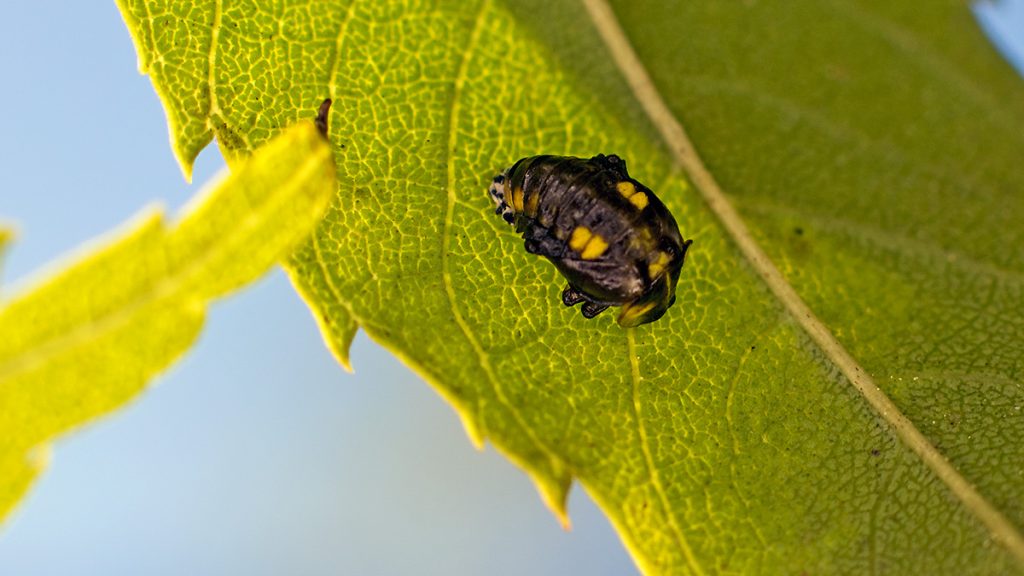
An interesting find was a cluster of pupal cocoons, probably of an ermine moth (family Yponomeutidae), on the underside of a large holly leaf. Unusual, as holly is not one of the larval food plants for these moths. However, as this holly bush is growing under one of the spindle trees that was festooned in early summer with the silken webs of hundreds of gorging caterpillars of the Spindle Ermine Moth (Yponomeuta cagnagella) it is possible that these could be the pupal cocoons of this species. They could have been here since mid-August when the first Spindle Ermine moths started appearing in large numbers and may simply have ended up where they are now having become detached from the spindle tree and snagged on the holly beneath.
![Spindle Ermine [Yponomeuta cagnagella?]](https://downsdiary.uk/wp-content/gallery/dec_2025/NG8_5405_EOS-1D_TheDowns_11Dec2025.jpg "Spindle Ermine [Yponomeuta cagnagella?]")
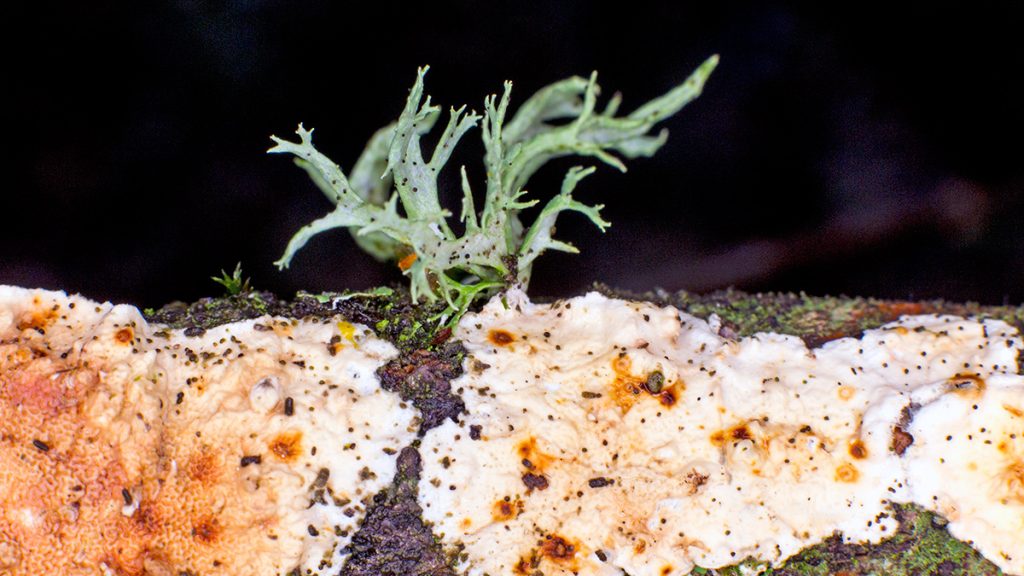
In the woodland I found Oakmoss (Evernia prunastri), which is a lichen not a moss as the name suggests, not surprisingly on an oak branch, together with a crust fungus.
In the same area I located some Soft-Shield Fern (Polystichum setiferum).
![Old Man’s Beard / Traveller’s Joy [Clematis vitalba]](https://downsdiary.uk/wp-content/gallery/dec_2025/NG8_5400_EOS-1D_TheDowns_11Dec2025.jpg "Old Man’s Beard / Traveller’s Joy [Clematis vitalba]")
![Oakmoss lichen [Evernia prunastri]](https://downsdiary.uk/wp-content/gallery/dec_2025/NG8_5407_EOS-1D_TheDowns_11Dec2025.jpg "Oakmoss lichen [Evernia prunastri]")
![Soft-Shield Fern [Polystichum setiferum]](https://downsdiary.uk/wp-content/gallery/dec_2025/JO8V5066_EOS-1D_TheDowns_11Dec2025.jpg "Soft-Shield Fern [Polystichum setiferum]")
![Oakmoss lichen [Evernia prunastri]](https://downsdiary.uk/wp-content/gallery/fungi-slime-moulds/NG8_5407_EOS-1D_TheDowns_11Dec2025.jpg "Oakmoss lichen [Evernia prunastri]")
Nature note for the day
Why do I believe that today’s fern is a Soft-Shield Fern or even of the genus Polystichum?
There are a few useful pointers, which my image of the underside of the fern frond illustrate. Fern spores are produced and contained in a sporangium. On a fern, sporangia cluster together in a body known as a sorus. The sori have a cover of protective tissue called an indusium. The shape of these indusia helps separate different fern families (and genera). Shield ferns (Polystichum) have circular indusia, whereas the indusia of the also common wood ferns (Dryopteris) are kidney-shaped.
In ferns pinnules are the individual sub-leaflets or segments of the pinnae, the larger leaflets that are arranged along the midrib making up the frond as a whole. Another feature that helps distinguish Polystichum ferns is the presence on the basal pinnule of each pinna of an auricle, a prominent ‘thumb-like lobe’ that points both towards the tip of the pinna and the tip of the frond. This lends an asymmetry to the base of the pinnae.
The way in which the pinnules are connected to the midrib of each pinna helps to separate Soft-Shield Fern (Polystichum setiferum) from another common shield fern, Hard-Shield Fern (Polystichum aculeatum). In P. setiferum there is a very short stalk attaching the pinnules to the midrib, whereas in P. aculeatum the pinnules are sessile (stalkless), attached directly to the midrib.
![Soft-Shield Fern [Polystichum setiferum]](https://downsdiary.uk/wp-content/gallery/dec_2025/NG8_5419b_EOS-1D_TheDowns_11Dec2025.jpg "Soft-Shield Fern [Polystichum setiferum]")
There is a very readable online resource for other useful features to help with fern ID.
<<<< Previous page | Next Page >>>>