Damper and damper, even the leaf litter in the woodland is now distinctly soggy.
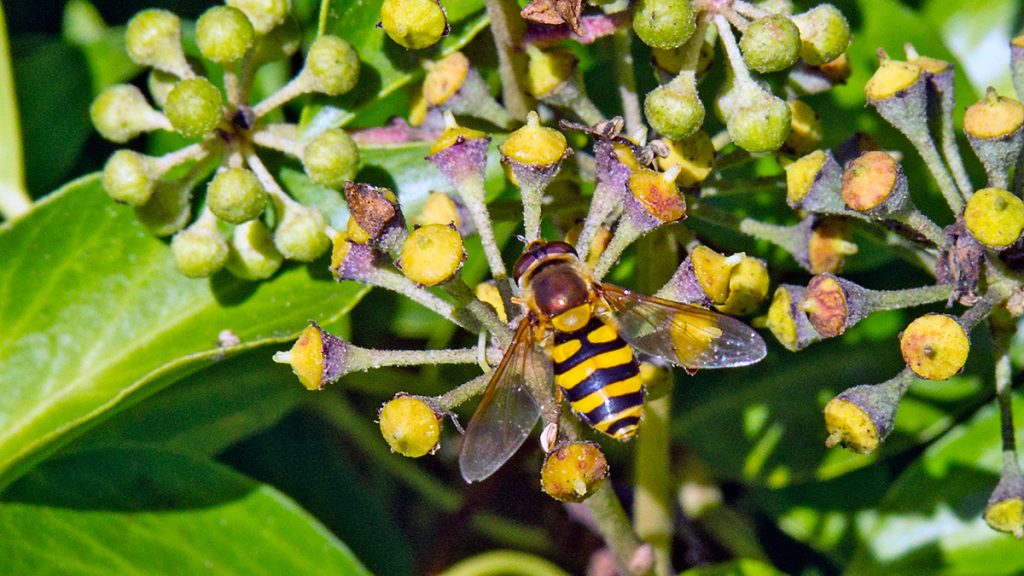
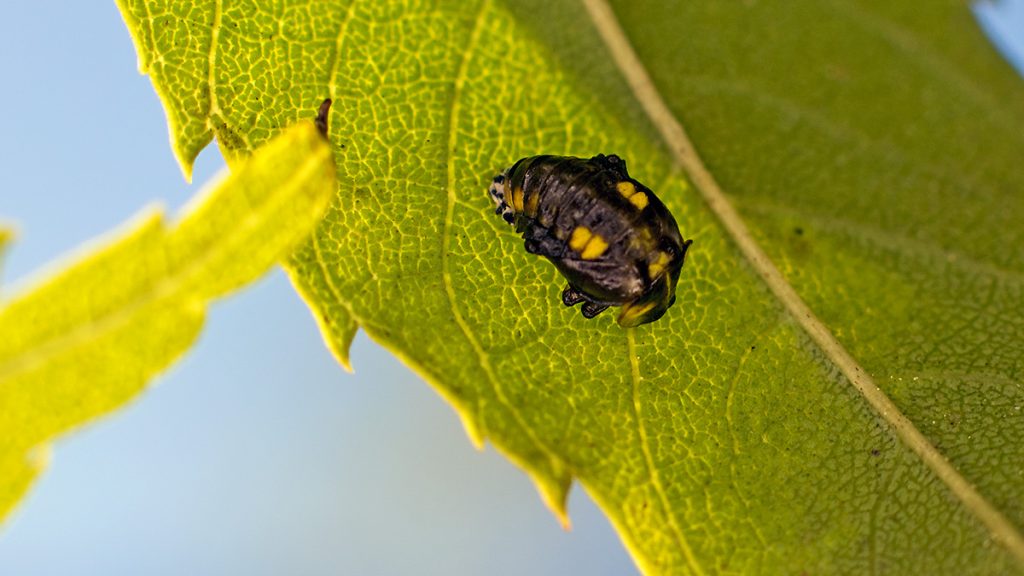
I was only just onto the Downs today when I made my first discovery. Searching the underside of ivy leaves for anything of interest I found the pupa of a hoverfly (Syrphidae sp.) in plain sight on the upper surface of an ivy leaf.
In the woodland I thought I was taking a photo of an ant. The ‘ant’ turned out to be a wingless female ant-mimicking parasitic wasp (possibly of the genus Gelis) on a bramble leaf no doubt searching for the pupae of other insects in which to lay her eggs. The bramble leaf itself showed many larval leaf cut-outs, as well as old leaf mines probably caused by larvae of the Golden Dot moth (Stigmella aurella).
I literally just had to turn around to find a fly sitting on a large mushroom. Given the context this could be a fly of the Heleomyzidae family, possibly in the sub-family Suilliinae, as they can be found year-round and are usually associated with fungi and decaying matter as these are the larval food sources for these flies.
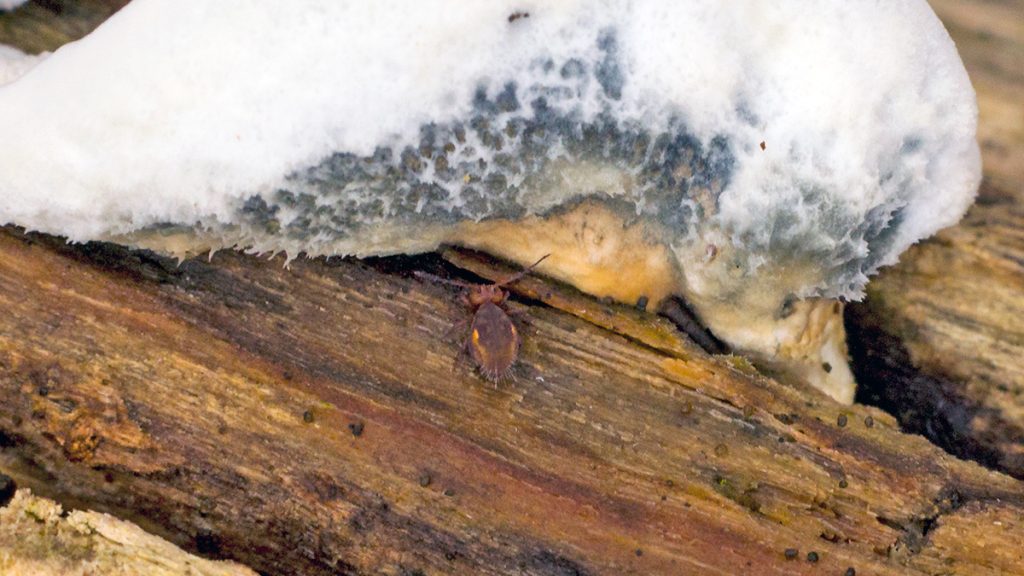
While photographing a Postia sp. fungus (possibly P. subcaesia, Blueing Bracket) on a fallen oak branch, I became aware of a woodlouse crawling in and out of my field of view. Subsequent processing of these images revealed it to be a Common Rough Woodlouse (Porcellio scaber). During processing I also discovered something I had missed in the field, tiny globular springtails were also present, probably Dicyrtomina saundersi, the same species that I first posted a week ago.
![hoverfly pupa [Syrphidae sp.?]](https://downsdiary.uk/wp-content/gallery/dec_2025/NG8_5368_EOS-1D_TheDowns_10Dec2025.jpg "hoverfly pupa [Syrphidae sp.?]")
![parasitic wasp [Gelis sp.?]](https://downsdiary.uk/wp-content/gallery/dec_2025/JO8V5052_EOS-1D_TheDowns_10Dec2025.jpg "parasitic wasp [Gelis sp.?]")
![Heleomyzid fly ? [unidentified]](https://downsdiary.uk/wp-content/gallery/dec_2025/JO8V5048_EOS-1D_TheDowns_10Dec2025.jpg "Heleomyzid fly ? [unidentified]")
![bracket fungus [Postia sp.?]](https://downsdiary.uk/wp-content/gallery/dec_2025/NG8_5374_EOS-1D_TheDowns_10Dec2025.jpg "bracket fungus [Postia sp.?]")
![bracket fungus [Postia sp.?]](https://downsdiary.uk/wp-content/gallery/dec_2025/NG8_5370_EOS-1D_TheDowns_10Dec2025.jpg "bracket fungus [Postia sp.?]")
![Common Rough Woodlouse [Porcellio scaber]](https://downsdiary.uk/wp-content/gallery/dec_2025/NG8_5374b_EOS-1D_TheDowns_10Dec2025.jpg "Common Rough Woodlouse [Porcellio scaber]")
![globular springtail [Dicyrtomina saundersi?]](https://downsdiary.uk/wp-content/gallery/dec_2025/NG8_5370b_EOS-1D_TheDowns_10Dec2025.jpg "globular springtail [Dicyrtomina saundersi?]")
Many of the fallen and decaying branches in this area, mainly oak, birch or hawthorn, showed growth of Mycena sp. bonnet mushrooms. On a large pile of grass cuttings I found the now decaying caps of Wood Blewit (Collybia nuda) mushrooms. Digging away the grass around them revealed much more of these mushrooms.
![bonnet mushrooms [Mycena sp.?]](https://downsdiary.uk/wp-content/gallery/dec_2025/NG8_5379_EOS-1D_TheDowns_10Dec2025.jpg "bonnet mushrooms [Mycena sp.?]")
![Blewit mushrooms [Collybia sp.]](https://downsdiary.uk/wp-content/gallery/dec_2025/JO8V5037_EOS-1D_TheDowns_10Dec2025.jpg "Blewit mushrooms [Collybia sp.]")
![Blewit mushrooms [Collybia sp.]](https://downsdiary.uk/wp-content/gallery/dec_2025/JO8V5033_EOS-1D_TheDowns_10Dec2025.jpg "Blewit mushrooms [Collybia sp.]")
<<<< Previous page | Next Page >>>>