Lovely sunshine again, but much colder this morning. The temperature firmly in wintry single digit territory.
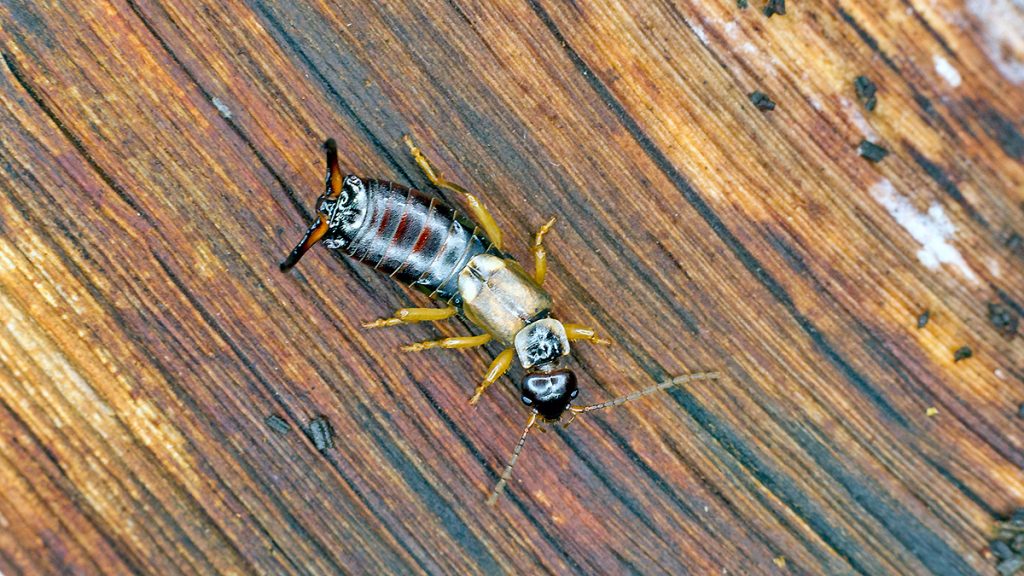
I tried peeling back a piece of bark on a dead birch tree and was rewarded with mixed age group of variably coloured Common Rough Woodlouse (Porcellio scaber) and my first ever sighting on the downs of a Common Earwig (Forficula auricularia).
![Common Earwig [Forficula auricularia]](https://downsdiary.uk/wp-content/gallery/dec_2025/NG8_5458_EOS-1D_TheDowns_13Dec2025.jpg "Common Earwig [Forficula auricularia]")
![Common Rough Woodlouse [Porcellio scaber]](https://downsdiary.uk/wp-content/gallery/dec_2025/NG8_5460_EOS-1D_TheDowns_13Dec2025.jpg "Common Rough Woodlouse [Porcellio scaber]")
A Yew (Taxus baccata) sported a single ‘berry’. Just one ‘berry’ on a 3-4 m high tree. Of course, as the yew is dioecious this is a female tree. Either this is one the birds have missed or it is all that this tree produced. Yews only start producing seeds after 15 – 30 years so the height of this tree suggests that it may only be reaching that age bracket. A yew ‘berry’ is yet another example of a ‘berry’ that is not a berry. It is actually a single-seed cone surrounded by a red fleshy cup known as an aril, giving it a berry-like structure. Interestingly that red fleshy part is sweet and edible, while the seed that it surrounds is highly toxic.
Right next to this yew tree was a Scaly Male Fern (Dryopteris affinis). This Dryopteris species is semi-evergreen, meaning that it keeps most of its leaves through winter, but loses them for a short period when new foliage starts to grow in spring. The one in my image shows a lot of white speckling on the upper surfaces of the leaflet, especially close to the margins. This is probably a result of ‘grazing’ by various insect larvae, which took place months ago. The undersides show ‘exploded’ sporangia that would have released their spores in late summer. I located yet another globular springtail on one of the fronds. They seem to be popping up everywhere recently.
In this same area I found Ochre Spreading Tooth (Steccherinum ochraceum) fungus on a dead branch.
![Yew [Taxus baccata]](https://downsdiary.uk/wp-content/gallery/dec_2025/NG8_5477_EOS-1D_TheDowns_13Dec2025.jpg "Yew [Taxus baccata]")
![Yew [Taxus baccata]](https://downsdiary.uk/wp-content/gallery/dec_2025/NG8_5480_EOS-1D_TheDowns_13Dec2025.jpg "Yew [Taxus baccata]")
![Scaly Male Fern [Dryopteris affinis]](https://downsdiary.uk/wp-content/gallery/dec_2025/JO8V5080_EOS-1D_TheDowns_13Dec2025.jpg "Scaly Male Fern [Dryopteris affinis]")
![Scaly Male Fern [Dryopteris affinis]](https://downsdiary.uk/wp-content/gallery/dec_2025/JO8V5082_EOS-1D_TheDowns_13Dec2025.jpg "Scaly Male Fern [Dryopteris affinis]")
![Scaly Male Fern [Dryopteris affinis]](https://downsdiary.uk/wp-content/gallery/dec_2025/NG8_5484_EOS-1D_TheDowns_13Dec2025.jpg "Scaly Male Fern [Dryopteris affinis]")
![Scaly Male Fern [Dryopteris affinis]](https://downsdiary.uk/wp-content/gallery/dec_2025/NG8_5488b_EOS-1D_TheDowns_13Dec2025.jpg "Scaly Male Fern [Dryopteris affinis]")
![Ochre Spreading Tooth [Steccherinum ochraceum]](https://downsdiary.uk/wp-content/gallery/dec_2025/JO8V5076_EOS-1D_TheDowns_13Dec2025.jpg "Ochre Spreading Tooth [Steccherinum ochraceum]")
![Ochre Spreading Tooth [Steccherinum ochraceum]](https://downsdiary.uk/wp-content/gallery/dec_2025/NG8_5467_EOS-1D_TheDowns_13Dec2025.jpg "Ochre Spreading Tooth [Steccherinum ochraceum]")
<<<< Previous page | Next Page >>>>