A lovely sunny afternoon. The first thing that attracted my attention today was a foraging flock of Redwing (Turdus iliacus) in the tree canopy of the woodland adjacent to Downs Road. This is our smallest member of the thrush family (Turdidae) and a winter visitor.
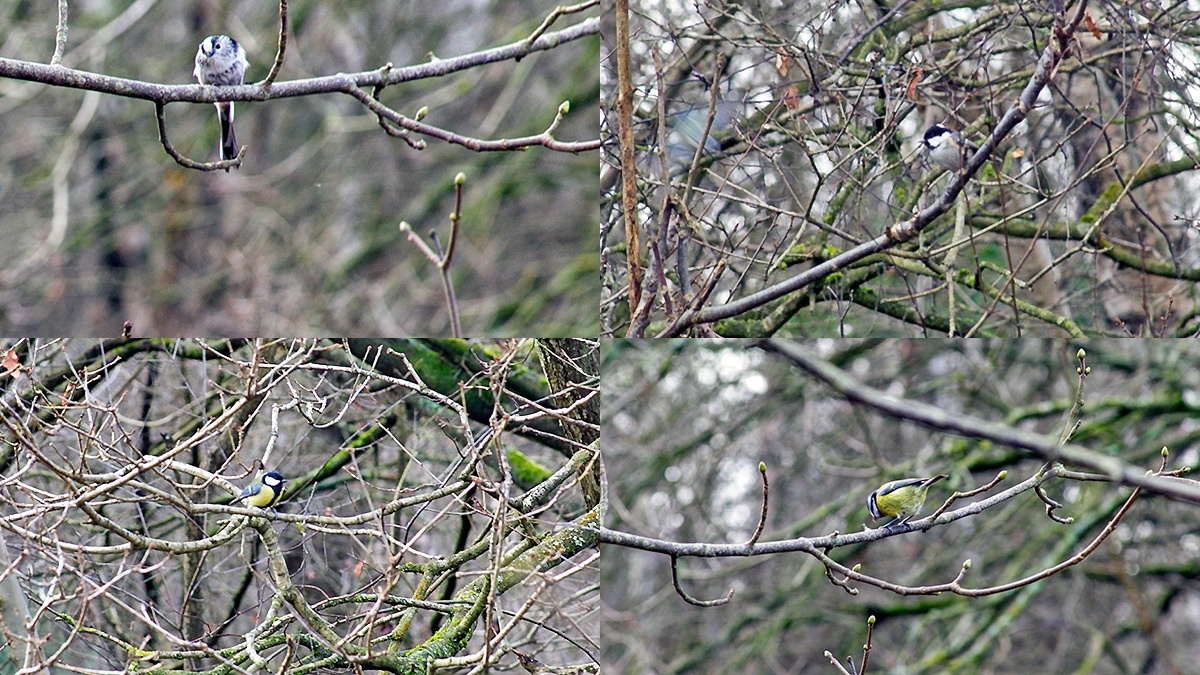
Crossing Sutton Road and entering the clearing there I encountered another foraging flock on the woodland edge, this time of mixed tits. Great Tit (Parus major), Blue Tit (Cyanistes caeruleus), Coal Tit (Periparus ater) and Long-tailed Tit (Aegithalos caudatus) were all present, although as I explained in my post of 25th November the last-named, despite its name, is not actually a member of the tit family. I took a photo of each, but using a 135 mm lens at distance could do no more than give a good ID shot of each of these four tits.
Very active today were many Grey Squirrel (Sciurus carolinensis). Perhaps the warmer sunny weather is reponsible.
The sunny weather also seems to be convincing some of the trees to start their spring display. The presence of their opened male catkins, ‘lamb’s tails’, is usually one of the earliest signs of spring and this image shows three Common Hazel (Corylus avellana) with male catkins that are very different colours. This is due to the differing stages of opening reached by their catkins. The unopened catkins of the tree in the middle appear grey-brown, while those on the tree to the left are largely fully opened and bright yellow. The tree on the right has catkins in an intermediate stage, appearing pale yellow. A composite close-up image shows these three stages.
A rather unusual find was a Leatherleaf Viburnum (Viburnum rhytidophyllum), under a large stand-alone oak tree and surrounded by a tangle of brambles. This is an evergreen shrub native to Asia, so undoubtedly a garden escapee.
![Common Hazel [Corylus avellana]](https://downsdiary.uk/wp-content/gallery/jan_2026/NG8_5814_EOS-1D_TheDowns_31Jan2026.jpg "Common Hazel [Corylus avellana]")
![Common Hazel [Corylus avellana]](https://downsdiary.uk/wp-content/gallery/jan_2026/NG8_5817_EOS-1D_TheDowns_31Jan2026.jpg "Common Hazel [Corylus avellana]")
![Common Hazel [Corylus avellana]](https://downsdiary.uk/wp-content/gallery/jan_2026/NG8_5816_EOS-1D_TheDowns_31Jan2026.jpg "Common Hazel [Corylus avellana]")
![Common Hazel [Corylus avellana]](https://downsdiary.uk/wp-content/gallery/jan_2026/NG8_5820_EOS-1D_TheDowns_31Jan2026.jpg "Common Hazel [Corylus avellana]")
![Common Hazel [Corylus avellana]](https://downsdiary.uk/wp-content/gallery/jan_2026/BD2_0041-44-46_7D_TheDowns_31Jan2026.jpg "Common Hazel [Corylus avellana]")
![Leatherleaf Viburnum [Viburnum rhytidophyllum]](https://downsdiary.uk/wp-content/gallery/jan_2026/NG8_5843_EOS-1D_TheDowns_31Jan2026.jpg "Leatherleaf Viburnum [Viburnum rhytidophyllum]")
Fungi again feature largely in my photos, with two new ones found on the same tree. The oak mentioned above hosted what I believe to be Yellow Brain Fungus (Tremella mesenterica). Another oak was covered in a Stereum sp., either Hairy Curtain Crust (S. hirsutum) or Bleeding Oak Crust (S. gausapatum), although I lean towards the former. Hairy Curtain Crust was also found later on a fallen oak. The photos show just how difficult fungus ID is as it is often hard to believe that any two of these are of the same species.
![Yellow Brain Fungus [Tremella mesenterica]](https://downsdiary.uk/wp-content/gallery/jan_2026/NG8_5837_EOS-1D_TheDowns_31Jan2026.jpg "Yellow Brain Fungus [Tremella mesenterica]")
![crust fungus [Stereum sp.]](https://downsdiary.uk/wp-content/gallery/jan_2026/NG8_5844_EOS-1D_TheDowns_31Jan2026.jpg "crust fungus [Stereum sp.]")
![crust fungus [Stereum sp.]](https://downsdiary.uk/wp-content/gallery/jan_2026/BD2_0062_7D_TheDowns_31Jan2026.jpg "crust fungus [Stereum sp.]")
![crust fungus [Stereum sp.]](https://downsdiary.uk/wp-content/gallery/jan_2026/NG8_5850_EOS-1D_TheDowns_31Jan2026.jpg "crust fungus [Stereum sp.]")
![crust fungus [Stereum sp.]](https://downsdiary.uk/wp-content/gallery/jan_2026/NG8_5849_EOS-1D_TheDowns_31Jan2026.jpg "crust fungus [Stereum sp.]")
![crust fungus [Stereum sp.]](https://downsdiary.uk/wp-content/gallery/jan_2026/BD2_0056_7D_TheDowns_31Jan2026.jpg "crust fungus [Stereum sp.]")
![Hairy Curtain Crust [Stereum hirsutum]](https://downsdiary.uk/wp-content/gallery/jan_2026/NG8_5857_EOS-1D_TheDowns_31Jan2026.jpg "Hairy Curtain Crust [Stereum hirsutum]")
![Hairy Curtain Crust [Stereum hirsutum]](https://downsdiary.uk/wp-content/gallery/jan_2026/BD2_0120_7D_TheDowns_31Jan2026.jpg "Hairy Curtain Crust [Stereum hirsutum]")
![Hairy Curtain Crust [Stereum hirsutum]](https://downsdiary.uk/wp-content/gallery/jan_2026/BD2_0129_7D_TheDowns_31Jan2026.jpg "Hairy Curtain Crust [Stereum hirsutum]")
![Hairy Curtain Crust [Stereum hirsutum]](https://downsdiary.uk/wp-content/gallery/jan_2026/BD2_0137_7D_TheDowns_31Jan2026.jpg "Hairy Curtain Crust [Stereum hirsutum]")
![slime mould [Physarum album ?]](https://downsdiary.uk/wp-content/gallery/jan_2026/BD2_0104_7D_TheDowns_31Jan2026.jpg "slime mould [Physarum album ?]")
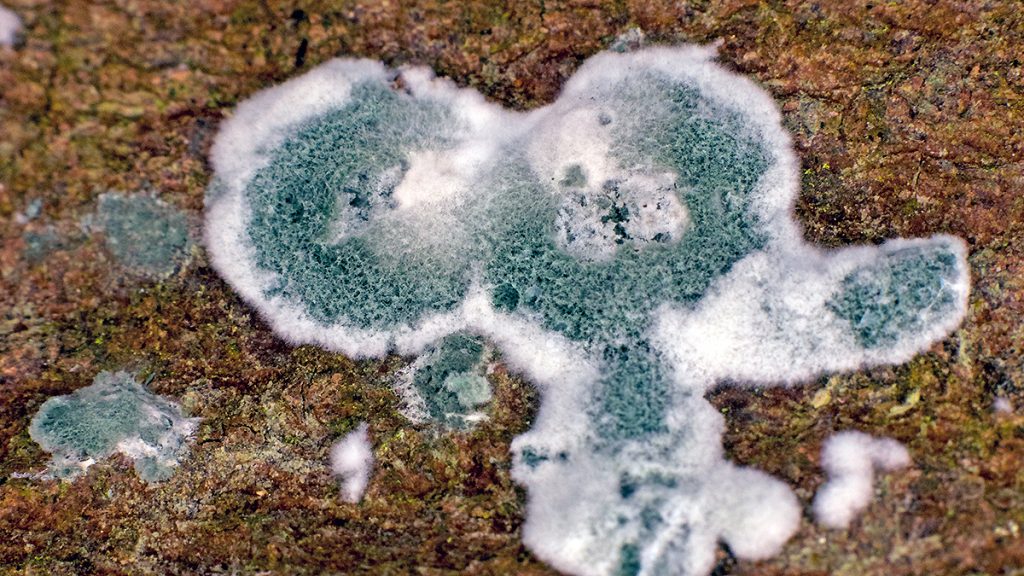
The two new fungi (new for me that is) were found on a dead tree, I think a beech tree. These are Green Mould (Trichoderma viride) and the bright red fruiting body stage of Coral Spot (Nectria cinnabarina).
The sporangia (spore-bearing fruiting bodies) of a slime mould, possibly Physarum album, were discovered on a different dead but still erect tree.
![Green Mould [Trichoderma viride]](https://downsdiary.uk/wp-content/gallery/jan_2026/NG8_5852_EOS-1D_TheDowns_31Jan2026.jpg "Green Mould [Trichoderma viride]")
![Green Mould [Trichoderma viride]](https://downsdiary.uk/wp-content/gallery/jan_2026/BD2_0079_7D_TheDowns_31Jan2026.jpg "Green Mould [Trichoderma viride]")
![Coral Spot [Nectria cinnabarina]](https://downsdiary.uk/wp-content/gallery/jan_2026/NG8_5856_EOS-1D_TheDowns_31Jan2026.jpg "Coral Spot [Nectria cinnabarina]")
![Coral Spot [Nectria cinnabarina]](https://downsdiary.uk/wp-content/gallery/jan_2026/BD2_0090_7D_TheDowns_31Jan2026.jpg "Coral Spot [Nectria cinnabarina]")
Nature note for the day
The male catkins of the Common Hazel (Corylus avellana) because of their appearance are commonly referred to as ‘lamb’s tails’, but what is a catkin? A catkin is essentially an inflorescence, a tightly packed bundle of flower buds. Each catkin will contain over 200 male flowers.
Why are they called male flowers? Well, the Common Hazel is monoecious, meaning that it possesses both male and female reproductive structures on the same individual. The catkins will go on to produce large quantities of very fine pollen in early spring. Wind scattering will ensure that some of this pollen lands on and fertilises the female flowers. These are tiny red flowers, which have not yet opened. The fertilised female flowers will develop into hazelnuts in late summer.
Watch this space – I will post some images of the female flowers when they appear.
<<<< Previous page | Next Page >>>>