Another of those days when I wished I had the 300 mm lens with me. A Song Thrush (Turdus philomelos) perched in full view on a branch no more than 5 m away and let me stop and watch it for a good 15 seconds or so before flying off.
In my last post I said that I would post images of female Common Hazel flowers as and when they appear. I checked at least 20 hazel trees this morning, but no signs of the female flowers yet. However, on one, and one only, I found that as many as half of the leaf buds on some of the twigs had been infested with mites. The Hazelnut Gall Mite (Phytoptus avellanae) causes a chemically induced distortion and swelling of the buds to produce ‘big bud’ galls. In excess of 200 of these tiny (0.3 mm) mites and their nymphs live inside the gall throughout the year. Affected buds do not develop any further.
![Hazelnut Gall Mite [Phytoptus avellanae]](https://downsdiary.uk/wp-content/gallery/feb_2026/BD2_0167_7D_TheDowns_04Feb2026.jpg "Hazelnut Gall Mite [Phytoptus avellanae]")
![Hazelnut Gall Mite [Phytoptus avellanae]](https://downsdiary.uk/wp-content/gallery/feb_2026/NG8_5882_EOS-1D_TheDowns_04Feb2026.jpg "Hazelnut Gall Mite [Phytoptus avellanae]")
Only five days ago I posted images of an oak tree with extensive development of Black Witches’ Butter (Exidia glandulosum) and today found yet another.
Returning to the dead tree where I found the possible Physarum album slime mould four days ago it would seem that the fruiting bodies have mostly split open to release their spores, a process known as dehiscence. The inset to the main image shows a higher magnification image with two different development stages of the fruiting bodies.
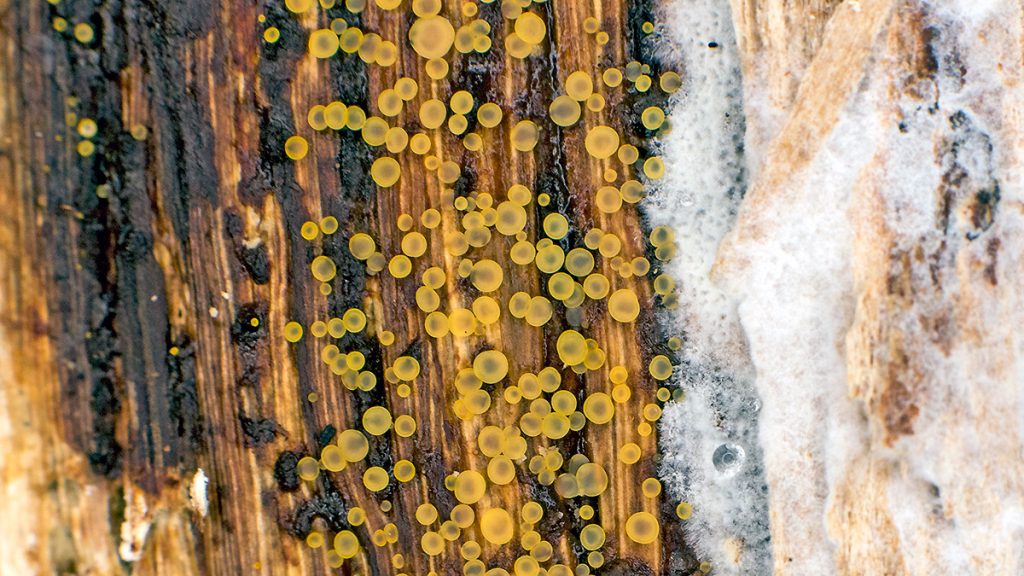
On the same dead tree I found extensive development too of Common Glasscup fungus (Orbilia xanthostigma). The largest ‘disc’ of the fungus seen in the posted image is only 0.9 mm diameter.
![Black Witches' Butter [Exidia glandulosa]](https://downsdiary.uk/wp-content/gallery/feb_2026/NG8_5863_EOS-1D_TheDowns_04Feb2026.jpg "Black Witches' Butter [Exidia glandulosa]")
![Black Witches' Butter [Exidia glandulosa]](https://downsdiary.uk/wp-content/gallery/feb_2026/NG8_5870_EOS-1D_TheDowns_04Feb2026.jpg "Black Witches' Butter [Exidia glandulosa]")
![slime mould [Physarum album ?]](https://downsdiary.uk/wp-content/gallery/feb_2026/BD2_0163-PHO00006b_TheDowns_04Feb2026.jpg "slime mould [Physarum album ?]")
![Common Glasscup [Orbilia xanthostigma ?]](https://downsdiary.uk/wp-content/gallery/feb_2026/BD2_0148_7D_TheDowns_04Feb2026.jpg "Common Glasscup [Orbilia xanthostigma ?]")
<<<< Previous page | Next Page >>>>