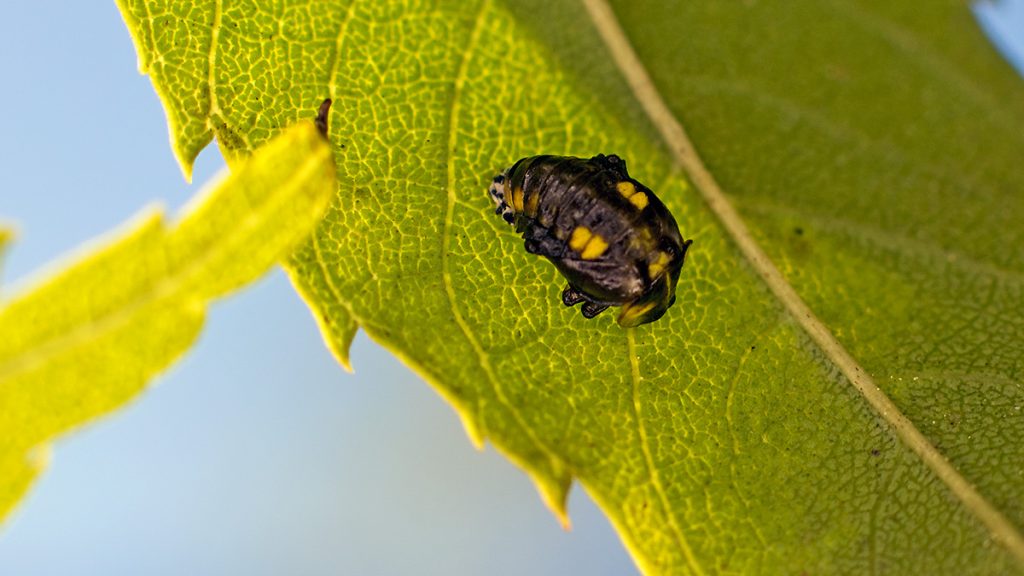
Today, a search of evergreen leaves turned up this tiny (+/-2mm) sub-adult female(?) Bleeding Heart Spider (Nigma puella) on an ivy leaf. Also found was a tiny cynipid gall wasp on a cherry laurel leaf, which I believe to be an Andricus sp. Species of this genus are responsible for Marble, Artichoke and Knopper galls, among others, on oak trees. My usual search of the undersides of rotting bark fragments produced a Blunt-tailed Snake Millipede (Cylindroiulus punctatus) and a Common Rough Woodlouse (Porcellio scaber) side-by-side with a Common Pill Woodlouse (Armadillidium vulgare).
![Bleeding Heart Spider [Nigma puella]](https://downsdiary.uk/wp-content/gallery/mar_2026/BD2_1399_7D_TheDowns_16Mar2026.jpg "Bleeding Heart Spider [Nigma puella]")
![Cynipid gall wasp [Andricus sp.?]](https://downsdiary.uk/wp-content/gallery/mar_2026/BD2_1388-90_7D_TheDowns_16Mar2026.jpg "Cynipid gall wasp [Andricus sp.?]")
![Blunt-tailed Snake Millipede [Cylindroiulus punctatus]](https://downsdiary.uk/wp-content/gallery/mar_2026/BD2_1366_7D_TheDowns_16Mar2026.jpg "Blunt-tailed Snake Millipede [Cylindroiulus punctatus]")
![Common Rough Woodlouse [Porcellio scaber]](https://downsdiary.uk/wp-content/gallery/mar_2026/BD2_1370_7D_TheDowns_16Mar2026.jpg "Common Rough Woodlouse [Porcellio scaber]")
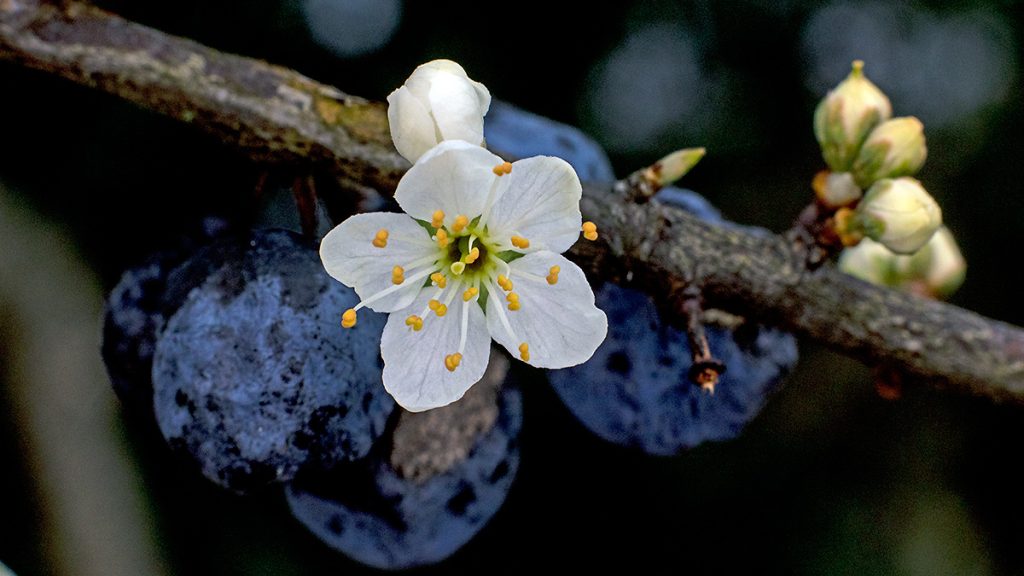
Three newly-flowering trees are Wild Cherry (Prunus avium), Blackthorn (Prunus spinosa) and Norway Maple (Acer platanoides). A few weeks ago, I confused the early-flowering Cherry Plum (Prunus cerasifera) with Blackthorn (see post of Friday, 13 Feb 2026), but no such confusion this time as the new flowers can be seen in my image with some of last season’s berries. Despite the Norway Maple being the same genus as Sycamore (Acer pseudoplatanus) its flowers start appearing before the leaf buds open, whereas the sycamore’s flowers are simultaneous with or later than first leaf appearance.
A patch of Snowdrop (Galanthus nivalis) that was flowering six weeks ago is now producing its fruiting capsules, ranging from green early stage ones to yellowish semi-ripe ones. These will eventually produce seeds that have an interesting method of dispersal, known as myrmecochory.
![Wild Cherry [Prunus avium]](https://downsdiary.uk/wp-content/gallery/mar_2026/NG8_6219_EOS-1D_TheDowns_16Mar2026.jpg "Wild Cherry [Prunus avium]")
![Wild Cherry [Prunus avium]](https://downsdiary.uk/wp-content/gallery/mar_2026/BD2_1405_7D_TheDowns_16Mar2026.jpg "Wild Cherry [Prunus avium]")
![Blackthorn [Prunus spinosa]](https://downsdiary.uk/wp-content/gallery/mar_2026/NG8_6216_EOS-1D_TheDowns_16Mar2026.jpg "Blackthorn [Prunus spinosa]")
![Blackthorn [Prunus spinosa]](https://downsdiary.uk/wp-content/gallery/mar_2026/BD2_1394_7D_TheDowns_16Mar2026.jpg "Blackthorn [Prunus spinosa]")
![Norway Maple [Acer platanoides]](https://downsdiary.uk/wp-content/gallery/mar_2026/NG8_6223_EOS-1D_TheDowns_16Mar2026.jpg "Norway Maple [Acer platanoides]")
![Snowdrop [Galanthus nivalis]](https://downsdiary.uk/wp-content/gallery/mar_2026/NG8_6208-BD2_1374_EOS-1D_TheDowns_16Mar2026.jpg "Snowdrop [Galanthus nivalis]")
Nature Note for the Day
So, what is myrmecochory?
We all know about seed dispersal by birds eating berries or burrs sticking to animal fur (fancy name is zoochory), or wind dispersal of dandelion clocks or sycamore ‘helicopters’ (anemochory). We may even know about explosive (ballistic) dispersion by the likes of legume pods popping open and launching their seeds far and wide, or even simple gravity dispersal, such as acorns or fruits falling to the ground.
Myrmecochory derives from the Ancient Greek words myrmex (=ant) and khoreia (=movement), so it is dispersal by ants. How do snowdrops achieve this?
As the snowdrop seed capsule ripens and fills with seeds, it turns yellow, becomes heavier, and the stem of the flower bends down, often resting on the ground. When they are completely ripe the capsules split open and release their seeds, to each of which is attached a fleshy appendage known as an elaiosome.
These elaiosomes are lipid- and protein-rich, and importantly nutritious to ants. The seeds with the elaiosomes are carried to the ant’s nests where the ants eat the elaiosomes and discard the seeds in their ‘rubbish dump’ outside their nest, where the seeds can hopefully germinate.
Other common UK plants that have seed dispersal by myrmecochory are the Sweet Violet (Viola odorata) and Wood Anemone (Anemone nemorosa). Gorse (Ulex Europaea) uses both explosive dispersion and myrmecochory.
<<<< Previous page | Next Page >>>>