Yet another of those days when I wished I had the 300 mm lens with me. It is, though, a case of either/or. Either I carry my two Canons set up for macro shots and for 28-135 mm zoom or I take one camera with 300mm lens and x2 extender, as the weight and bulk of the long lens are quite prohibitive. Also, if I just took the long lens with the two camera set-up by the time the lenses have been changed the photo opportunity has usually gone.
So, I had to use the 135 mm yet again, for what would have been my first ever Firecrest photo when I encountered a small single species feeding flock. What I have are no more than good ‘ID shots’, but at least I can now prove I have seen a Firecrest (Regulus ignicapilla) and not confused it with a Goldcrest (Regulus regulus).
![Firecrest [Regulus ignicapilla]](https://downsdiary.uk/wp-content/gallery/feb_2026/NG8_5906-09-11_EOS-1D_TheDowns_13Feb2026.jpg "Firecrest [Regulus ignicapilla]")
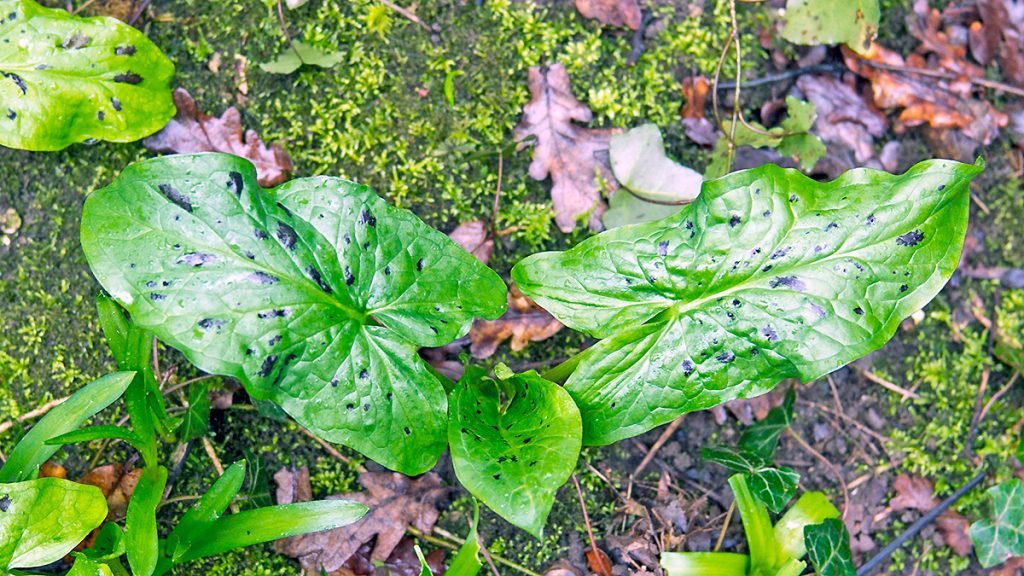
In January I posted an image of new leaf growth of Cuckoo-pint (Arum maculatum) of the form immaculatum with plain leaves. This morning I located several plants of the form maculatum with black-spotted leaves.
The recent warm and rainy weather seems to be coaxing many plants and insects into an earlier than usual appearance. Today is the turn of Cherry Plum (Prunus cerasifera).
![Cuckoo-pint [Arum maculatum]](https://downsdiary.uk/wp-content/gallery/feb_2026/NG8_5903_EOS-1D_TheDowns_13Feb2026.jpg "Cuckoo-pint [Arum maculatum]")
![Cherry Plum [Prunus cerasifera]](https://downsdiary.uk/wp-content/gallery/feb_2026/NG8_5917_EOS-1D_TheDowns_13Feb2026.jpg "Cherry Plum [Prunus cerasifera]")
![Cherry Plum [Prunus cerasifera]](https://downsdiary.uk/wp-content/gallery/feb_2026/BD2_0233_7D_Belmont_13Feb2026.jpg "Cherry Plum [Prunus cerasifera]")
Nature Note for the Day
No sooner had I posted the images of Blackthorn than it was pointed out to me that my Blackthorn is actually Cherry Plum, so the necessary amendments have been made. It is an easy trap to fall into given the strong similarity between the two Prunus species. What I was unaware of is that Cherry Plum (Prunus cerasifera) flowers 3-4 weeks earlier than Blackthorn (Prunus spinosa), which should have been a clue that I was not dealing with Blackthorn. There are other differences that I could have seen by closer inspection of my images –
- the width of the Cherry Plum flower at approx. 20mm is almost double that of approx. 12mm for Blackthorn. The width of the flower in my close-up image can be determined from the known full frame width and is indeed just under 20mm.
- new growth on Cherry Plum is green while on Blackthorn it is brown.
- new growth on Cherry Plum is glabrous (smooth) while on Blackthorn it is hairy.
- the twigs of Cherry Plum are usually spineless while those of Blackthorn have spines.
There are differences in the sepals of the two species, not so apparent in my images. For further reading, an excellent well-illustrated comparison of Cherry Plum and Blackthorn can be found here.
<<<< Previous page | Next Page >>>>