Twenty-four hours since the first meaningful rain in 9 weeks and there is definitely a fresher look to the Downs today. I suspect that this has more to do with the rain washing away a 9-week dust accumulation than it has with any new foliage growth.
Butterfly numbers are still well down and likely to remain so, as for most species we are approaching the end of the flight season. A total of 7 species today, Meadow Brown, Small Copper, Small Heath, Common Blue, Brown Argus, Small White and surprisingly a single Clouded Yellow. It has been a good summer for this cross-Channel migrant species.
The rain has brought out many more flies, including two members of the soldier fly family, the Stratiomyidae. I found a Twin-spot Centurion (Sargus bipunctatus) on a Common Buckthorn (Rhamnus cathartica) and a Chorisops sp., possibly a Bright Four-spined Legionnaire (Chorisops nagatomii) – it could be confused with the similar C. tibialis – on a Norway Maple (Acer platanoides).
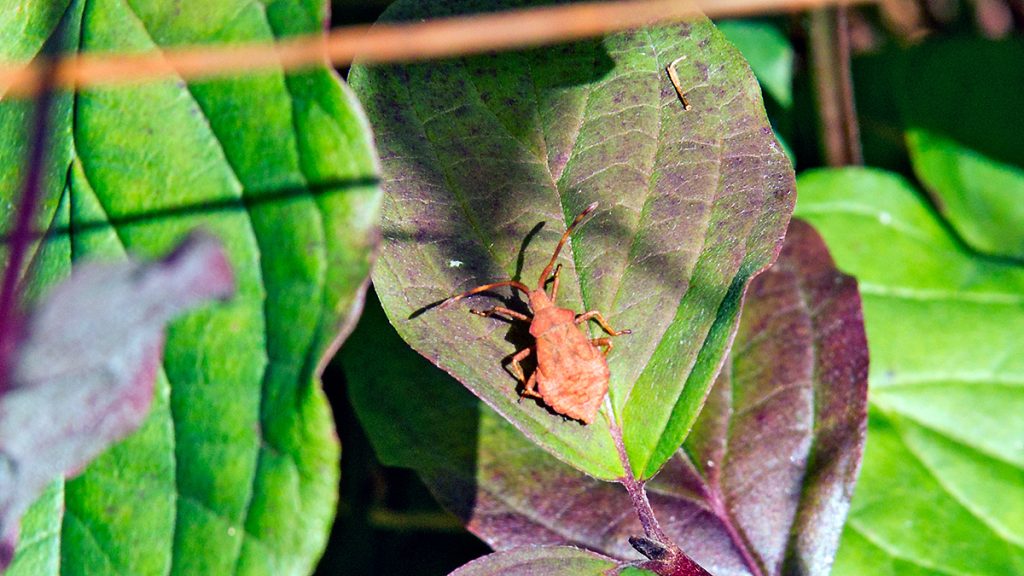
The Hemiptera were represented by a leafhopper nymph, possibly an Edwardsiana sp. on a Whitebeam (Aria edulis) and a Dock Bug (Coreus marginatus) nymph on Dogwood (Cornus sanguinea). Rolling of leaf margins and associated galls caused by larvae of the Jumping Plant Louse (Trichochermes walkeri) were seen on Common Buckthorn.
As well as dozens of nymphs and adults of various colour forms of the Brassica Shieldbug on my favourite Horseradish (Armoracia rusticana) patch, I also snapped an ichneumon wasp, possibly a male Ichneumon stramentor and a Nursery Web Spider (Pisaura mirabilis).
On an English Oak I found a leaf mine, possibly of the Common Oak Leaf-miner moth (Phyllonorycter quercifoliella).
![Twin-spot Centurion [Sargus bipunctatus]](https://downsdiary.uk/wp-content/gallery/aug_2026/BD2_6455_7D_TheDowns_28Aug2026.jpg "Twin-spot Centurion [Sargus bipunctatus]")
![Bright Four-spined Legionnaire [Chorisops nagatomii?]](https://downsdiary.uk/wp-content/gallery/aug_2026/NG9_2013_EOS-1D_TheDowns_28Aug2026.jpg "Bright Four-spined Legionnaire [Chorisops nagatomii?]")
![leafhopper [Edwardsiana sp.?]](https://downsdiary.uk/wp-content/gallery/aug_2026/BD2_6445_7D_TheDowns_28Aug2026.jpg "leafhopper [Edwardsiana sp.?]")
![Dock Bug [Coreus marginatus]](https://downsdiary.uk/wp-content/gallery/aug_2026/NG9_2037_EOS-1D_TheDowns_28Aug2026.jpg "Dock Bug [Coreus marginatus]")
![Jumping Plant Louse [Trichochermes walkeri]](https://downsdiary.uk/wp-content/gallery/aug_2026/NG9_2009_EOS-1D_TheDowns_28Aug2026.jpg "Jumping Plant Louse [Trichochermes walkeri]")
![ichneumon wasp [Ichneumon stramentor?]](https://downsdiary.uk/wp-content/gallery/aug_2026/NG9_2004_EOS-1D_TheDowns_28Aug2026.jpg "ichneumon wasp [Ichneumon stramentor?]")
![Nursery Web Spider [Pisaura mirabilis]](https://downsdiary.uk/wp-content/gallery/aug_2026/NG9_1999_EOS-1D_TheDowns_28Aug2026.jpg "Nursery Web Spider [Pisaura mirabilis]")
![Common Oak Leaf-miner [Phyllonorycter quercifoliella?]](https://downsdiary.uk/wp-content/gallery/aug_2026/BD2_6429_7D_TheDowns_28Aug2026.jpg "Common Oak Leaf-miner [Phyllonorycter quercifoliella?]")
Nature Note for the Day
On another English Oak (Quercus robur) with a large number of Knopper Galls on its acorns, I watched red Myrmica sp. ants swarming along several twigs and congregating on the galls. I have not noticed this behaviour before.
Why are the ants there?
First, we need to understand what the galls are. These abnormal, knobbly growths form on the developing acorns of English Oak (Quercus robur) trees as a response to the presence of the larvae of the Knopper Gall Wasp (Andricus quercuscalicis). The wasp chemically alters the tree’s normal growth patterns, causing the oak to build these protective, ridged chambers around the developing larvae, instead of normal acorns.
Why are the ants interested in the wasp larvae?
We are witnessing a good example of mutualistic symbiosis, a win-win situation in which each party provides something that the other needs.
As the wasp larvae grow inside the galls, they secrete a sticky, sugar-rich fluid known as gall nectar or honeydew. This is a rich, high-energy food source that ants crave. In exchange for this sweet food, the ants become highly aggressive protectors of the galls and the larvae within. They actively patrol the branch and ward off other predators or parasitic insects (such as other wasps) that might try to drill into the galls and harm the larvae inside.
This has a direct parallel with the relationship between ants and aphids, in which the aphids secrete honeydew and the ants ward off voracious aphid-eaters like hoverfly larvae and ladybirds.
![ants [Myrmica sp.]](https://downsdiary.uk/wp-content/gallery/aug_2026/NG9_1996_EOS-1D_TheDowns_28Aug2026.jpg "ants [Myrmica sp.]")
<<<< Previous page | Next Page >>>>