Another pleasant day for walking, with a strong easterly breeze countering the continuing high humidity.
Insect numbers were yet again poor, with butterfly numbers down again (although as I rarely walk the same route on two consecutive visits direct comparisons are not that meaningful). Meadow Brown is still the most numerous, with Small Heath next, a pair of Green-veined White and single Brown Argus, Speckled Wood and a distant ‘white’, for only 5 (or 6) species.
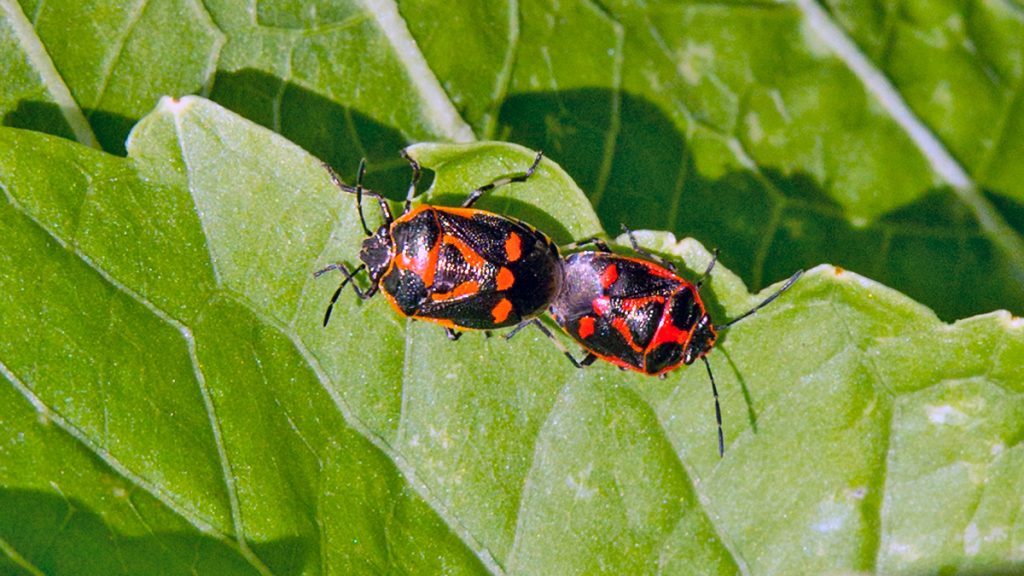
A patch of Horseradish (Armoracia rusticana) hosted dozens of Brassica Shieldbug (Eurydema oleracea) from 1st instar nymphs, through the various instar stages, to adults. This shieldbug is highly variable in colour, with adults being a dark green or black colour with markings that start white but become yellow, orange or red as they age. Nymphs are usually pale yellow and black but can have some dark pink to red markings also. The patterning too, of all ages, is variable.
As has happened several times before, a couple of these images contained another insect peripherally (and therefore not quite in focus) found only on image processing. This time it was a Turnip Sawfly (Athalia rosae), also called Cabbage Leaf Sawfly, which is a more appropriate name for where it was found, on a Brassica leaf.
On a Norway Maple (Acer platanoides) I found a cluster of Norway Maple Periphyllus Aphid (Periphyllus lyropictus) on the underside of a leaf. This is a new aphid for me as all that I have seen on Norway Maple before are species that can occur on both Norway Maple and Sycamore, as well as other Acer species. This one is Norway Maple specific.
On a leaf of a Silver Birch (Betula pendula) sapling I found leaf mines that I believe are those of a larva of the Birch Tuft moth (Bucculatrix demaryella).
Leaf rolls on a Sycamore (Acer pseudoplatanus) leaf are probably those of the Rufous Stilt moth (Caloptilia rufipennella). These larvae form rolls (or cones) at the tips of leaf lobes, usually three, each progressively bigger as the larva grows, often on the same leaf. This may well be the case in my image.
Another sycamore displayed a major infection by Tar Spot (Rhytisma acerinum), a fungus that is a biotrophic parasite. This means that the fungus gets all its nutrients from the living host, in this case the sycamore, relying on the host to survive and complete its life cycle. It is, however, a purely cosmetic disease and does not have any adverse long-term effect on the sycamore.
![Brassica Shieldbug [Eurydema oleracea]](https://downsdiary.uk/wp-content/gallery/aug_2026/NG9_1919_EOS-1D_TheDowns_24Aug2026.jpg "Brassica Shieldbug [Eurydema oleracea]")
![Brassica Shieldbug [Eurydema oleracea]](https://downsdiary.uk/wp-content/gallery/aug_2026/NG9_1917-25_EOS-1D_TheDowns_24Aug2026.jpg "Brassica Shieldbug [Eurydema oleracea]")
![Turnip Sawfly [Athalia rosae]](https://downsdiary.uk/wp-content/gallery/aug_2026/NG9_1917-18_EOS-1D_TheDowns_24Aug2026.jpg "Turnip Sawfly [Athalia rosae]")
![Norway Maple Periphyllus Aphid [Periphyllus lyropictus]](https://downsdiary.uk/wp-content/gallery/aug_2026/BD2_6366_7D_TheDowns_24Aug2026.jpg "Norway Maple Periphyllus Aphid [Periphyllus lyropictus]")
![Birch Tuft moth [Bucculatrix demaryella?]](https://downsdiary.uk/wp-content/gallery/aug_2026/NG9_1894_EOS-1D_TheDowns_24Aug2026.jpg "Birch Tuft moth [Bucculatrix demaryella?]")
![Rufous Stilt moth [Caloptilia rufipennella?]](https://downsdiary.uk/wp-content/gallery/aug_2026/NG9_1905_EOS-1D_TheDowns_24Aug2026.jpg "Rufous Stilt moth [Caloptilia rufipennella?]")
![Tar Spot [Rhytisma acerinum]](https://downsdiary.uk/wp-content/gallery/aug_2026/NG9_1928_EOS-1D_TheDowns_24Aug2026.jpg "Tar Spot [Rhytisma acerinum]")
<<<< Previous page | Next Page >>>>