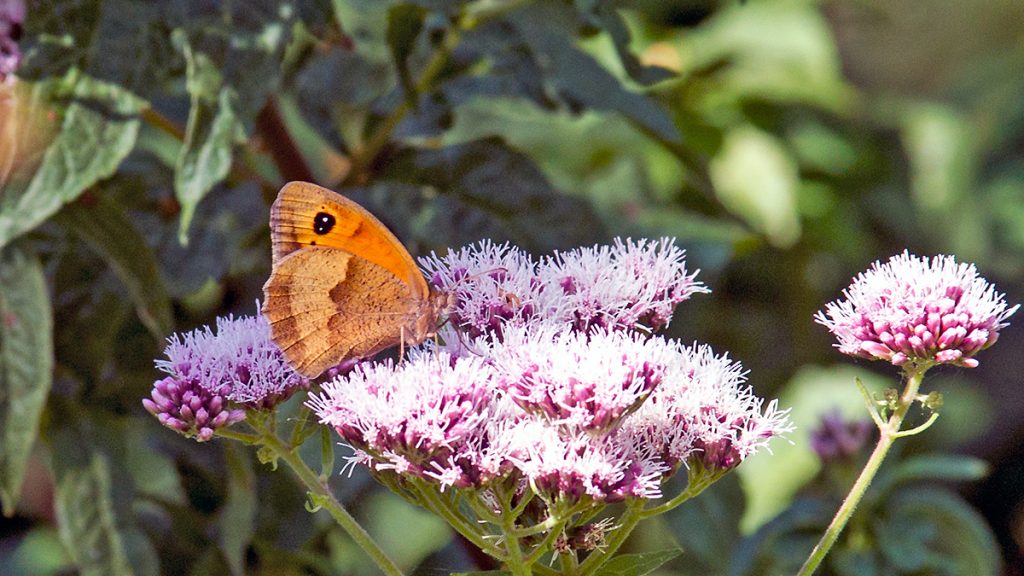
Another good day for butterfly numbers, with Chalk Hill Blue probably now outnumbering Gatekeeper (Pyronia tithonus) and Meadow Brown (Maniola jurtina), these three making up well over 90% of the total seen. There were just a few Small White and Common Blue, with just one each of Red Admiral (Vanessa atalanta), Painted Lady, Brown Argus (Aricia agestis), Speckled Wood, Small Heath and my second ever Clouded Yellow (Colias croceus), for a species total of 11.
Spindle Ermine (Yponomeuta cagnagella) moths are now starting to emerge from the pupae formed by those masses of caterpillars in the communal webs on the Spindle trees back in April and May.
![Gatekeeper [Pyronia tithonus]](https://downsdiary.uk/wp-content/gallery/aug_2026/NG9_1598_EOS-1D_TheDowns_01Aug2026.jpg "Gatekeeper [Pyronia tithonus]")
![Meadow Brown [Maniola jurtina]](https://downsdiary.uk/wp-content/gallery/aug_2026/NG9_1596_EOS-1D_TheDowns_01Aug2026.jpg "Meadow Brown [Maniola jurtina]")
![Brown Argus [Aricia agestis]](https://downsdiary.uk/wp-content/gallery/aug_2026/NG9_1561_EOS-1D_TheDowns_01Aug2026.jpg "Brown Argus [Aricia agestis]")
![Clouded Yellow [Colias croceus]](https://downsdiary.uk/wp-content/gallery/aug_2026/NG9_1650_EOS-1D_TheDowns_01Aug2026.jpg "Clouded Yellow [Colias croceus]")
![Spindle Ermine [Yponomeuta cagnagella]](https://downsdiary.uk/wp-content/gallery/aug_2026/NG9_1611_EOS-1D_TheDowns_01Aug2026.jpg "Spindle Ermine [Yponomeuta cagnagella]")
Three different bugs (i.e. Hemiptera ‘true bugs’) were located on different plants, a Dock Bug (Coreus marginatus) on Ragwort, a 4th instar nymph of the Green Shieldbug (Palomena prasina) on Hemp-agrimony and a Striped Shieldbug (Graphosoma italicum) on Wild Parsnip. This is now the 4th location on the Downs that I have found the latter, so this scarce bug is undoubtedly now well established here.
The Hymenoptera were well represented today and just like yesterday there were hundreds of Honey Bee and White/Buff-tailed Bumblebee to be seen. A Tree Bumblebee (Bombus hypnorum) was found on Hemp-agrimony and a Sphecodes sp. blood bee (possibly S. monilicornis or S. ephippius) on Yarrow (Achillea millefolium).
There appears to have been an eruption of Large Tiphia (Tiphia femorata) wasps and they are favouring one particular wildflower, as there seemed to be at least one on every Wild Carrot. Also found on Wild Carrot and a new addition to my Downs list was the Turnip Sawfly (Athalia rosae). Another sawfly located was a Curled Rose Sawfly (Allantus cinctus).
![Dock Bug [Coreus marginatus]](https://downsdiary.uk/wp-content/gallery/aug_2026/NG9_1562_EOS-1D_TheDowns_01Aug2026.jpg "Dock Bug [Coreus marginatus]")
![Common Green Shieldbug [Palomena prasina]](https://downsdiary.uk/wp-content/gallery/aug_2026/NG9_1569_EOS-1D_TheDowns_01Aug2026.jpg "Common Green Shieldbug [Palomena prasina]")
![Striped Shieldbug [Graphosoma italicum]](https://downsdiary.uk/wp-content/gallery/aug_2026/NG9_1546_EOS-1D_TheDowns_01Aug2026.jpg "Striped Shieldbug [Graphosoma italicum]")
![Tree Bumblebee [Bombus hypnorum]](https://downsdiary.uk/wp-content/gallery/aug_2026/NG9_1566_EOS-1D_TheDowns_01Aug2026.jpg "Tree Bumblebee [Bombus hypnorum]")
![blood bee [Sphecodes sp.]](https://downsdiary.uk/wp-content/gallery/aug_2026/NG9_1627_EOS-1D_TheDowns_01Aug2026.jpg "blood bee [Sphecodes sp.]")
![Large Tiphia [Tiphia femorata]](https://downsdiary.uk/wp-content/gallery/aug_2026/NG9_1657_EOS-1D_TheDowns_01Aug2026.jpg "Large Tiphia [Tiphia femorata]")
![Turnip Sawfly [Athalia rosae]](https://downsdiary.uk/wp-content/gallery/aug_2026/NG9_1633-40_EOS-1D_TheDowns_01Aug2026.jpg "Turnip Sawfly [Athalia rosae]")
![Curled Rose Sawfly [Allantus cinctus]](https://downsdiary.uk/wp-content/gallery/aug_2026/NG9_1609_EOS-1D_TheDowns_01Aug2026.jpg "Curled Rose Sawfly [Allantus cinctus]")
I have recorded Willow-umbellifer Aphid and Black Bean Aphid on Wild Parsnip in the past week and today added a third aphid species on this plant. This one is new to my Downs list. I believe it to be Fly Honeysuckle Aphid (Hyadaphis foeniculi), although there is at least one other very similar Hyadaphis species with which it could be confused. One of the identifying features of Hyadaphis is the presence of brownish patches around the base of the siphunculi (the protuberances on either side at the rear of the aphid) that can hopefully be seen in what is not the best focussed of images.
I found a Common Comfrey that is showing the start of an infection by a Golovinomyces sp. powdery mildew, possibly G. asperifoliorum, Borage Powdery Mildew, named for the genus of its known host plants. Powdery mildews form when the fungal spores land on leaves during weather that is hot and dry during the day and cooler and more humid at night. They do not require moisture on the leaves like most other fungi. Current weather conditions are ideal.
![Fly Honeysuckle Aphid [Hyadaphis foeniculi?]](https://downsdiary.uk/wp-content/gallery/aug_2026/BD2_6327_7D_TheDowns_01Aug2026.jpg "Fly Honeysuckle Aphid [Hyadaphis foeniculi?]")
![powdery mildew [Golovinomyces sp.?]](https://downsdiary.uk/wp-content/gallery/aug_2026/NG9_1555-6_EOS-1D_TheDowns_01Aug2026.jpg "powdery mildew [Golovinomyces sp.?]")
<<<< Previous page | Next Page >>>>