On another cloudless, warm day the wind continues to blow, keeping down the butterfly sightings. Brimstone is still present in good numbers, supported by a few Speckled Wood and Holly Blue, and just single Peacock, Painted Lady and Green Hairstreak.
It is the third time this month that I have seen the lone Common Buzzard (is it the same one?) circling over the northern part of the Downs.
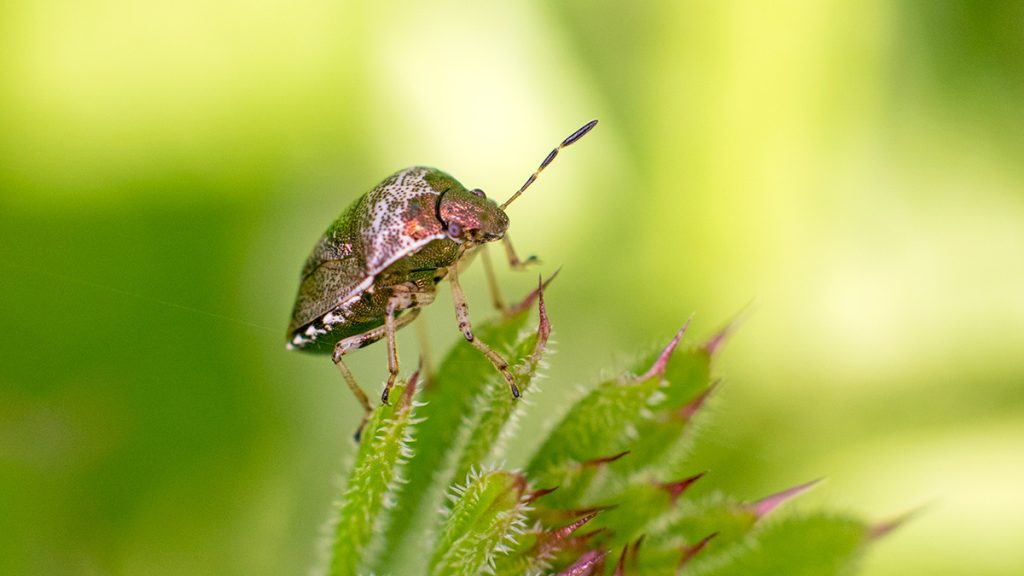
The Yellow Weevil site has turned up yet another new shieldbug. Today I found a Woundwort Shieldbug (Eysarcoris venustissimus) on Goosegrass (Galium aparine).
Sycamore trees produced an early instar nymph of the Striped Oak Bug (Rhabdomiris striatellus), a Mottled Umber (Erannis defoliaria) caterpillar and an unidentified caterpillar inside a woven silk tent on the underside of a leaf.
Some of the more advanced English Oak trees are already showing development of their male catkins and tiny red female flowers. The catkins in my image were populated by an Oak Catkin Bug (Harpocera thoracica) and an unidentified caterpillar. While shooting these images I felt movement on the back of my hand and found a small weevil (Archarius pyrrhoceras), which had no doubt been transferred from the catkins.
On another Oak I found yet another Mottled Umber (Erannis defoliaria) caterpillar. This species feeds on various broad-leaved trees and shrubs, including Oak, Sycamore and Rowan on which I found it just three days ago.
Just as I have found with Oak, Sycamore, Rowan and Common Lime, that even the early leaves are subject to attack by mites and various larvae, this is also true of Wych Elm (Ulmus glabra) on which I found galls caused by the Elm Pimple Gall Mite (Aceria campestricola).
![Woundwort Shieldbug [Eysarcoris venustissimus]](https://downsdiary.uk/wp-content/gallery/apr_2026/BD2_3613-19_7D_TheDowns_24Apr2026.jpg "Woundwort Shieldbug [Eysarcoris venustissimus]")
![Striped Oak Bug [Rhabdomiris striatellus]](https://downsdiary.uk/wp-content/gallery/apr_2026/BD2_3585_7D_TheDowns_24Apr2026.jpg "Striped Oak Bug [Rhabdomiris striatellus]")
![Mottled Umber [Erannis defoliaria]](https://downsdiary.uk/wp-content/gallery/apr_2026/BD2_3594_7D_TheDowns_24Apr2026.jpg "Mottled Umber [Erannis defoliaria]")
![caterpillar [unidentified]](https://downsdiary.uk/wp-content/gallery/apr_2026/BD2_3602_7D_TheDowns_24Apr2026.jpg "caterpillar [unidentified]")
![English (or Pedunculate) Oak [Quercus robur]](https://downsdiary.uk/wp-content/gallery/apr_2026/NG8_7565_EOS-1D_TheDowns_24Apr2026.jpg "English (or Pedunculate) Oak [Quercus robur]")
![English (or Pedunculate) Oak [Quercus robur]](https://downsdiary.uk/wp-content/gallery/apr_2026/BD2_3648_7D_TheDowns_24Apr2026.jpg "English (or Pedunculate) Oak [Quercus robur]")
![Oak Catkin Bug [Harpocera thoracica]](https://downsdiary.uk/wp-content/gallery/apr_2026/BD2_3631_7D_TheDowns_24Apr2026.jpg "Oak Catkin Bug [Harpocera thoracica]")
![caterpillar [unidentified]](https://downsdiary.uk/wp-content/gallery/apr_2026/BD2_3628_7D_TheDowns_24Apr2026.jpg "caterpillar [unidentified]")
![weevil [Archarius pyrrhoceras]](https://downsdiary.uk/wp-content/gallery/apr_2026/BD2_3653_7D_TheDowns_24Apr2026.jpg "weevil [Archarius pyrrhoceras]")
![Mottled Umber [Erannis defoliaria]](https://downsdiary.uk/wp-content/gallery/apr_2026/BD2_3651_7D_TheDowns_24Apr2026.jpg "Mottled Umber [Erannis defoliaria]")
![Elm Pimple Gall Mite [Aceria campestricola]](https://downsdiary.uk/wp-content/gallery/apr_2026/NG8_7544_EOS-1D_TheDowns_24Apr2026.jpg "Elm Pimple Gall Mite [Aceria campestricola]")
After two weeks of finding nothing but Spanish Bluebells, I finally have my first Common (or English) Bluebell (Hyacinthoides non-scripta). Where the former have upright stems with flowers all around the stem, the Common Bluebell has a characteristic drooping stem and flowers on only one side of the stem. The petals of the Common Bluebell are quite distinctive too, in that they curl back on themselves.
Common Holly (Ilex aquifolium) is beginning to show development of masses of flower buds.
![Common (or English) Bluebell [Hyacinthoides non-scripta]](https://downsdiary.uk/wp-content/gallery/apr_2026/NG8_7552-BD2_3609_EOS-1D_TheDowns_24Apr2026.jpg "Common (or English) Bluebell [Hyacinthoides non-scripta]")
![Common Holly [Ilex aquifolium]](https://downsdiary.uk/wp-content/gallery/apr_2026/NG8_7550_EOS-1D_TheDowns_24Apr2026.jpg "Common Holly [Ilex aquifolium]")
<<<< Previous page | Next Page >>>>