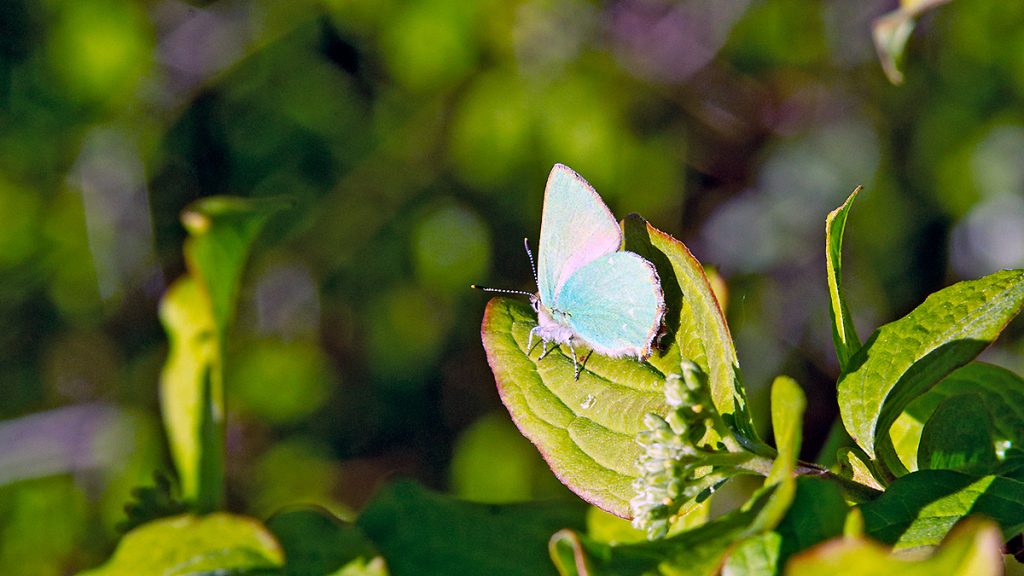
Not a cloud in the sky but quite windy. Despite the wind a better day for butterflies with dozens of Brimstone on the wing. Surprisingly the next most abundant, I stopped counting at 10, was Green Hairstreak (Callophrys rubi), along with 5 or 6 Holly Blue, a pair of Speckled Wood and a solitary Painted Lady (Vanessa cardui), the first of the year for this one.
Common Gorse Moth (Cydia ulicetana) are swarming all over the now fully flowering Gorse (Ulex europaeus) bushes. Also seen on Gorse was Gorse Shieldbug (Piezodorus lituratus), which was both a first of the year and a new species for me on the Downs. Its colours are perfect camouflage for a bug that spends its time among the gorse buds and flowers. Trying to get a close-up shot while avoiding those horrendous spines on the gorse proved quite a challenge (and was not bloodless!).
My Yellow Weevil (Lixus iridis) site produced a number of photo opportunities. Apart from Yellow Weevil these included Hairy Shieldbug (Dolycoris baccarum) and Brassica Shieldbug (Eurydema oleracea) both on Horseradish (Armoracia rusticana), a Nursery Web Spider (Pisaura mirabilis) and a Common Carder Bee (Bombus pascuorum).
![Green Hairstreak [Callophrys rubi]](https://downsdiary.uk/wp-content/gallery/apr_2026/NG8_7489_EOS-1D_TheDowns_22Apr2026.jpg "Green Hairstreak [Callophrys rubi]")
![Painted Lady [Vanessa cardui]](https://downsdiary.uk/wp-content/gallery/apr_2026/NG8_7516_EOS-1D_TheDowns_22Apr2026.jpg "Painted Lady [Vanessa cardui]")
![Common Gorse Moth [Cydia ulicetana]](https://downsdiary.uk/wp-content/gallery/apr_2026/BD2_3521_7D_TheDowns_22Apr2026.jpg "Common Gorse Moth [Cydia ulicetana]")
![Gorse Shieldbug [Piezodorus lituratus]](https://downsdiary.uk/wp-content/gallery/apr_2026/BD2_3517_7D_TheDowns_22Apr2026.jpg "Gorse Shieldbug [Piezodorus lituratus]")
![Hairy Shieldbug [Dolycoris baccarum]](https://downsdiary.uk/wp-content/gallery/apr_2026/BD2_3498_7D_TheDowns_22Apr2026.jpg "Hairy Shieldbug [Dolycoris baccarum]")
![Brassica Shieldbug [Eurydema oleracea]](https://downsdiary.uk/wp-content/gallery/apr_2026/NG8_7508_EOS-1D_TheDowns_22Apr2026.jpg "Brassica Shieldbug [Eurydema oleracea]")
![Nursery Web Spider [Pisaura mirabilis]](https://downsdiary.uk/wp-content/gallery/apr_2026/NG8_7506_EOS-1D_TheDowns_22Apr2026.jpg "Nursery Web Spider [Pisaura mirabilis]")
![Common Carder Bee [Bombus pascuorum]](https://downsdiary.uk/wp-content/gallery/apr_2026/NG8_7502_EOS-1D_TheDowns_22Apr2026.jpg "Common Carder Bee [Bombus pascuorum]")
The underside of sycamore leaves came up trumps again with the first Sycamore Periphyllus Aphid (Periphyllus acericola) of the season as well as a Common Grammoptera (Grammoptera ruficornis) beetle.
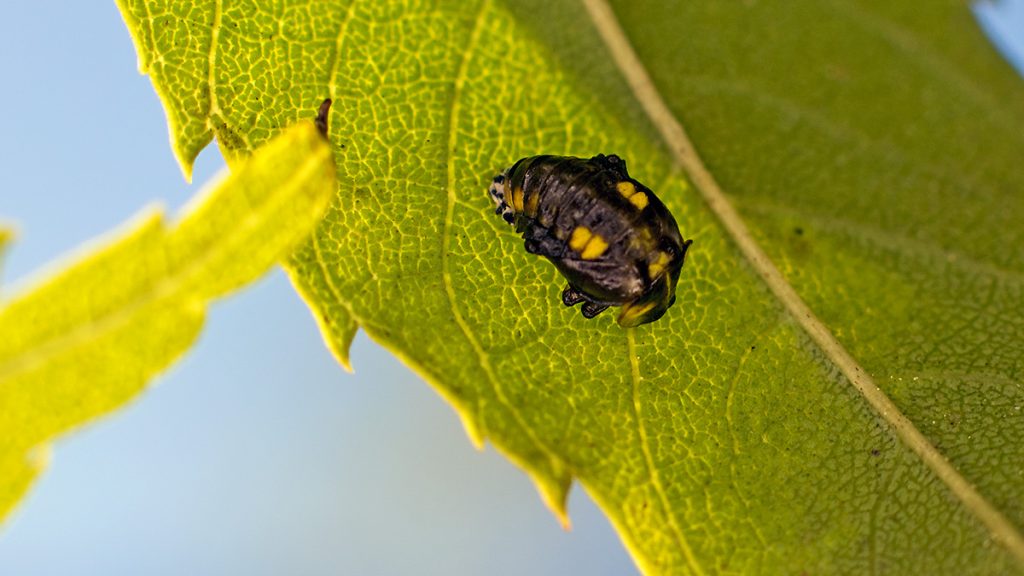
A patch of Hedge Bedstraw (Galium mollugo) that is not yet flowering did however host a Seven-spotted Ladybird (Coccinella septempunctata) and a Viburnum Beetle (Pyrrhalta viburni) larva. As has happened several times in the past year, I only noticed the beetle larva during the image processing stage.
Yesterday I could at least make a reasonable guess at the ID of the two ichneumon wasps that I photographed, but today, despite the distinctive red/orange/yellow colours of the wasp it remains just ‘an Ichneumon wasp’.
![Sycamore Periphyllus Aphid [Periphyllus acericola]](https://downsdiary.uk/wp-content/gallery/apr_2026/BD2_3582_7D_TheDowns_22Apr2026.jpg "Sycamore Periphyllus Aphid [Periphyllus acericola]")
![Common Grammoptera [Grammoptera ruficornis]](https://downsdiary.uk/wp-content/gallery/apr_2026/BD2_3496_7D_TheDowns_22Apr2026.jpg "Common Grammoptera [Grammoptera ruficornis]")
![Hedge Bedstraw [Galium mollugo]](https://downsdiary.uk/wp-content/gallery/apr_2026/NG8_7493_EOS-1D_TheDowns_22Apr2026.jpg "Hedge Bedstraw [Galium mollugo]")
![Seven-spotted Ladybird [Coccinella septempunctata]](https://downsdiary.uk/wp-content/gallery/apr_2026/BD2_3486_7D_TheDowns_22Apr2026.jpg "Seven-spotted Ladybird [Coccinella septempunctata]")
![Viburnum Beetle [Pyrrhalta viburni]](https://downsdiary.uk/wp-content/gallery/apr_2026/BD2_3484_7D_TheDowns_22Apr2026.jpg "Viburnum Beetle [Pyrrhalta viburni]")
![Ichneumon wasp [unidentified]](https://downsdiary.uk/wp-content/gallery/apr_2026/NG8_7491_EOS-1D_TheDowns_22Apr2026.jpg "Ichneumon wasp [unidentified]")
Turning attention now to oak trees I found a pair of mating Green Shield Bug (Palomena prasina) and a chalcidoid wasp, likely from the family Perilampidae and genus Perilampus.
Despite not yet being in full leaf many oak trees are showing Oak Apple galls in various stages of growth. The tiny glossy green chalcid wasp (Torymus affinis) can be seen on some of the more advanced galls. I noted 6 on just one oak apple.
![Green Shield Bug [Palomena prasina]](https://downsdiary.uk/wp-content/gallery/apr_2026/NG8_7535_EOS-1D_TheDowns_22Apr2026.jpg "Green Shield Bug [Palomena prasina]")
![chalcidoid wasp [Perilampus sp.]](https://downsdiary.uk/wp-content/gallery/apr_2026/BD2_3526_7D_TheDowns_22Apr2026.jpg "chalcidoid wasp [Perilampus sp.]")
![Oak Apple Gall Wasp [Biorhiza pallida]](https://downsdiary.uk/wp-content/gallery/apr_2026/NG8_7526-BD2_3576_EOS-1D_TheDowns_22Apr2026.jpg "Oak Apple Gall Wasp [Biorhiza pallida]")
![chalcid wasp [Torymus affinis]](https://downsdiary.uk/wp-content/gallery/apr_2026/BD2_3562_7D_TheDowns_22Apr2026.jpg "chalcid wasp [Torymus affinis]")
![chalcid wasp [Torymus affinis]](https://downsdiary.uk/wp-content/gallery/apr_2026/BD2_3556_7D_TheDowns_22Apr2026.jpg "chalcid wasp [Torymus affinis]")
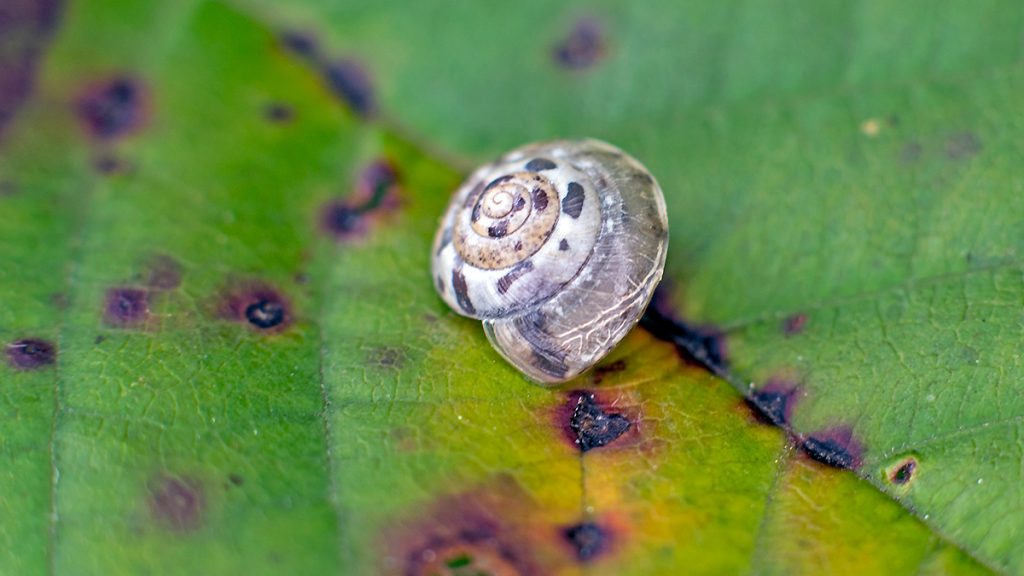
I found an abandoned snail shell lying in the grass. What impressed me was the size, some 25mm high and 35mm wide. I had not seen one on the Downs like this before, but it was clearly the shell of a Helicidae snail like the often seen White-lipped and Brown-lipped Snails. I put it on top of an old fence post to be able to photograph it better. Checking later I discovered that is the shell of a Garden Snail (Cornu aspersum), nocturnal in habit, which is why I have not seen one before.
Of course, the shell may not even have originated on the Downs. Birds, the Song Thrush in particular, are known to pick up snail shells and transport them before prising out the tasty morsel inside.
![Garden Snail [Cornu aspersum]](https://downsdiary.uk/wp-content/gallery/apr_2026/NG8_7527-8_EOS-1D_TheDowns_22Apr2026.jpg "Garden Snail [Cornu aspersum]")
Nature Note for the Day
What are Oak Apple galls?
Well, they are not fruits as the name might suggest. They result from the altered growth of leaf buds, due to chemicals released inside the dormant leaf buds of the oak by the hatched larvae of the eggs laid there by the Oak Apple Gall Wasp (Biorhiza pallida). Most galls contain a single wasp larva, although there can be several, in a hard seed-like chamber at the centre of the gall. The larvae feed on the modified leaf tissue in the gall until they mature, pupate and the next generation wasp bores its way out of the gall. This whole process does not adversely affect the growth of the tree even though a large oak may have hundreds of oak apples.
Young galls are red in colour, turning brown as they grow, and a mature gall can be some 4cm in diameter.
And what is the significance of seeing Torymus affinis wasps on the oak apples?
Torymus wasps use their long ovipositors to drill into the gall and lay their eggs. The larvae from these eggs seek out and feed on the larva of the Oak Apple Gall Wasp in the gall, which eventually results in its death. Torymus larvae in oak galls are generally considered as ‘ectoparasitoids’. The larvae feed on the larvae of the gall-making wasp from the outside, rather than living inside the host’s body (endoparasitism).
The English Oak has many different galls that can afflict it, mostly without any lasting detriment to the tree. For a fascinating look at some of these galls have a look at this Woodland Trust blog.
<<<< Previous page | Next Page >>>>