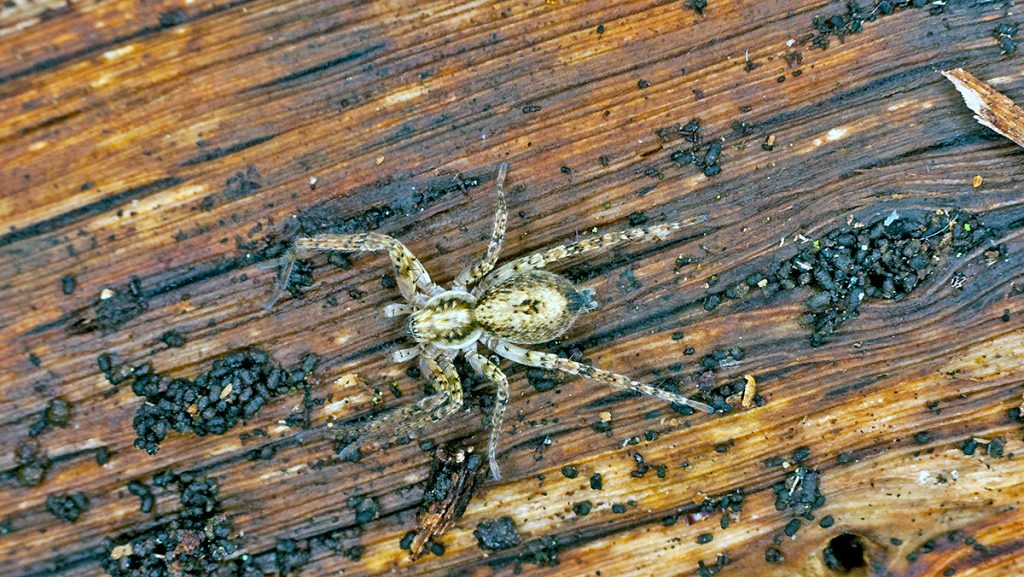
Leaf litter and dead branches and twigs seem to be the place to find things now. So, I found a fallen tree with a large piece of loose bark and gently prised it off wondering what I might find (I did put the bark back afterwards as carefully as possible). There was an immediate frenzied scurrying by dozens of woodlice, but what remained were a Buzzing Spider (Anyphaena accentuata), a White-legged White-legged Snake Millipede (Tachypodoiulus niger) and a young Garden Slug (Arion hortensis). The slug appeared to have no tentacles (apparently only insects have antennae), but what I have learned is that slugs have fully retractable tentacles for self-protection when they feel threatened.
![Buzzing Spider [Anyphaena accentuata]](https://downsdiary.uk/wp-content/gallery/dec_2025/JO8V5007_EOS-1D_TheDowns_06Dec2025.jpg "Buzzing Spider [Anyphaena accentuata]")
![White-legged Snake Millipede [Tachypodoiulus niger]](https://downsdiary.uk/wp-content/gallery/dec_2025/JO8V5003_EOS-1D_TheDowns_06Dec2025.jpg "White-legged Snake Millipede [Tachypodoiulus niger]")
![Garden Slug [Arion hortensis]](https://downsdiary.uk/wp-content/gallery/dec_2025/JO8V4995_EOS-1D_TheDowns_06Dec2025.jpg "Garden Slug [Arion hortensis]")
The real extent of the coverage of tree trunks and branches by Common Ivy (Hedera helix) is revealed at this time of year, with the evergreen ivy leaves standing out in sharp contrast to their bare hosts. I suppose I’ve noticed this before but never really given it much thought, ivy has a range of leaf shapes. This is known as heterophylly, the ability of a single plant to produce two or more distinct leaf forms, usually due to environmental changes (like ambient light conditions) or different growth stages (juvenile or adult). In ivy, the youngest leaves of the ground cover and early climbing stage have a three-lobed leaf while mature berry-producing plants have oval or heart-shaped leaves without lobes.
![Common Ivy [Hedera helix]](https://downsdiary.uk/wp-content/gallery/dec_2025/111203_SM-A326B_TheDowns_06Dec2025.jpg "Common Ivy [Hedera helix]")
![Common Ivy [Hedera helix]](https://downsdiary.uk/wp-content/gallery/dec_2025/111229_SM-A326B_TheDowns_06Dec2025.jpg "Common Ivy [Hedera helix]")
On a dead oak branch I located what I believe to be the fungus Oak Blackhead (Diatrypella quercina) and on another the jelly fungus Witch’s Butter (Exidia glandulosa). That first oak branch was also adorned with Hairy Curtain Crust (Stereum hirsutum ?).
Another rather striking fungus that caught my attention may be the uncommon coral fungus Pterula multifida but equally may be a species of Cordyceps fungi. These are parasitic fungi that infect, gradually kill and eventually consume insects. Whatever this fungus is its identity remains a mystery.
![Oak Blackhead [Diatrypella quercina]](https://downsdiary.uk/wp-content/gallery/dec_2025/JO8V4948_EOS-1D_TheDowns_06Dec2025.jpg "Oak Blackhead [Diatrypella quercina]")
![Oak Blackhead [Diatrypella quercina]](https://downsdiary.uk/wp-content/gallery/dec_2025/JO8V4937_EOS-1D_TheDowns_06Dec2025.jpg "Oak Blackhead [Diatrypella quercina]")
![Black Witches' Butter [Exidia glandulosa]](https://downsdiary.uk/wp-content/gallery/dec_2025/JO8V5013_EOS-1D_TheDowns_06Dec2025.jpg "Black Witches' Butter [Exidia glandulosa]")
![Hairy Curtain Crust [Stereum hirsutum ?]](https://downsdiary.uk/wp-content/gallery/dec_2025/JO8V4955_EOS-1D_TheDowns_06Dec2025.jpg "Hairy Curtain Crust [Stereum hirsutum ?]")
![Hairy Curtain Crust [Stereum hirsutum ?]](https://downsdiary.uk/wp-content/gallery/dec_2025/JO8V4951_EOS-1D_TheDowns_06Dec2025.jpg "Hairy Curtain Crust [Stereum hirsutum ?]")
![Hairy Curtain Crust [Stereum hirsutum ?]](https://downsdiary.uk/wp-content/gallery/dec_2025/JO8V4959_EOS-1D_TheDowns_06Dec2025.jpg "Hairy Curtain Crust [Stereum hirsutum ?]")
![fungus [unidentified]](https://downsdiary.uk/wp-content/gallery/dec_2025/JO8V4968_EOS-1D_TheDowns_06Dec2025.jpg "fungus [unidentified]")
Most of the trees in this area, as well as all the dead wood on the ground, are carpeted with one of the most common mosses in the UK, Cypress-leaved Plaitmoss (Hypnum cupressiforme). Some of the moss is now developing the fruiting bodies, known as sporophytes, which comprise a stalk (the seta) topped by a capsule that contains the spores. This is very late in the year for this but is probably a response to the very mild and damp conditions. As this moss is dioecious these are the female plants.
![Cypress-leaved Plaitmoss [Hypnum cupressiforme]](https://downsdiary.uk/wp-content/gallery/dec_2025/JO8V4975_EOS-1D_TheDowns_06Dec2025.jpg "Cypress-leaved Plaitmoss [Hypnum cupressiforme]")
<<<< Previous page | Next Page >>>>