It was a shorter walk than usual today as I wanted to get back to a spot where I had taken a photo 2 days ago to get better images of the subject of the photo, but more of that later.
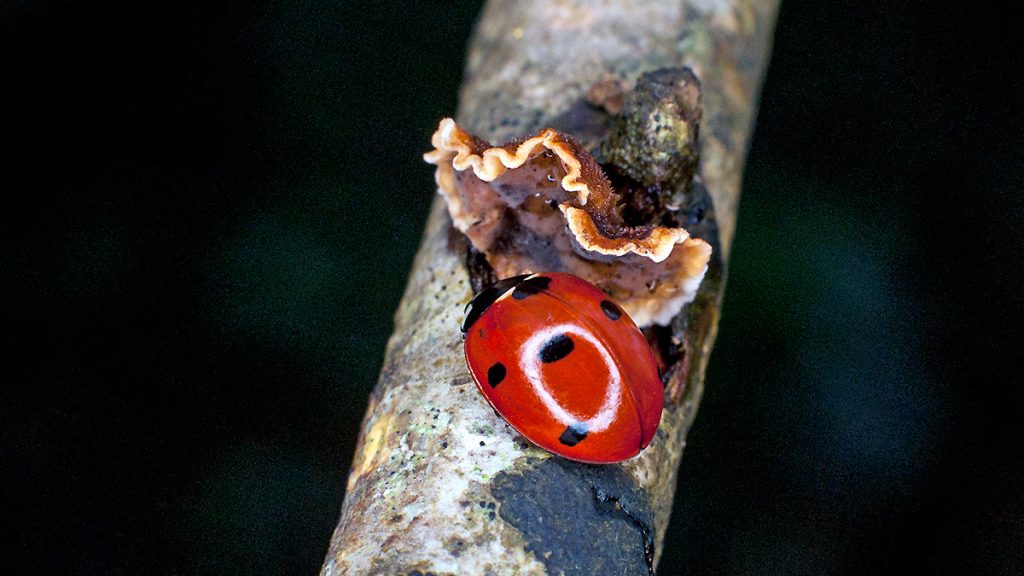
Along the way I discovered a Seven-spot Ladybird (Coccinella septempunctata) that looked as if it was sheltering beneath a growth of Hairy Curtain Crust (Stereum hirsutum) on an oak twig. Perhaps it has chosen this spot to overwinter, I can’t tell for certain. We tend to think of adult insects as short-lived, but adult ladybirds can live up to 2 years in ideal conditions.
![Seven-spot Ladybird [Coccinella septempunctata]](https://downsdiary.uk/wp-content/gallery/dec_2025/JO8V4934_EOS-1D_TheDowns_05Dec2025.jpg "Seven-spot Ladybird [Coccinella septempunctata]")
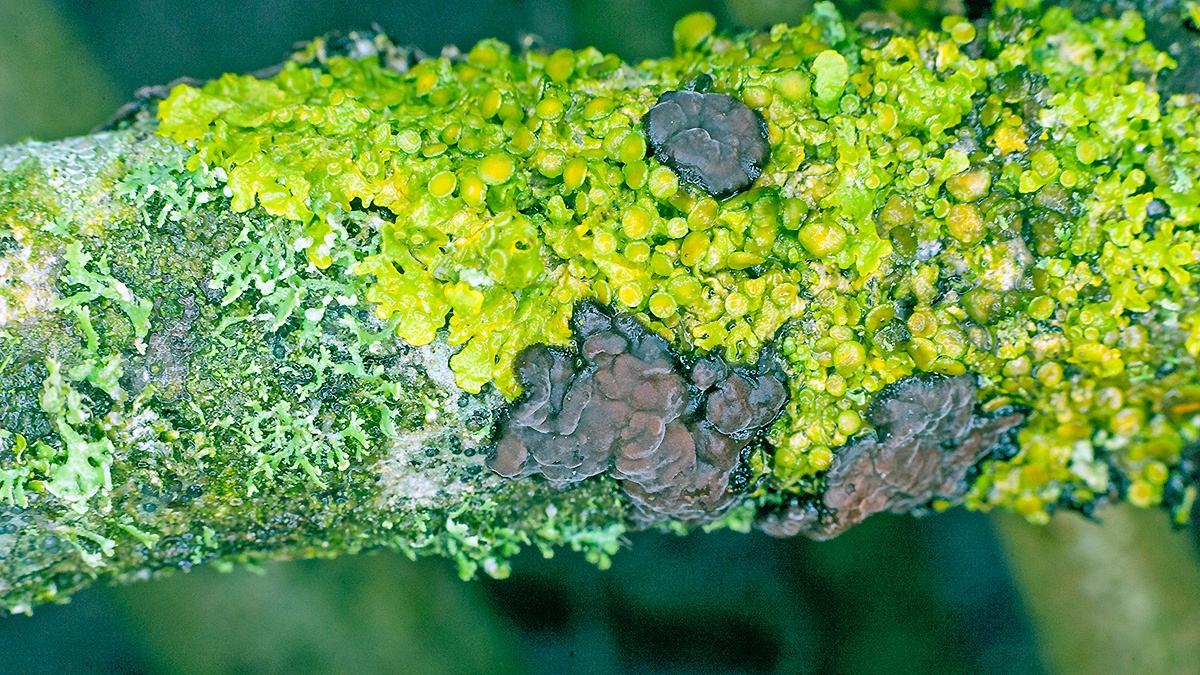
On a nearby fallen oak branch I found 2 lichens and a jelly fungus all growing quite happily together. The yellow-green lichen filling most of the image is probably a sunburst lichen of the Xanthoria genus, which surrounds patches of dark, brownish growths of a jelly fungus probably of the genus Exidia, possibly E. glandulosa, known as Witch’s Butter.
A dead buckthorn branch covered in moss hosted some tiny Bonnet mushrooms, probably a Mycena sp. The caps of this pair of mushrooms are only 5 mm in diameter.
![bonnet mushrooms [Mycena sp.?]](https://downsdiary.uk/wp-content/gallery/dec_2025/JO8V4928_EOS-1D_TheDowns_05Dec2025.jpg "bonnet mushrooms [Mycena sp.?]")
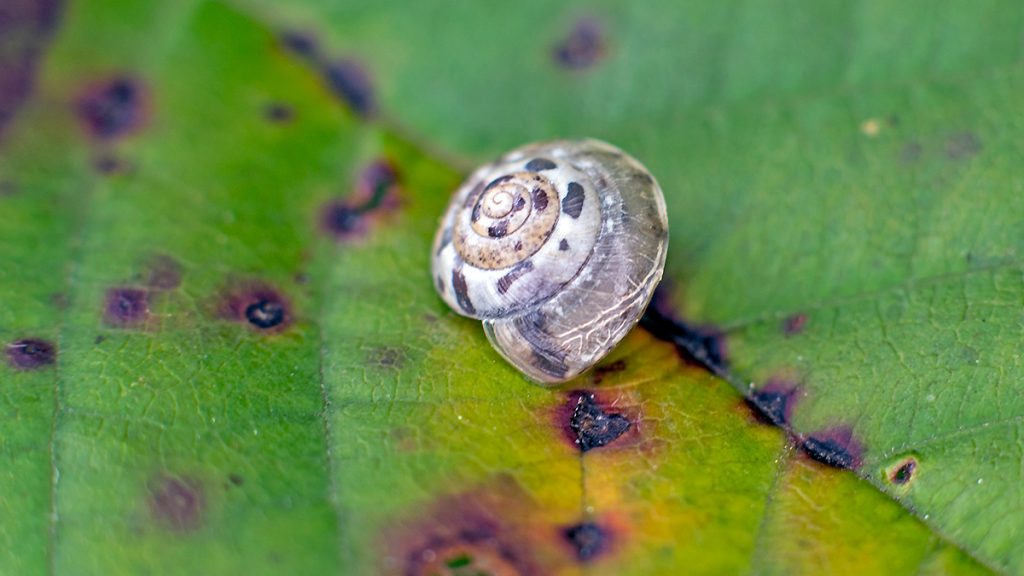
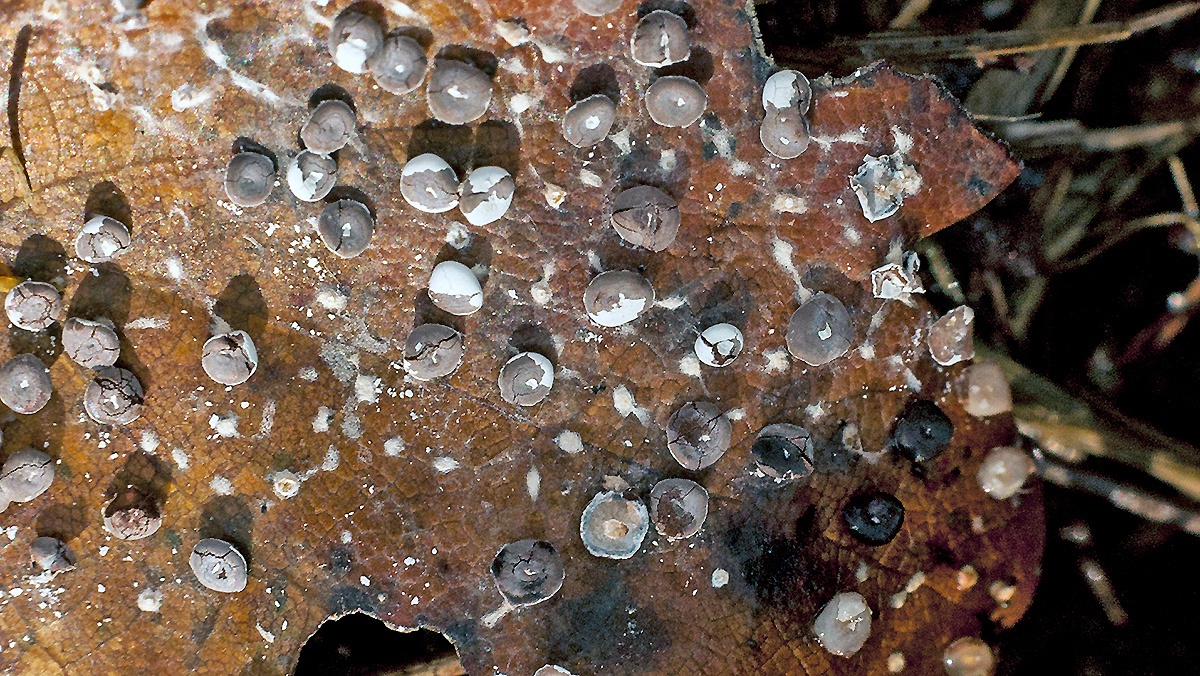
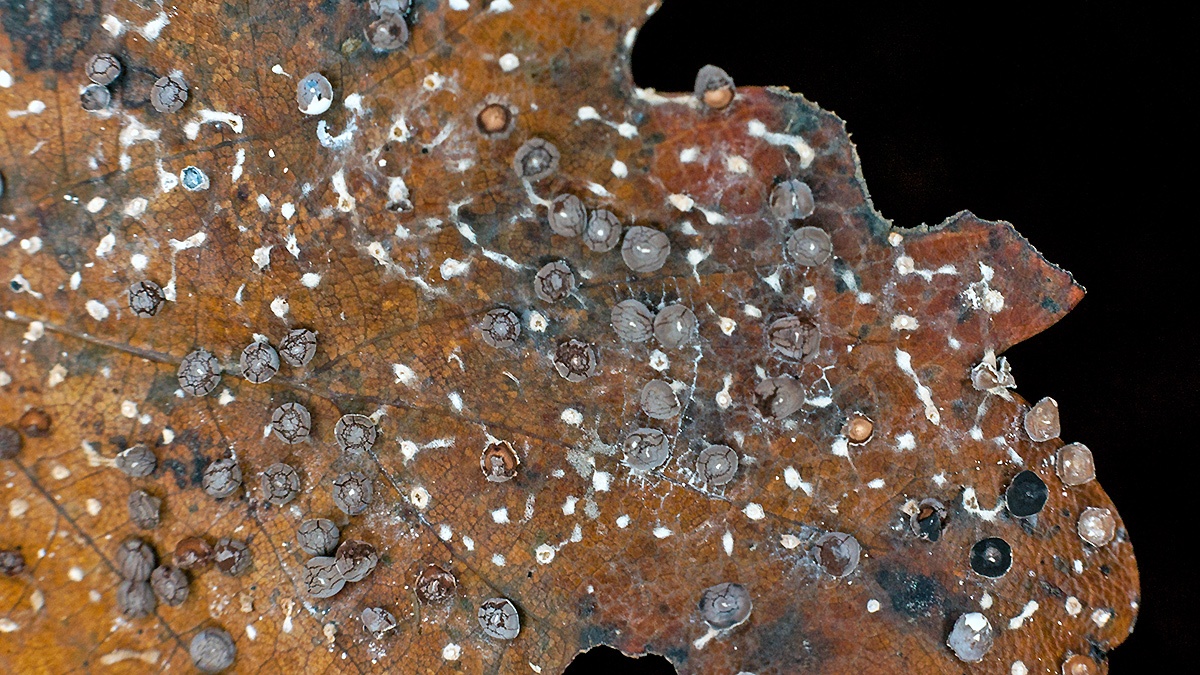
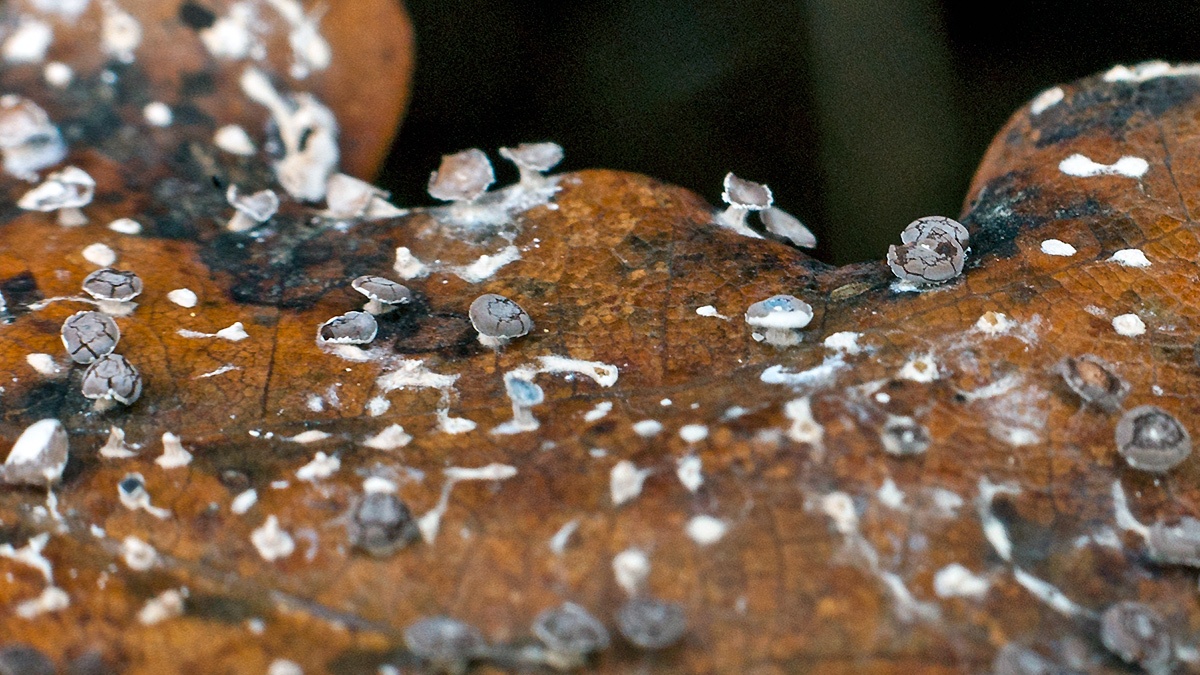
Back to the photo from 2 days ago. I believed when I took the photo that I was looking at Spangle or Button Galls on an oak leaf in largely oak leaf litter that had become coated with a powdery mildew. However, image searches online were telling me something different. Returning today I was lucky to relocate the leaf. I first checked whether I had been looking at the upper surface or underside of the leaf. It was the upper surface and galls should be on the underside. I also noticed that this was the only oak leaf among hundreds that showed these particular growths. I took another photo of the same part of the leaf to compare with the earlier image and then some sideways on to see if the circular growths were flat against the leaf or if they had stalks. I think the images show conclusively that they do have stalks.
While it is not impossible that these are some form of fungus, I believe that what I have photographed is a slime mould of the Diderma genus, possibly D. hemisphaericum.
Nature note for the day
So what is slime mould? Sounds like it ought to be a fungus. Where does it fit in?
I’ve mentioned taxonomic groupings before in my posts. You may well be familiar with the lower levels such as species, genus and family, but these are only the lowest 3 levels of an 8-level hierarchy. From top down these are Domain, Kingdom, Phylum (or Division in plants), Order, Class, Family, Genus and Species.
Well, you have to go right to the top level of the hierarchy. There are 2 domains, Eukaryotes and Prokaryotes. The latter is things like bacteria, micro-organisms whose cells do not have a nucleus. Eukaryotes on the other hand are all lifeforms that are based on cells containing a nucleus and this domain comprises 4 Kingdoms (or 5 depending on whose classification is followed), 3 of which we are all familiar with – the Plant Kingdom, the Animal Kingdom and the Fungi Kingdom. The 4th kingdom known as the Protista is made up of all Eukaryotes that are not plants, animals or fungi. Very diverse and including things like amoebae and algae, this is where slime moulds are placed.
You are now probably as confused as I was when I had finished reading about this. So simply put, slime moulds are a diverse group of organisms whose cells have a nucleus, that are not animals, plants or fungi. They are quite common and play an important role in decomposing organic matter.
New Forest National Park boasts many examples of some of the more exotic looking slime moulds.
<<<< Previous page | Next Page >>>>