I headed out this morning at 08:45 with the temperature already 24°C and probably heading for a new UK record high temperature for the month of May. The current record was set only yesterday, 34.8°C at Kew Gardens, just 10 miles away as the crow flies. Despite the early hour, a line from one of Noel Coward’s 1930s satirical songs was going through my head, “Mad dogs and Englishmen go out in the midday sun”. Apart from one dog-walker I had the Downs to myself, but not for long. The heat had me home by 10:25.
The insects were obviously suffering from the heat too. The only butterflies on the wing were Brimstone and Speckled Wood. The few Common Blue and Small Heath that I saw I disturbed from their resting places among the low foliage.
Despite the conditions I added two completely new insects to my list.
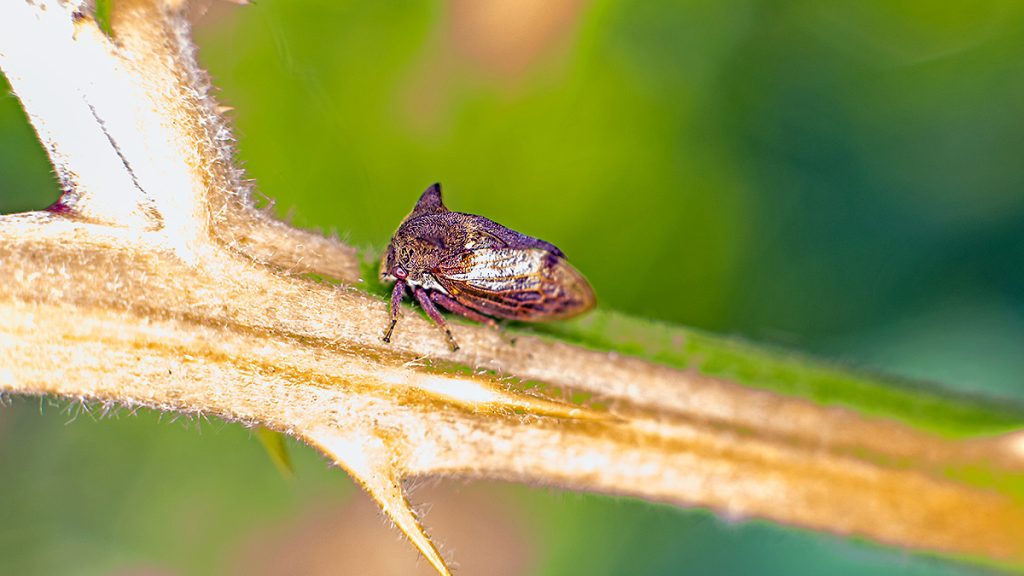
The first was one of the two species of UK treehopper, which are Hemiptera and related to cicadas, leafhoppers and froghoppers. This was the Horned Treehopper (Centrotus cornutus) found on Himalayan Blackberry (Rubus armeniacus).
The other was the second species of lacewing that I have found on the Downs. So, in addition to the Common Green Lacewing (Chrysoperla carnea) I have now added Pearly Green Lacewing (Chrysopa perla), which was located on a Curled Dock (Rumex crispus) leaf. Not the greatest of images, but they show the key features that confirm the ID – many black (not green) wing cross-veins, a black underside to the abdomen and blackish head markings surrounding a pale round spot.
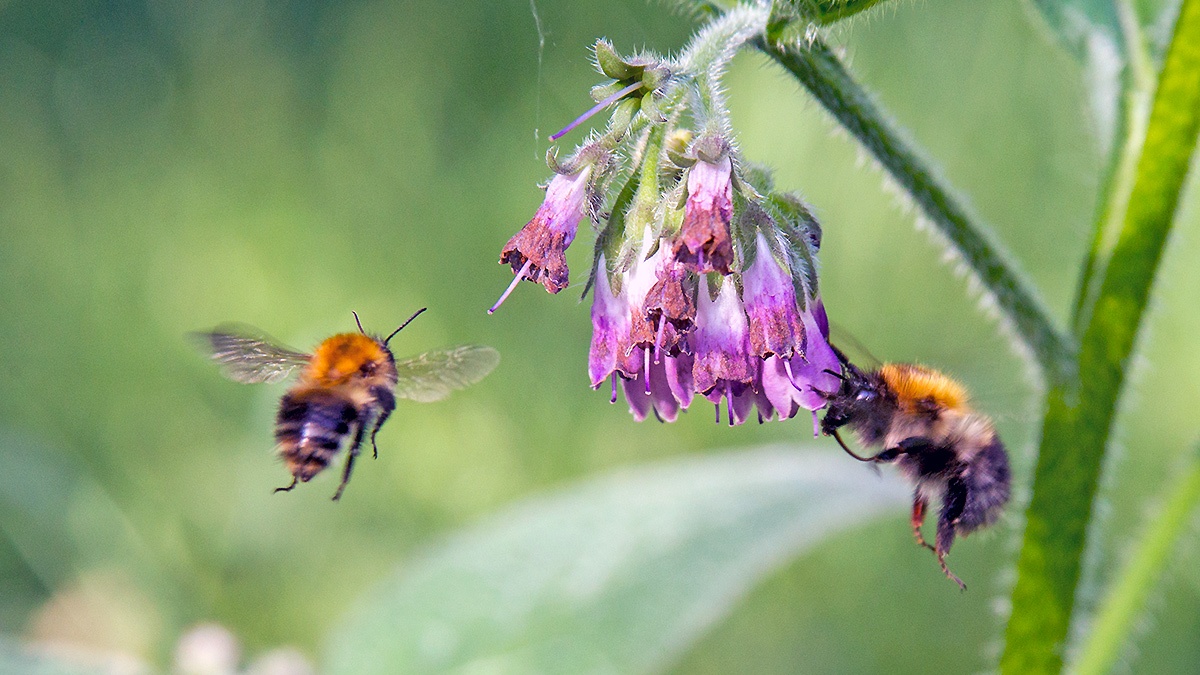
Two bumblebees were photographed, a Tree Bumblebee (Bombus hypnorum), like the treehopper on Himalayan Blackberry, and a Common Carder Bee (Bombus pascuorum) on Common Comfrey (Symphytum officinale).
![Horned Treehopper [Centrotus cornutus]](https://downsdiary.uk/wp-content/gallery/may_2026/BD2_5739_7D_TheDowns_26May2026.jpg "Horned Treehopper [Centrotus cornutus]")
![Pearly Green Lacewing [Chrysopa perla]](https://downsdiary.uk/wp-content/gallery/may_2026/NG8_8934-6_EOS-1D_TheDowns_26May2026.jpg "Pearly Green Lacewing [Chrysopa perla]")
![Tree Bumblebee [Bombus hypnorum]](https://downsdiary.uk/wp-content/gallery/may_2026/NG8_8898_EOS-1D_TheDowns_26May2026.jpg "Tree Bumblebee [Bombus hypnorum]")
I have referred twice already to Himalayan Blackberry (Rubus armeniacus). This is one of the many Rubus species to be found on the Downs and which I usually just lump together as ‘Rubus sp.’ or ‘brambles’. However, this particular plant stood out as different to the surrounding brambles and I took a series of photos with a view to trying to identify it. Indeed, it was because of this that I located the treehopper. Its scientific name accurately refers to the region where it is a native species, an area centred on the present-day Armenia, yet the most commonly used English name gets the geography completely wrong. It is a species originally introduced to European gardens for its good blackberry yield but is now considered to be a vigorous and invasive garden escapee into the British countryside.
Other plants photographed were some of the first flowers on Common Honeysuckle (Lonicera periclymenum) and Cock’s-foot (Dactylis glomerata) grass.
![Himalayan Blackberry [Rubus armeniacus]](https://downsdiary.uk/wp-content/gallery/may_2026/NG8_8886_EOS-1D_TheDowns_26May2026.jpg "Himalayan Blackberry [Rubus armeniacus]")
![Common Honeysuckle [Lonicera periclymenum]](https://downsdiary.uk/wp-content/gallery/may_2026/NG8_8966_EOS-1D_TheDowns_26May2026.jpg "Common Honeysuckle [Lonicera periclymenum]")
![Cock’s-foot [Dactylis glomerata]](https://downsdiary.uk/wp-content/gallery/may_2026/NG8_8960-4_EOS-1D_TheDowns_26May2026.jpg "Cock’s-foot [Dactylis glomerata]")
<<<< Previous page | Next Page >>>>