The south-eastern corner of the Downs was where I headed this morning, where I found a flock of at least 20 Redwing (Turdus iliacus) foraging in the canopy of the woodland trees.
In the woodland itself the English Yew (Taxus baccata) are beginning to bloom, the male trees producing short spikes of small yellowish cones. Pollen from these male cones will eventually fertilise the small cones on the female trees, each of which then develops into a bright red fleshy aril (often wrongly referred to as a berry) which contains a single seed (referenced in my post of 13 Dec 2025). The woodland floor in this area is being carpeted by vigorous new growth of Ground Ivy (Glechoma hederacea).
Some Goat Willow (Salix caprea) are already showing off their male catkins. Another of those early signs that spring is on the way.
![English Yew [Taxus baccata]](https://downsdiary.uk/wp-content/gallery/feb_2026/NG8_5948_EOS-1D_TheDowns_17Feb2026.jpg "English Yew [Taxus baccata]")
![English Yew [Taxus baccata]](https://downsdiary.uk/wp-content/gallery/feb_2026/BD2_0404_7D_TheDowns_17Feb2026.jpg "English Yew [Taxus baccata]")
![Ground Ivy [Glechoma hederacea]](https://downsdiary.uk/wp-content/gallery/feb_2026/NG8_5945_EOS-1D_TheDowns_17Feb2026.jpg "Ground Ivy [Glechoma hederacea]")
![Goat Willow [Salix caprea]](https://downsdiary.uk/wp-content/gallery/feb_2026/BD2_0420_7D_TheDowns_17Feb2026.jpg "Goat Willow [Salix caprea]")
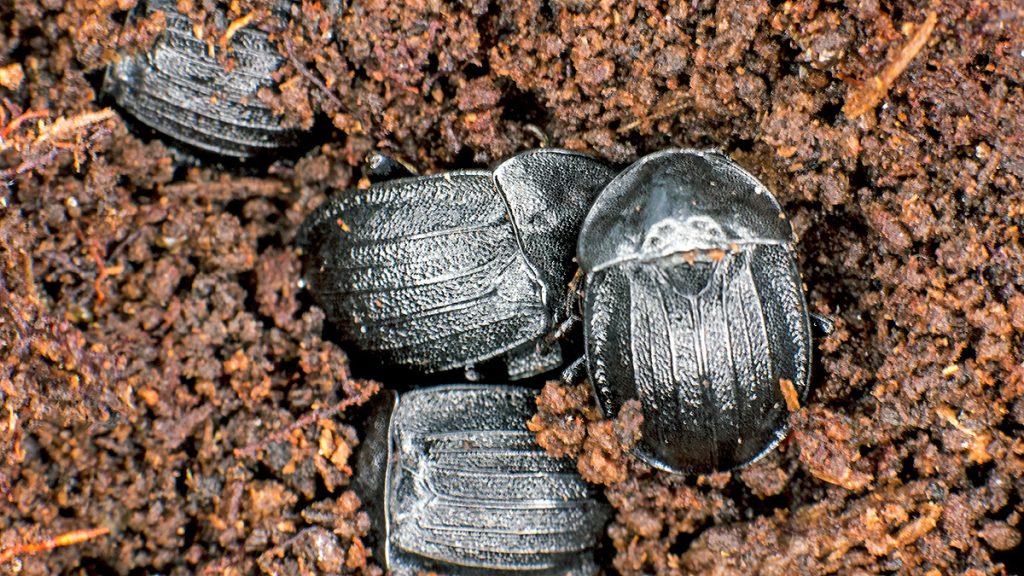
Turning over a rotting bough, I carefully lifted off a large piece of bark, which revealed quite a mix of creatures. There was small cluster of Black Snail Beetle (Phosphuga atrata) in apparent hibernation. The ‘headless’ pose, with head bent under the pronotum is apparently quite usual for this species. The others, however, were all quite active. These included Blunt-tailed Snake Millipede (Cylindroiulus punctatus), Common Rough Woodlouse (Porcellio scaber) and a female Buzzing Spider (Anyphaena accentuata). Most active, hardly pausing at all making photographing it more difficult, difficult enough already with a body length of just under 1mm, was a mite (Linopodes sp.)
![Black Snail Beetle [Phosphuga atrata]](https://downsdiary.uk/wp-content/gallery/feb_2026/BD2_0339_7D_TheDowns_17Feb2026.jpg "Black Snail Beetle [Phosphuga atrata]")
![Blunt-tailed Snake Millipede [Cylindroiulus punctatus]](https://downsdiary.uk/wp-content/gallery/feb_2026/BD2_0383_7D_TheDowns_17Feb2026.jpg "Blunt-tailed Snake Millipede [Cylindroiulus punctatus]")
![Common Rough Woodlouse [Porcellio scaber]](https://downsdiary.uk/wp-content/gallery/feb_2026/BD2_0367_7D_TheDowns_17Feb2026.jpg "Common Rough Woodlouse [Porcellio scaber]")
![Common Rough Woodlouse [Porcellio scaber]](https://downsdiary.uk/wp-content/gallery/feb_2026/BD2_0365_7D_TheDowns_17Feb2026.jpg "Common Rough Woodlouse [Porcellio scaber]")
![Buzzing Spider [Anyphaena accentuata]](https://downsdiary.uk/wp-content/gallery/feb_2026/BD2_0370_7D_TheDowns_17Feb2026.jpg "Buzzing Spider [Anyphaena accentuata]")
![mite [Linopodes sp.]](https://downsdiary.uk/wp-content/gallery/feb_2026/BD2_0345_7D_TheDowns_17Feb2026.jpg "mite [Linopodes sp.]")
<<<< Previous page | Next Page >>>>