Brimstone numbers down today, almost matched by Speckled Wood, these two by far the most dominant of the butterfly species. A bit more variety today, with 5 Peacock, 2 Orange Tip, 1 Comma, and first sightings of the season of just one each of Red Admiral and Holly Blue (Celastrina argiolus).
Still large numbers of Green Longhorn moth (Adela reaumurella) around, though now found at rest on leaves rather than swarming. I managed to find a female today, recognised by having much shorter antennae than the impressively long antennae of the male.
On the newly opening leaves of a Horse Chestnut (Aesculus hippocastanum) tree I found a Horse-chestnut Leaf Miner moth (Cameraria ohridella). It is the larvae of this moth that feed on the leaves internally, creating leaf mines that can be seen as brown blotches on the leaves.
I am finding a lot of very small caterpillars. As they grow, during four or five moults, they can change their colour and patterning, so trying to identify them at the first stage is a rather futile task.
![Holly Blue [Celastrina argiolus]](https://downsdiary.uk/wp-content/gallery/apr_2026/NG8_6833_EOS-1D_TheDowns_09Apr2026.jpg "Holly Blue [Celastrina argiolus]")
![Green Longhorn [Adela reaumurella]](https://downsdiary.uk/wp-content/gallery/apr_2026/NG8_6853_EOS-1D_TheDowns_09Apr2026.jpg "Green Longhorn [Adela reaumurella]")
![Horse-chestnut Leaf Miner [Cameraria ohridella]](https://downsdiary.uk/wp-content/gallery/apr_2026/BD2_2448_7D_TheDowns_09Apr2026.jpg "Horse-chestnut Leaf Miner [Cameraria ohridella]")
![Horse-chestnut Leaf Miner [Cameraria ohridella]](https://downsdiary.uk/wp-content/gallery/june_2025/NG8_0673_EOS-1D_TheDowns_04Jun2025.jpg "Horse-chestnut Leaf Miner [Cameraria ohridella]")
![caterpillars [unidentified]](https://downsdiary.uk/wp-content/gallery/apr_2026/NG8_6854-BD2_2422_7D_TheDowns_09Apr2026.jpg "caterpillars [unidentified]")
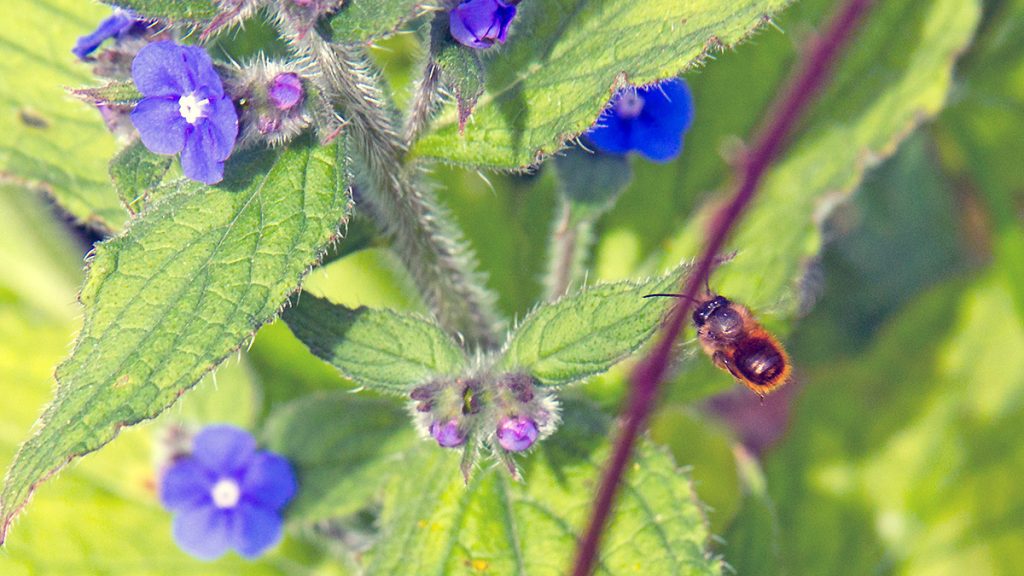
On Green Alkanet (Pentaglottis sempervirens) I came across a shield bug not only a first for the year but a first for me anywhere, a Banded Rhopalid (Stictopleurus punctatonervosus). The same plant was being visited by a Red Mason Bee (Osmia bicornis). Other bees seen were a Chocolate Mining Bee (Andrena scotica) on Sycamore (Acer pseudoplatanus) and a Gooden’s Nomad Bee (Nomada goodeniana) on Wild Cherry (Prunus avium).
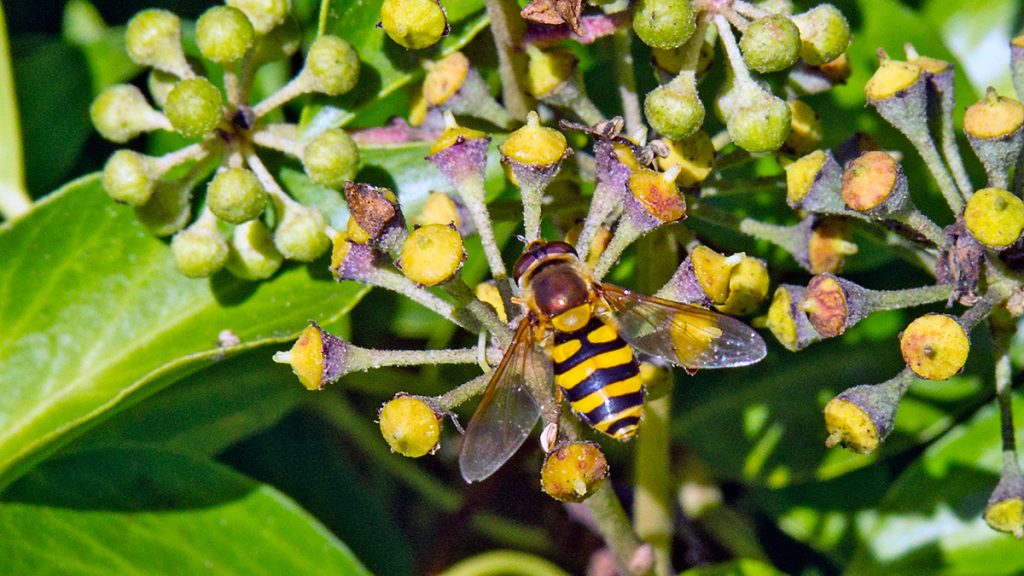
Flies were represented by two hoverflies, a Spring Epistrophe (Epistrophe eligans) found on a Horse Chestnut and a Sun Fly (Helophilus pendulus), as well as Yellow Swarming Fly (Thaumatomyia notata) which were living up to their name. Three separate swarms of these tiny yellow flies were seen. The males possess paired eversible vesicles (see Nature Note below) which can clearly be seen in one of my images.
Another swarm was of the small Yellow-brown Raspberry Beetle (Byturus ochraceus) which had descended on all the dandelion flowers in one area.
On the same Rowan (Sorbus aucuparia) that I found the sac spider yesterday I located a different spider. Having stayed still long enough for me to get a decent close-up photo it scuttled away before I could take a better shot for ID purposes. Nevertheless, I believe it to be one of the crab spiders (Thomisidae), possibly the Red Crab Spider (Xysticus lanio).
![Banded Rhopalid [Stictopleurus punctatonervosus]](https://downsdiary.uk/wp-content/gallery/apr_2026/NG8_6837_EOS-1D_TheDowns_09Apr2026.jpg "Banded Rhopalid [Stictopleurus punctatonervosus]")
![Red Mason Bee [Osmia bicornis]](https://downsdiary.uk/wp-content/gallery/apr_2026/NG8_6839_EOS-1D_TheDowns_09Apr2026.jpg "Red Mason Bee [Osmia bicornis]")
![Red Mason Bee [Osmia bicornis]](https://downsdiary.uk/wp-content/gallery/apr_2026/NG8_6840_EOS-1D_TheDowns_09Apr2026.jpg "Red Mason Bee [Osmia bicornis]")
![Chocolate Mining Bee [Andrena scotica]](https://downsdiary.uk/wp-content/gallery/apr_2026/NG8_6829-32_EOS-1D_TheDowns_09Apr2026.jpg "Chocolate Mining Bee [Andrena scotica]")
![Gooden's Nomad Bee [Nomada goodeniana]](https://downsdiary.uk/wp-content/gallery/apr_2026/NG8_6809_EOS-1D_TheDowns_09Apr2026.jpg "Gooden's Nomad Bee [Nomada goodeniana]")
![Spring Epistrophe [Epistrophe eligans]](https://downsdiary.uk/wp-content/gallery/apr_2026/NG8_6820_EOS-1D_TheDowns_09Apr2026.jpg "Spring Epistrophe [Epistrophe eligans]")
![Sun Fly [Helophilus pendulus]](https://downsdiary.uk/wp-content/gallery/apr_2026/NG8_6811_EOS-1D_TheDowns_09Apr2026.jpg "Sun Fly [Helophilus pendulus]")
![Yellow Swarming Fly [Thaumatomyia notata]](https://downsdiary.uk/wp-content/gallery/apr_2026/BD2_2435_7D_TheDowns_09Apr2026.jpg "Yellow Swarming Fly [Thaumatomyia notata]")
![Yellow Swarming Fly [Thaumatomyia notata]](https://downsdiary.uk/wp-content/gallery/apr_2026/BD2_2430_7D_TheDowns_09Apr2026.jpg "Yellow Swarming Fly [Thaumatomyia notata]")
![Yellow-brown Raspberry Beetle [Byturus ochraceus]](https://downsdiary.uk/wp-content/gallery/apr_2026/BD2_2482_7D_TheDowns_09Apr2026.jpg "Yellow-brown Raspberry Beetle [Byturus ochraceus]")
![Red Crab Spider [Xysticus lanio ?]](https://downsdiary.uk/wp-content/gallery/apr_2026/BD2_2492_7D_TheDowns_09Apr2026.jpg "Red Crab Spider [Xysticus lanio ?]")
Nature Note for the Day
Eversible vesicles in insects are specialized, retractable tubular organs, often located on the abdomen, used for many purposes including water uptake, ion regulation and adhesion, dependent upon the particular species.
It is thought that the eversible vesicles of the Yellow Swarming Fly are used to release pheromones for mating. Only found in males, these bright yellow, sponge-like vesicles are located at the abdominal tip and can often be seen while the fly is resting. The vesicles are pushed out (everted) by haemolymph (the insect’s body fluid) pressure and retracted by internal muscle rods.
<<<< Previous page | Next Page >>>>