First seen on 21st October I came across more Himalayan Cotoneaster (Cotoneaster simonsii) this morning. A quick glance at the red ‘berries’ as you walk past and you might simply dismiss them as ‘rosehips’. Stop and look carefully, though, and you will realise that the fruits are smaller than their Rosa counterparts, the leaves although the right shape and size are not serrated and there are no thorns on the twigs.
![Himalayan Cotoneaster [Cotoneaster simonsii]](https://downsdiary.uk/wp-content/gallery/nov_2025/NG8_5319_EOS-1D_TheDowns_27Nov2025.jpg "Himalayan Cotoneaster [Cotoneaster simonsii]")
I returned to the holly bush of 2 days ago with the Birch Catkin Bugs clustered among the tight flower buds, in the hope that I might get some macro shots of the aphids. This I was able to do, but an added bonus at the image processing stage was finding an odd-looking hexapod on a holly stem right at the edge of one of the images. As it wasn’t the intended subject of the image it is not quite in focus and even if I had seen it, I don’t think I’d have got a good crisp image of something <2 mm in size. The image is good enough, however, to identify my first ever member of the Sminthuridae, the globular springtails. I can’t do better than a family level ID unfortunately.
![Birch Catkin Bug [Kleidocerys resedae]](https://downsdiary.uk/wp-content/gallery/nov_2025/JO8V4662_EOS-1D_TheDowns_27Nov2025.jpg "Birch Catkin Bug [Kleidocerys resedae]")
![Birch Catkin Bug [Kleidocerys resedae]](https://downsdiary.uk/wp-content/gallery/nov_2025/JO8V4669_EOS-1D_TheDowns_27Nov2025.jpg "Birch Catkin Bug [Kleidocerys resedae]")
![globular springtail [unidentified]](https://downsdiary.uk/wp-content/gallery/nov_2025/JO8V4666_EOS-1D_TheDowns_27Nov2025.jpg "globular springtail [unidentified]")
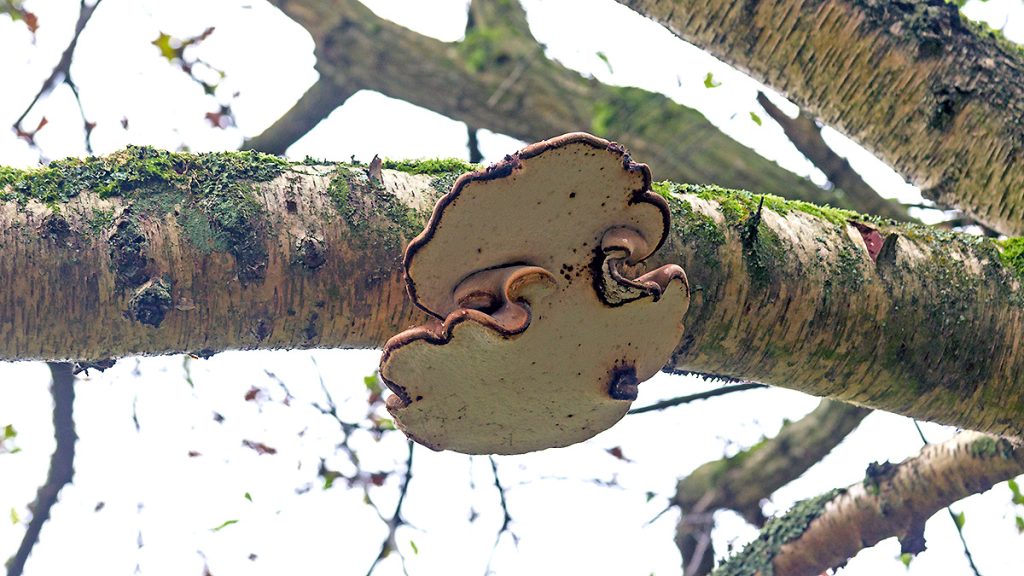
As for fungi, one of the most prominent is the Birch Polypore (Fomitopsis betulina). I came across yet another dinner plate size specimen, this time on the underside of an overhanging birch bough.
A dead oak branch sported an extensive area of Hairy Curtain Fungus (Stereum hirsutum). Look carefully at the images and you will see larvae (approx. 3 mm size) in two of them that are presumably feeding on the fungus. I can’t identify even which Order they belong too. There are fungus eating larvae of beetles, flies and others.
A very hairy fungus was found on a dead Buckthorn branch. I won’t attempt an ID on this one.
![Birch Polypore [Fomitopsis betulina]](https://downsdiary.uk/wp-content/gallery/nov_2025/NG8_5326_EOS-1D_TheDowns_27Nov2025.jpg "Birch Polypore [Fomitopsis betulina]")
![Hairy Curtain Fungus [Stereum hirsutum]](https://downsdiary.uk/wp-content/gallery/nov_2025/NG8_5325_EOS-1D_TheDowns_27Nov2025.jpg "Hairy Curtain Fungus [Stereum hirsutum]")
![Hairy Curtain Crust [Stereum hirsutum]](https://downsdiary.uk/wp-content/gallery/nov_2025/JO8V4645_EOS-1D_TheDowns_27Nov2025.jpg "Hairy Curtain Crust [Stereum hirsutum]")
![Hairy Curtain Crust [Stereum hirsutum]](https://downsdiary.uk/wp-content/gallery/nov_2025/JO8V4650_EOS-1D_TheDowns_27Nov2025.jpg "Hairy Curtain Crust [Stereum hirsutum]")
![Hairy Curtain Crust [Stereum hirsutum]](https://downsdiary.uk/wp-content/gallery/nov_2025/JO8V4649_EOS-1D_TheDowns_27Nov2025.jpg "Hairy Curtain Crust [Stereum hirsutum]")
![fungus [unidentified]](https://downsdiary.uk/wp-content/gallery/nov_2025/JO8V4658_EOS-1D_TheDowns_27Nov2025.jpg "fungus [unidentified]")
<<<< Previous page | Next Page >>>>