A windy day so I kept mainly within the woodland and continued with my recent tactic of searching under loose bark on rotting trunks and branches. Very obvious on the outer surface of the bark on one rotting Silver Birch bough was the fungus Birch Woodwart (Jackrogersella multiformis).
Under bark that had spalled off a felled oak stump and was lying amongst the leaf litter I located Common Flat-backed Millipede (Polydesmus angustus), which is not a great photograph, and two springtail species, Isotomurus unifasciatus and the lilac-coloured Lepidocyrtus cyaneus. The latter, being just under 1mm long, is beyond the limits of decent resolution with my camera equipment, so bear that in mind as you look at the image.
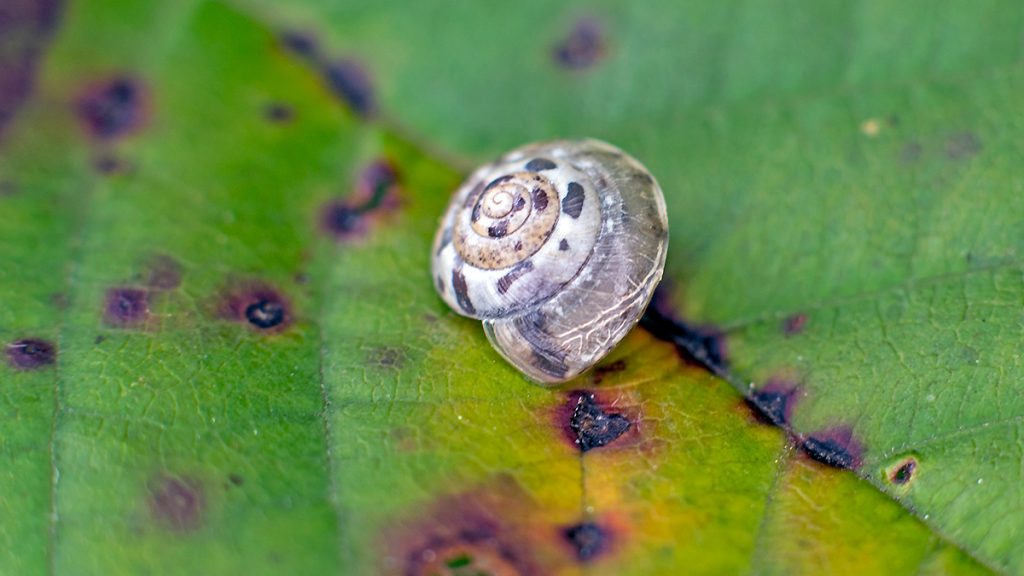
During processing of one image of the Isotomurus springtail I realised that on the periphery of the image there was a Slippery Moss Snail (Cochlicopa cf. lubrica) inside its shell. The shell is only 5.5mm long. It is glossy and translucent, hence the unfortunate reflection from my ring light. Without it though it would have been too dark to take a photo at all.
![Birch Woodwart [Jackrogersella multiforme]](https://downsdiary.uk/wp-content/gallery/feb_2026/NG8_6076_EOS-1D_TheDowns_26Feb2026.jpg "Birch Woodwart [Jackrogersella multiforme]")
![Birch Woodwart [Jackrogersella multiforme]](https://downsdiary.uk/wp-content/gallery/feb_2026/BD2_0815_7D_TheDowns_26Feb2026.jpg "Birch Woodwart [Jackrogersella multiforme]")
![Common Flat-backed Millipede [Polydesmus angustus]](https://downsdiary.uk/wp-content/gallery/feb_2026/BD2_0787_7D_TheDowns_26Feb2026.jpg "Common Flat-backed Millipede [Polydesmus angustus]")
![slender springtail [Isotomurus unifasciatus ?]](https://downsdiary.uk/wp-content/gallery/feb_2026/BD2_0785_7D_TheDowns_26Feb2026.jpg "slender springtail [Isotomurus unifasciatus ?]")
![slender springtail [Isotomurus unifasciatus ?]](https://downsdiary.uk/wp-content/gallery/feb_2026/BD2_0773_7D_TheDowns_26Feb2026.jpg "slender springtail [Isotomurus unifasciatus ?]")
![slender springtail [Lepidocyrtus cyaneus ?]](https://downsdiary.uk/wp-content/gallery/feb_2026/BD2_0779_7D_TheDowns_26Feb2026.jpg "slender springtail [Lepidocyrtus cyaneus ?]")
![Slippery Moss Snail [Cochlicopa cf. lubrica]](https://downsdiary.uk/wp-content/gallery/feb_2026/BD2_0768_7D_TheDowns_26Feb2026.jpg "Slippery Moss Snail [Cochlicopa cf. lubrica]")
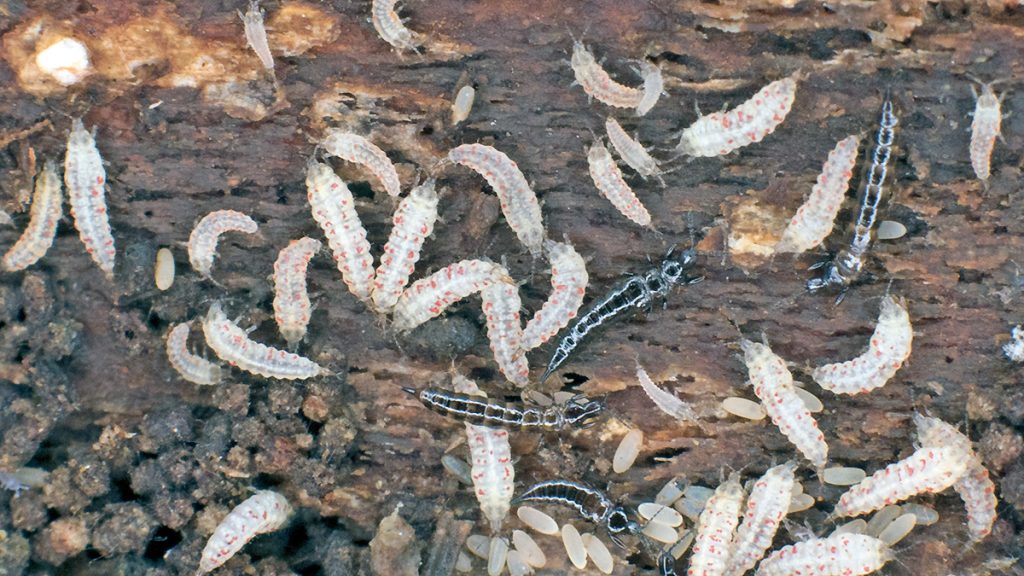
Under a flap of loose bark that I peeled back from a rotting bough lying in the leaf litter I found tube-tailed thrips (of family Phlaeothripidae), with eggs, nymphs of different growth stages and adults all present. The egg to adult cycle for these thrips is around 10 days. They are possibly a Hoplothrips species.
[P.S. I submitted my images to an eminent institution to get some expert insight on a possible ID, and this is an extract from their reply – “…. an expert who put a fair likelihood on it being the species Hoplothrips semicaecus but wanted to strongly point out that this is not a certainty, just based on the general appearance, habitat and time of year. There may well also be more than one species present in the images.”]
As with the springtail images, while processing the images of the thrips I found something else in the periphery of two of the images. The first of these is an adult rove beetle (of family Staphylinidae), probably a Leptusa sp., the second a mite (of family Cocceupodidae), most likely a Linopodes sp. (first seen on 17th February).
![tube-tailed thrips [Hoplothrips semicaecus?]](https://downsdiary.uk/wp-content/gallery/feb_2026/BD2_0820_7D_TheDowns_26Feb2026.jpg "tube-tailed thrips [Hoplothrips semicaecus?]")
![tube-tailed thrips [Hoplothrips semicaecus?]](https://downsdiary.uk/wp-content/gallery/feb_2026/BD2_0838_7D_TheDowns_26Feb2026.jpg "tube-tailed thrips [Hoplothrips semicaecus?]")
![rove beetle [Leptusa sp.]](https://downsdiary.uk/wp-content/gallery/feb_2026/BD2_0830_7D_TheDowns_26Feb2026.jpg "rove beetle [Leptusa sp.]")
<<<< Previous page | Next Page >>>>