Only had an hour this morning for a quick sortie onto the Downs, but had only just arrived when I got a photo of another new insect species, a rove beetle (Staphylinus dimidiaticornis?) that scuttled across the path ahead of me (which is why the photo is not totally in focus – it was moving rather quickly).
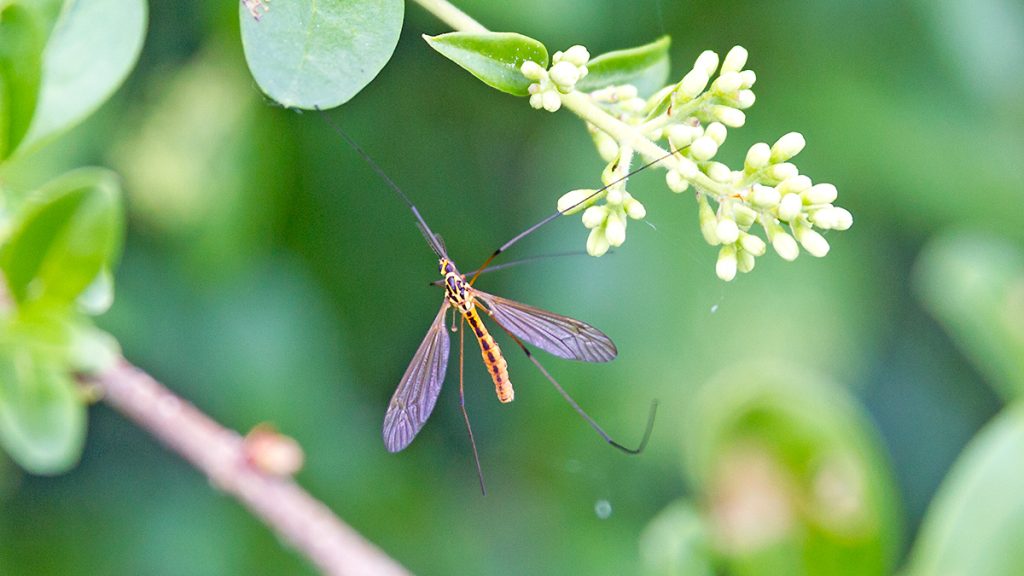
Also added was a Tiger Cranefly (Nephrotoma flavescens). His cousin the Black-striped Cranefly (Tipula vernalis) is appearing in large numbers too.
The Silver Birch (Betula pendula) is now displaying its catkins. Both female and male catkins grow on the same tree.
![rove beetle [Staphylinus dimidiaticornis]](https://downsdiary.uk/wp-content/gallery/may_2025/NG8_0593_EOS-1D_TheDowns_31May2025.jpg "rove beetle [Staphylinus dimidiaticornis]")
![Tiger Cranefly [Nephrotoma flavescens]](https://downsdiary.uk/wp-content/gallery/may_2025/NG8_0604_EOS-1D_TheDowns_31May2025.jpg "Tiger Cranefly [Nephrotoma flavescens]")
![Silver Birch [Betula pendula]](https://downsdiary.uk/wp-content/gallery/may_2025/NG8_0619_EOS-1D_TheDowns_31May2025.jpg "Silver Birch [Betula pendula]")
Nature note for the day
If a tree (or any plant) bears both male and female reproductive parts, whether as catkins, cones or flowers, it is said to be monoecious. This means that the plant can produce seeds by self-pollination, without needing separate male and female plants for pollination. Examples of common trees that are monoecious are oaks, birches, beeches and hazels.
Conversely, plants that have only male or female individuals and therefore require cross-pollination between two separate plants, are referred to as dioecious. Willows, yews, ash and holly are examples of dioecious trees.
Further information can be found here.
<<<< Previous page | Next Page >>>>