Not quite as hot as yesterday and a little more insect activity. Another good day for butterflies too. The Gatekeeper (Pyronia tithonus) remains the most abundant, but a sudden surge in numbers puts the Chalk Hill Blue (Lysandra coridon) in second place. Meadow Brown and Ringlet are still fairly prominent and I noted maybe a dozen each of Marbled White, Dark Green Fritillary and Small Skipper, while there was a few of several other ‘blues’, Purple Hairstreak, Small Copper, Brown Argus, Common Blue, Holly Blue (Celastrina argiolus) and a pair of very late Small Blue, a species I have not seen many of this summer. Last but not least bringing up a total of 14 species was a single Common Brimstone (Gonepteryx rhamni).
Just as two days ago I encountered a day-flying moth, also the first of its species this summer, a Wavy-barred Sable (Pyrausta nigrata).
I am always pleased to see dragonflies on the Downs as I can usually count on one hand the number of times this happens in a year. Today I saw two, the first was a Southern Hawker (Aeshna cyanea), the common one, if there is such a thing here, seen in an area where I have made most sightings of this large strong-flying dragonfly. More often than not it does not land, just keeps up a repetitive back and forth patrol of the woodland edge.
The second sighting was a real surprise, a female Beautiful Demoiselle (Calopteryx virgo), which landed often enough for me to visually confirm the identity, but too high up in the tree branches to allow a good photograph. Why this is surprising is that the Beautiful Demoiselle is a damselfly species that prefers flowing clear water streams with a sand or gravel bottom. There is certainly nothing like this on the Downs and the nearest point that I am aware of with these conditions is the River Wandle in Morden Hall Park just under 6km to the north (there may be something closer). While the breeding males will never stray more than 100m from the water, females are known to travel as far as 6km away during a day, which puts my sighting just within the realms of possibility. The only possible confusion would be with the Banded Demoiselle, but again distance from water is an issue.
I have mentioned in a few posts this year the relatively rare species of shieldbug, the Striped Shieldbug (Graphosoma italicum), which I have located at three different localities on the Downs. It was pleasing to find one again this morning at one of those three places.
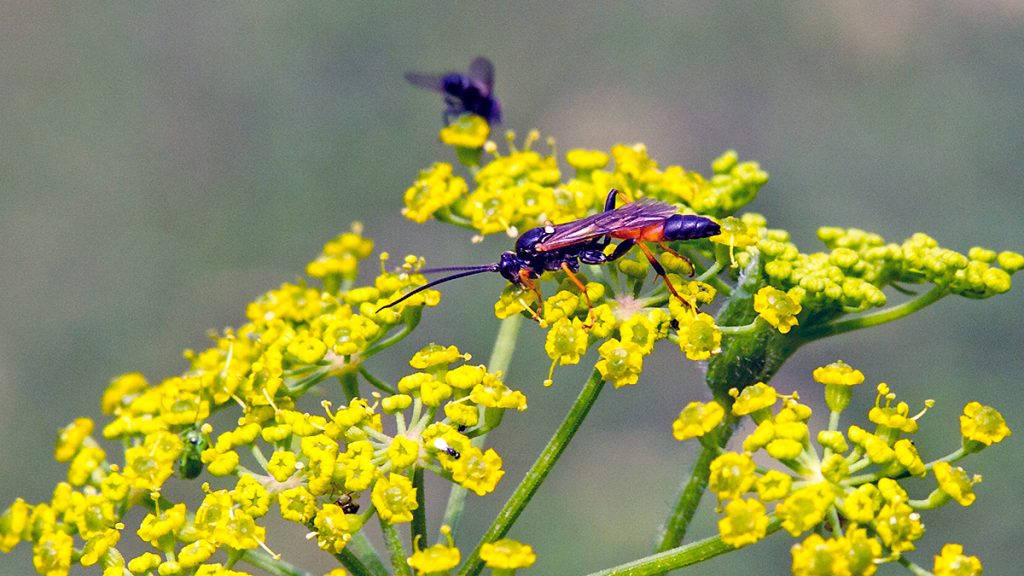
Other insects photographed today were Speckled Bush-cricket (Leptophyes punctatissima), Yellow Dung Fly (Scathophaga stercoraria), Red Spotted Parasite Fly (Eriothrix rufomaculata) and an unidentified ichneumon wasp.
![Gatekeeper [Pyronia tithonus]](https://downsdiary.uk/wp-content/gallery/jul_2026/NG9_0901_EOS-1D_TheDowns_10Jul2026.jpg "Gatekeeper [Pyronia tithonus]")
![Chalk Hill Blue [Lysandra coridon]](https://downsdiary.uk/wp-content/gallery/jul_2026/NG9_0828_EOS-1D_TheDowns_10Jul2026.jpg "Chalk Hill Blue [Lysandra coridon]")
![Holly Blue [Celastrina argiolus]](https://downsdiary.uk/wp-content/gallery/jul_2026/NG9_0795_EOS-1D_TheDowns_10Jul2026.jpg "Holly Blue [Celastrina argiolus]")
![Common Brimstone [Gonepteryx rhamni]](https://downsdiary.uk/wp-content/gallery/jul_2026/NG9_0893_EOS-1D_TheDowns_10Jul2026.jpg "Common Brimstone [Gonepteryx rhamni]")
![Wavy-barred Sable [Pyrausta nigrata]](https://downsdiary.uk/wp-content/gallery/jul_2026/NG9_0841_EOS-1D_TheDowns_10Jul2026.jpg "Wavy-barred Sable [Pyrausta nigrata]")
![Striped Shieldbug [Graphosoma italicum]](https://downsdiary.uk/wp-content/gallery/jul_2026/NG9_0822_EOS-1D_TheDowns_10Jul2026.jpg "Striped Shieldbug [Graphosoma italicum]")
![Speckled Bush-cricket [Leptophyes punctatissima]](https://downsdiary.uk/wp-content/gallery/jul_2026/NG9_0776_EOS-1D_TheDowns_10Jul2026.jpg "Speckled Bush-cricket [Leptophyes punctatissima]")
![Yellow Dung Fly [Scathophaga stercoraria]](https://downsdiary.uk/wp-content/gallery/jul_2026/NG9_0813-5_EOS-1D_TheDowns_10Jul2026.jpg "Yellow Dung Fly [Scathophaga stercoraria]")
![Red Spotted Parasite Fly [Eriothrix rufomaculata]](https://downsdiary.uk/wp-content/gallery/jul_2026/NG9_0867_EOS-1D_TheDowns_10Jul2026.jpg "Red Spotted Parasite Fly [Eriothrix rufomaculata]")
![ichneumon wasp [unidentified]](https://downsdiary.uk/wp-content/gallery/jul_2026/NG9_0879_EOS-1D_TheDowns_10Jul2026.jpg "ichneumon wasp [unidentified]")
Wildflowers noted for the first time this summer were Common Harebell (Campanula rotundifolia) and Greater Knapweed (Centaurea scabiosa).
![Common Harebell [Campanula rotundifolia]](https://downsdiary.uk/wp-content/gallery/jul_2026/NG9_0871_EOS-1D_TheDowns_10Jul2026.jpg "Common Harebell [Campanula rotundifolia]")
![Greater Knapweed [Centaurea scabiosa]](https://downsdiary.uk/wp-content/gallery/jul_2026/NG9_0873_EOS-1D_TheDowns_10Jul2026.jpg "Greater Knapweed [Centaurea scabiosa]")
<<<< Previous page | Next Page >>>>