Much colder this morning. As I set out the temperature was reported as 8°C (feels like 5°C taking the wind chill into account) and with a wind blowing I thought I may not see too many flying insects. That was true for butterflies, not even one.
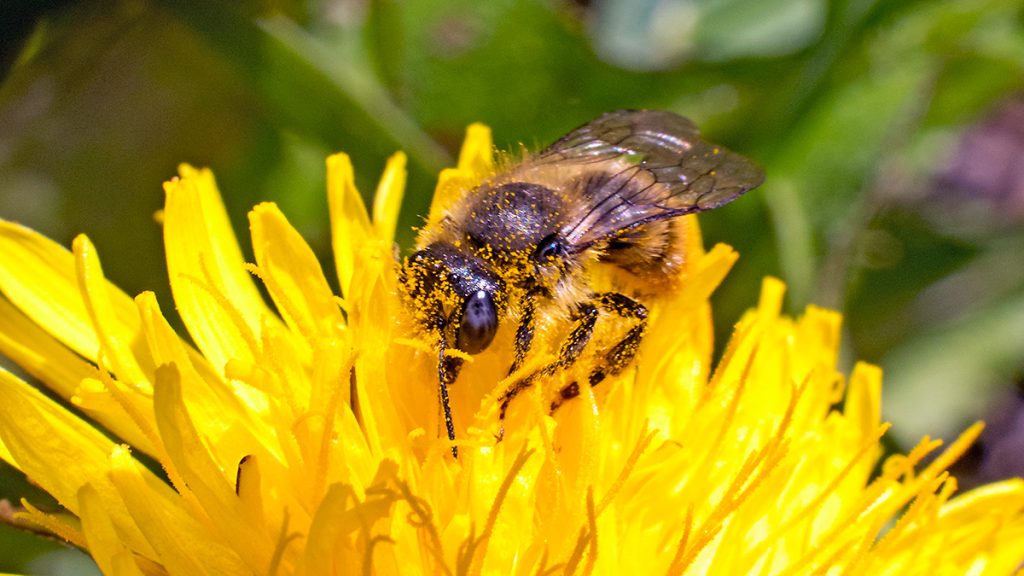
However, the bees more than made up for this with one patch of Blackthorn buzzing audibly, with dozens of Honey Bee and several large queen Buff-tailed Bumblebee. On one of these Blackthorn I also found a male Tawny Mining Bee (Andrena fulva), while almost buried in the petals of a nearby Dandelion I located a male Ashy Mining Bee (Andrena cineraria).
I noticed damage on an opening leaf bud of a Silver Birch that was probably due to grazing by an insect larva of some sort, then found on the opposite side of the leaf bud the nymph of a birch-feeding leafhopper, probably Oncopsis flavicollis/subangulata. The nymphs of the two species are inseparable visually and as both often occur together on the same tree it is advisable to regard your ID as an ‘either/or’.
![Tawny Mining Bee [Andrena fulva]](https://downsdiary.uk/wp-content/gallery/mar_2026/NG8_6549_EOS-1D_TheDowns_28Mar2026.jpg "Tawny Mining Bee [Andrena fulva]")
![Ashy Mining Bee [Andrena cineraria]](https://downsdiary.uk/wp-content/gallery/mar_2026/BD2_1803_7D_TheDowns_28Mar2026.jpg "Ashy Mining Bee [Andrena cineraria]")
![Ashy Mining Bee [Andrena cineraria]](https://downsdiary.uk/wp-content/gallery/mar_2026/BD2_1808_7D_TheDowns_28Mar2026.jpg "Ashy Mining Bee [Andrena cineraria]")
![birch-feeding leafhopper [Oncopsis flavicollis/subangulata]](https://downsdiary.uk/wp-content/gallery/mar_2026/BD2_1830-35_7D_TheDowns_28Mar2026.jpg "birch-feeding leafhopper [Oncopsis flavicollis/subangulata]")
On the flower front I found a small patch of Three-cornered Leek (Allium triquetrum), which is listed in Schedule 9 of The Wildlife and Countryside Act as a “non-native species …. already established in the wild, which continue to pose a conservation threat to native biodiversity”. It is a truly invasive plant.
While taking some close-up photos of Red Dead-nettle (Lamium purpureum) I noticed a common weed that I have probably overlooked before now. This is Common Groundsel (Senecio vulgaris), a widespread annual weed with yellow, daisy-like flowers that turn into fluffy, white seed heads, resembling miniature dandelion clocks’. It is a rapid-growing annual, completing its life cycle in as little as 5–6 weeks, enabling multiple generations to appear year-round. It is quite common to see unopened flower buds and the last vestiges of the seed receptacle on the same plant.
![Three-cornered Leek [Allium triquetrum]](https://downsdiary.uk/wp-content/gallery/mar_2026/NG8_6566_EOS-1D_TheDowns_28Mar2026.jpg "Three-cornered Leek [Allium triquetrum]")
![Three-cornered Leek [Allium triquetrum]](https://downsdiary.uk/wp-content/gallery/mar_2026/BD2_1786-88_7D_TheDowns_28Mar2026.jpg "Three-cornered Leek [Allium triquetrum]")
![Red Dead-nettle [Lamium purpureum]](https://downsdiary.uk/wp-content/gallery/mar_2026/BD2_1817_7D_TheDowns_28Mar2026.jpg "Red Dead-nettle [Lamium purpureum]")
![Common Groundsel [Senecio vulgaris]](https://downsdiary.uk/wp-content/gallery/mar_2026/NG8_6578b_EOS-1D_TheDowns_28Mar2026.jpg "Common Groundsel [Senecio vulgaris]")
Nature Note for the Day
So how does the non-native invasive Three-cornered Leek (Allium triquetrum) over-run native plant species?
It is a vigorous grower, spreading rapidly by two methods.
Firstly, it produces bulbils (through asexual reproduction), small clones of its bulb. Many garlic, leek and lily species do this. These bulbils form in their leaf axils or flower heads and eventually fall off, take root, and grow into new, genetically identical plants, which serve to spread the plant at that specific site.
Secondly, their flowers produce huge quantities of seeds that are spread through myrmecochory (see post of 16th March 2026) in the same way that snowdrops do. The seeds have an edible attachment that is nutritious to ants. Ants collect the seeds and transport them well away from the parent plant. In this way the Three-cornered Leek springs up in new locations, in addition to increasing its footprint around the original parent plant by producing bulbils.
<<<< Previous page | Next Page >>>>