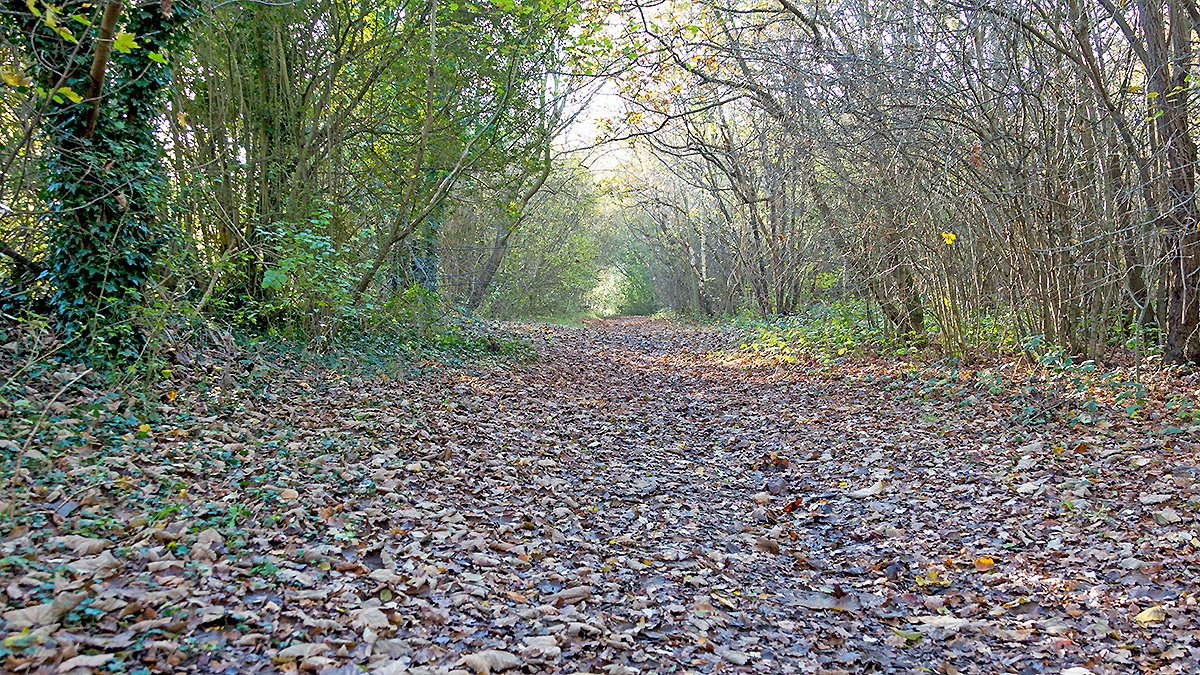
Over a week since my last visit and what a change! The unseasonal warm weather is a thing of the past. We’ve had rain, strong winds, snow flurries and frost. The wind is now from the north-east and it is definitely more wintry than autumnal.
There are still fungi to be found and this morning I came across a dinner-plate sized Birch Polypore (Fomitopsis betulina) unsurprisingly on the trunk of a Silver Birch.
![Birch Polypore [Fomitopsis betulina]](https://downsdiary.uk/wp-content/gallery/nov_2025/NG8_5277_EOS-1D_TheDowns_21Nov2025.jpg "Birch Polypore [Fomitopsis betulina]")
On my last visit I tried out my new light ring on the camera with the 28-135 mm zoom lens while photographing fungi at a distance of 25 cm. Today I used it on the camera with the 50 mm lens and extension rings, which allows me to get to within 10cm of the subject. The results were even more satisfying than last time.
First close-up today was Common Striped Woodlouse (Philoscia muscorum). Unlike many insects, woodlice do not hibernate or go through winter in another form, such as an egg, pupa or nymph and will be found by turning over most logs lying on the forest floor. Their natural environment is already sheltered and frost-free. Also found in this image, circled in blue, is a slender springtail, possibly the Shaggy Springtail (Orchesella villosa ?) and another springtail, the UK’s largest, a Long-horned Springtail (Pogonognathellus longicornis ?).
Next I turned over a sycamore leaf to find Birch Catkin Bug (Kleidocerys resedae) clustered at the base of the leaf, at the point where the midrib and other leaf veins radiate from. They are no doubt already in overwintering mode, a state known as diapause, similar to hibernation, where activity decreases but they will become more active again during warmer weather spells, not just waiting for Spring.
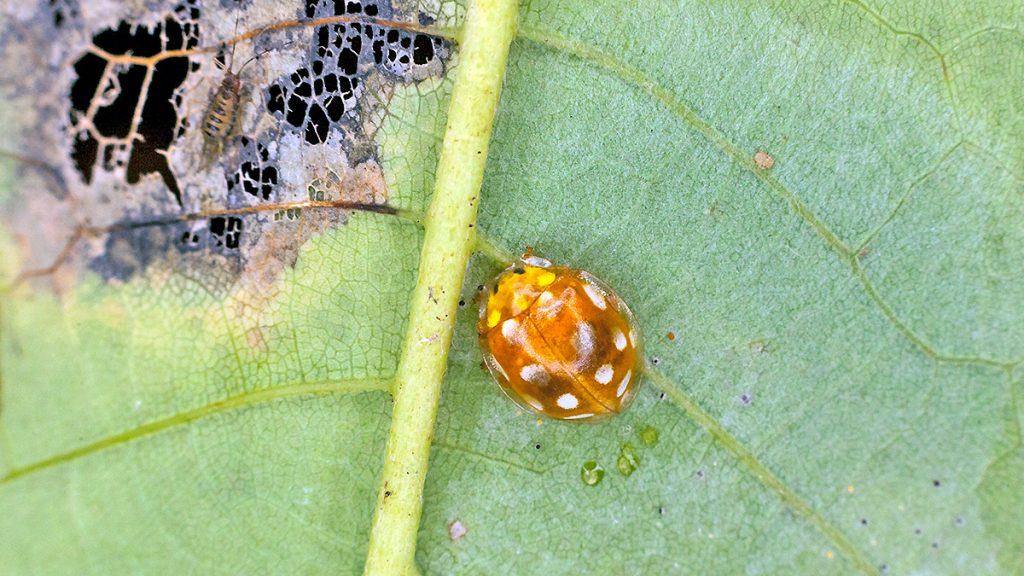
Under another sycamore leaf I discovered an Orange Ladybird (Halyzia sedecimguttata) probably also in a state of diapause. Look carefully at this image and you will see an aphid in the area of the old leaf-mine. This is a Common Sycamore Aphid (Drepanosiphum platanoidis) ovipara (fancy word for a wingless egg-laying sexual generation female aphid). She will not see the winter through, however, as once she has laid her eggs in the crevices of the tree’s bark she will die. Only the eggs, some of them anyway, will survive till Spring.
Another leaf on the same branch revealed another Common Sycamore Aphid (Drepanosiphum platanoidis) ovipara with some nymphs or ovipara of another of the sycamore aphids. The same leaf also had an alate sexual generation male Common Sycamore Aphid with a late-stage male alate nymph and various nymphs (all female?) and ovipara, possibly of the Sapling Sycamore Aphid (Drepanosiphum acerinum). A male Common Sycamore Aphid was also found on a bramble leaf.
Finally, I tried my luck with a fallen oak branch covered with a foliose lichen (a lichen with flat, leaf-like lobes) and what I believe to be Cypress-leaved Plaitmoss (Hypnum cupressiforme ?).
![Common Striped Woodlouse [Philoscia muscorum]](https://downsdiary.uk/wp-content/gallery/nov_2025/JO8V4595x_EOS-1D_TheDowns_21Nov2025.jpg "Common Striped Woodlouse [Philoscia muscorum]")
![Birch Catkin Bug [Kleidocerys resedae]](https://downsdiary.uk/wp-content/gallery/nov_2025/JO8V4586_EOS-1D_TheDowns_21Nov2025.jpg "Birch Catkin Bug [Kleidocerys resedae]")
![Orange Ladybird [Halyzia sedecimguttata]](https://downsdiary.uk/wp-content/gallery/nov_2025/JO8V4609_EOS-1D_TheDowns_21Nov2025.jpg "Orange Ladybird [Halyzia sedecimguttata]")
![Common Sycamore Aphid [Drepanosiphum platanoidis]](https://downsdiary.uk/wp-content/gallery/nov_2025/JO8V4616_EOS-1D_TheDowns_21Nov2025.jpg "Common Sycamore Aphid [Drepanosiphum platanoidis]")
![Common Sycamore Aphid [Drepanosiphum platanoidis]](https://downsdiary.uk/wp-content/gallery/nov_2025/JO8V4624_EOS-1D_TheDowns_21Nov2025.jpg "Common Sycamore Aphid [Drepanosiphum platanoidis]")
![Common Sycamore Aphid [Drepanosiphum platanoidis]](https://downsdiary.uk/wp-content/gallery/nov_2025/JO8V4567_EOS-1D_TheDowns_21Nov2025.jpg "Common Sycamore Aphid [Drepanosiphum platanoidis]")
![Cypress-leaved Plaitmoss [Hypnum cupressiforme ?]](https://downsdiary.uk/wp-content/gallery/nov_2025/JO8V4605_EOS-1D_TheDowns_21Nov2025.jpg "Cypress-leaved Plaitmoss [Hypnum cupressiforme ?]")
<<<< Previous page | Next Page >>>>