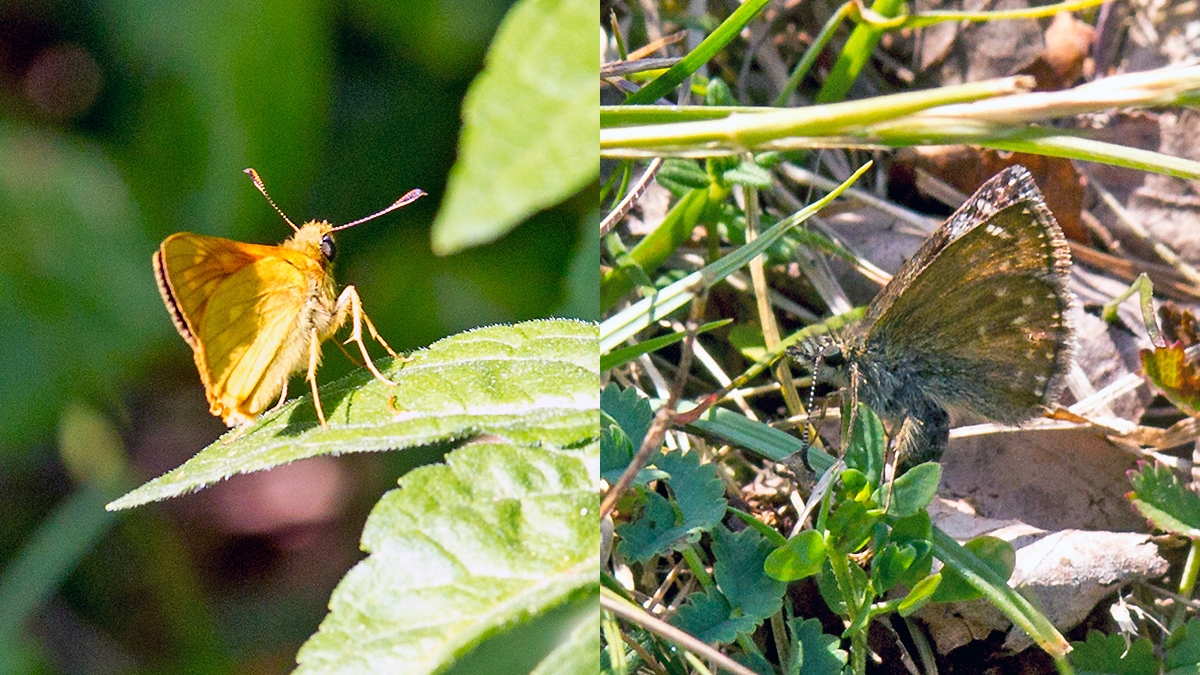
As the hot weather continues unabated there has been a dramatic increase in butterfly numbers today. For once Brimstone was not the most numerous, that honour went to Common Blue. Brimstone were hard pressed too, to outnumber Brown Argus and Small Heath. These were the dominant four species along with but a single sighting of each of Red Admiral, Small Blue, Dingy Skipper (Erynnis tages) and Large Skipper (Ochlodes sylvanus). Oddly, no Speckled Wood to be seen.
One moth was also seen, a White Plume Moth (Pterophorus pentadactyla) on bramble (Rubus sp.) flower buds.
I made my first sighting of the season of a Southern Hawker (Aeshna cyanea) dragonfly, a very strong and fast flyer patrolling along a woodland edge, back and forth but never settling. No photo today.
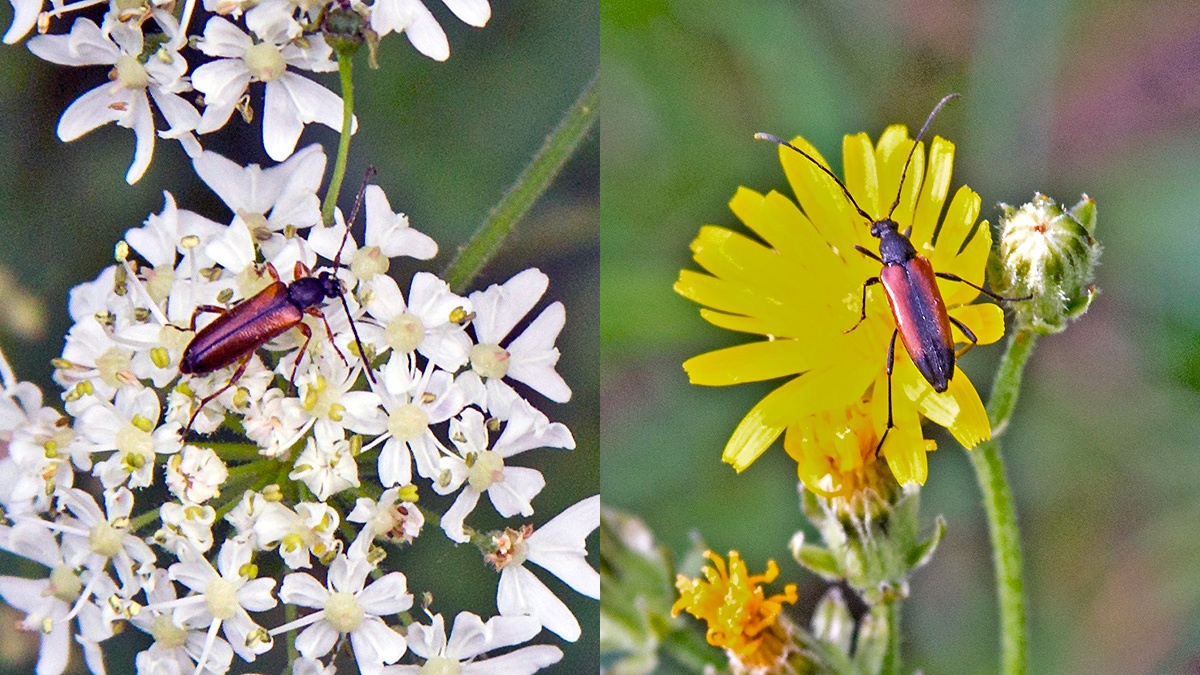
Two very similar longhorn beetles of the family Cerambycidae were only separated at the image processing stage as I thought I had been photographing a single species. These were a Tobacco-coloured Longhorn (Alosterna tabacicolor) on Hogweed (Heracleum sphondylium) and a female Black-striped Longhorn (Stenurella melanura) on Rough Hawk’s-beard (Crepis biennis).
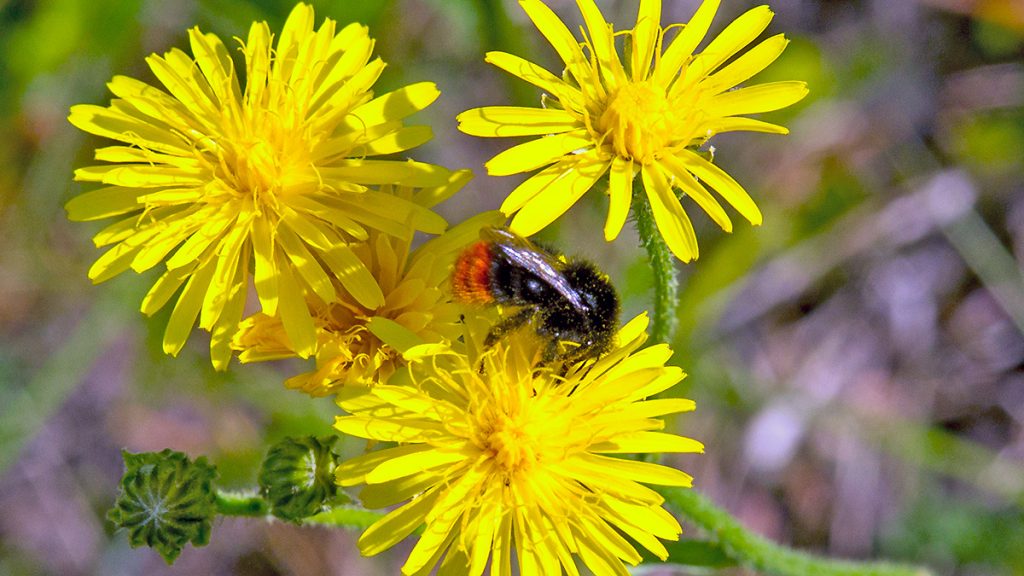
The same patch of Rough Hawk’s-beard was visited too by a female Red-tailed Bumblebee (Bombus lapidarius).
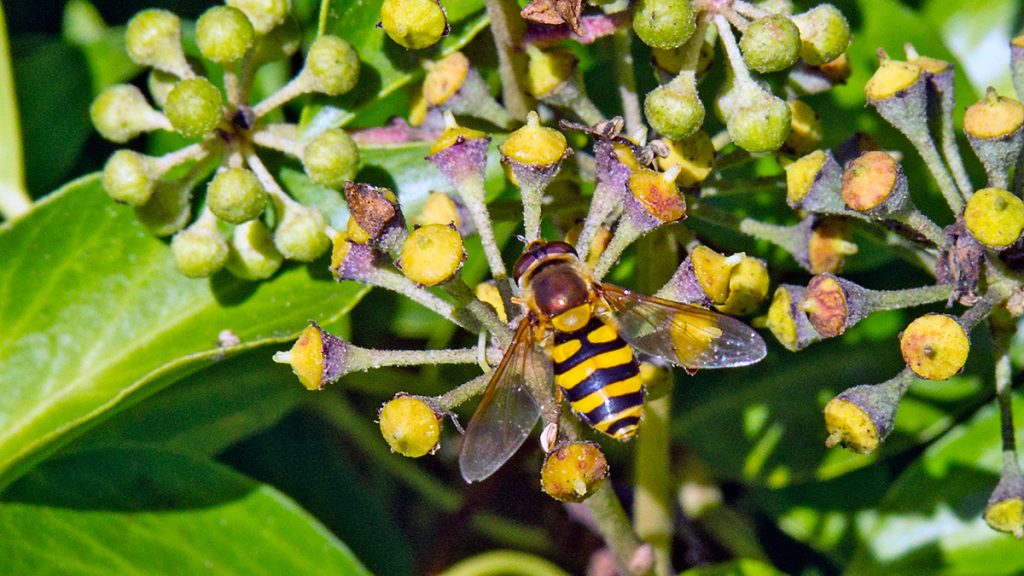
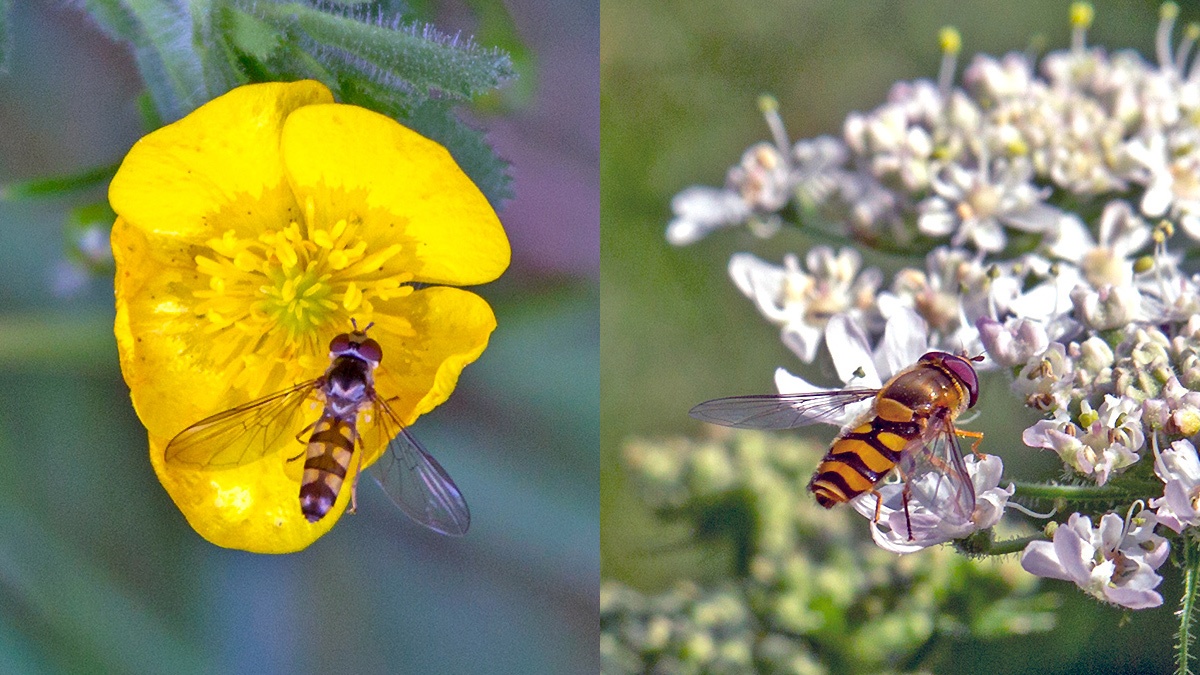
Two hoverflies photographed were a Spotted Thintail (Meliscaeva auricollis) on a buttercup (Ranunculus sp.) flower and a male Broad-banded Aphideater (Eupeodes latifasciatus) on Hogweed. The Eupeodes was fighting for space on the hogweed with a Narrow-barred Fusehorn (Arge melanochra) and several Trivial Plant Bug (Closterotomus trivialis).
Another insect photographed was a Common Red Ant (Myrmica rubra) that was in perpetual motion, while all I wanted it to do was just stay still for few seconds.
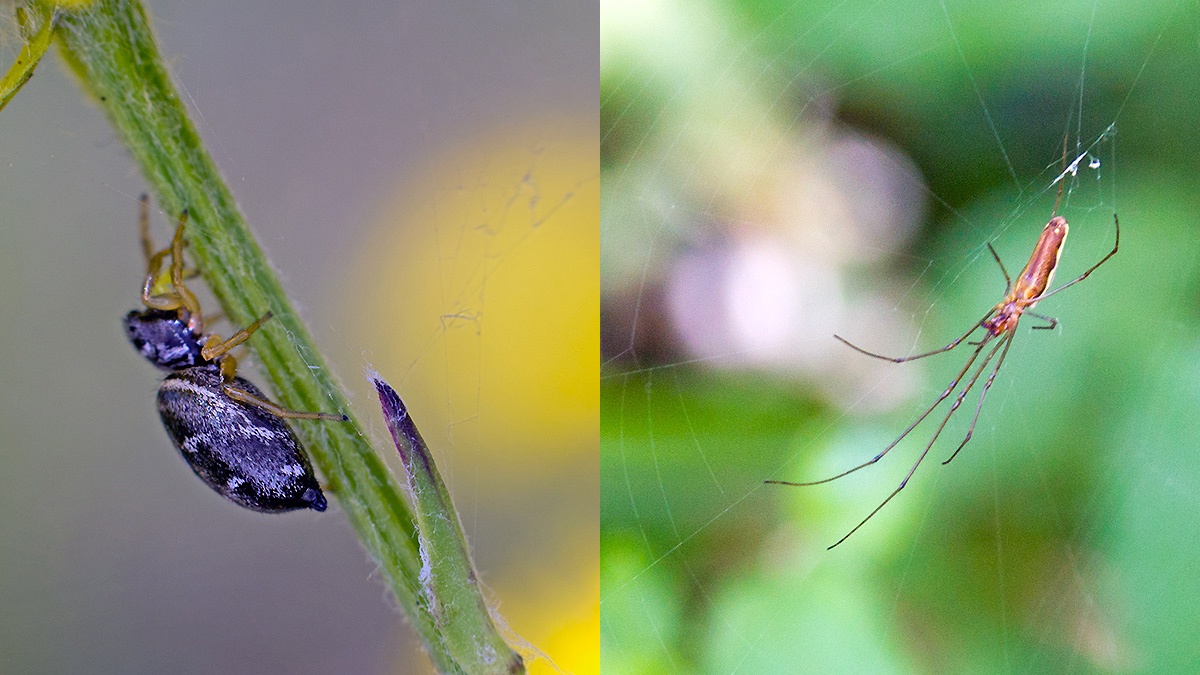
A pair of spiders that did stay still were a long-jawed orb weaver (Tetragnatha sp.) on its web spanning the gap between two Pendulous Sedge plants, and a female Common Sun-jumper (Heliophanus flavipes) on the stem of a Rough Hawk’s-beard.
Two leaf mines were found, one caused by the larva of a fly, the Old Man’s Beard Leaf Miner (Phytomyza vitalbae) on a Traveller’s Joy/Old Man’s Beard (Clematis vitalba) leaf. While this leaf mine is very similar to that of P. fulgens and it is safer to record as P. vitalba/fulgens, my image shows a mine that starts at the leaf tip on the upper surface and then follows the leaf margin before turning into the leaf. This is apparently much more characteristic of P. vitalba. There is no slit at the end of the mine through which the larva would exit to pupate, so this is probably still an active mine.
The other mine is caused by a larva of the Horse-chestnut Leaf Miner (Cameraria ohridella) moth, of which I posted an image taken on 9th April on this very same tree. There can be many mines on a Horse-chestnut leaf and this miner can cause serious defoliation, with up to three generations a year between May and October.
![White Plume Moth [Pterophorus pentadactyla]](https://downsdiary.uk/wp-content/gallery/may_2026/NG8_9084_EOS-1D_TheDowns_30May2026.jpg "White Plume Moth [Pterophorus pentadactyla]")
![Red-tailed Bumblebee [Bombus lapidarius]](https://downsdiary.uk/wp-content/gallery/may_2026/NG8_9137_EOS-1D_TheDowns_30May2026.jpg "Red-tailed Bumblebee [Bombus lapidarius]")
![Narrow-barred Fusehorn [Arge melanochra]](https://downsdiary.uk/wp-content/gallery/may_2026/NG8_9099_EOS-1D_TheDowns_30May2026.jpg "Narrow-barred Fusehorn [Arge melanochra]")
![Common Red Ant [Myrmica rubra]](https://downsdiary.uk/wp-content/gallery/may_2026/BD2_5842_7D_TheDowns_30May2026.jpg "Common Red Ant [Myrmica rubra]")
![Old Man's Beard Leaf Miner [Phytomyza vitalbae]](https://downsdiary.uk/wp-content/gallery/may_2026/NG8_9046_EOS-1D_TheDowns_30May2026.jpg "Old Man's Beard Leaf Miner [Phytomyza vitalbae]")
![Horse-chestnut Leaf Miner [Cameraria ohridella]](https://downsdiary.uk/wp-content/gallery/may_2026/BD2_5843-NG8_9057_EOS-1D_TheDowns_30May2026.jpg "Horse-chestnut Leaf Miner [Cameraria ohridella]")
![Horse-chestnut Leaf Miner [Cameraria ohridella]](https://downsdiary.uk/wp-content/gallery/apr_2026/BD2_2448_7D_TheDowns_09Apr2026.jpg "Horse-chestnut Leaf Miner [Cameraria ohridella]")
<<<< Previous page | Next Page >>>>