The weather very much the same as my last walk on the Downs two days ago. Disappointingly still no increase in butterfly activity. Brimstone still dominate, with a supporting cast of Speckled Wood (Pararge aegeria), Holly Blue and Green Hairstreak. I did get glimpses of what might have been one of the Skippers and an early Small Heath, but couldn’t get close enough to either for a good ID.
However, it was a good day for other insects and spiders with several new species recorded. Photographed species included a Wasp Beetle (Clytus arietis) and a rust fly (Psila fimetaria) both found on Common Hogweed (Heracleum sphondylium), an Oak Catkin Bug (Harpocera thoracica) nymph on a Garlic Mustard (Alliaria petiolata) leaf, a long-jawed orb-weaver spider (Tetragnatha sp.) on Sycamore and a Copper Underwing moth (Amphipyra pyramidea) caterpillar on Common Lime (Tilia × europaea).
This caterpillar is nocturnal and spends the day hanging from a twig, camouflaged as a leaf.
I was very lucky to capture a Red Mason Bee (Osmia bicornis) in flight about to land on a Green Alkanet (Pentaglottis sempervirens) flower.
![Speckled Wood [Pararge aegeria]](https://downsdiary.uk/wp-content/gallery/apr_2026/NG8_7636_EOS-1D_TheDowns_27Apr2026.jpg "Speckled Wood [Pararge aegeria]")
![Wasp Beetle [Clytus arietis]](https://downsdiary.uk/wp-content/gallery/apr_2026/NG8_7625_EOS-1D_TheDowns_27Apr2026.jpg "Wasp Beetle [Clytus arietis]")
![rust fly [Psila fimetaria]](https://downsdiary.uk/wp-content/gallery/apr_2026/NG8_7634_EOS-1D_TheDowns_27Apr2026.jpg "rust fly [Psila fimetaria]")
![Oak Catkin Bug [Harpocera thoracica]](https://downsdiary.uk/wp-content/gallery/apr_2026/BD2_3951_7D_TheDowns_27Apr2026.jpg "Oak Catkin Bug [Harpocera thoracica]")
![long-jawed orb-weaver spider [Tetragnatha sp.]](https://downsdiary.uk/wp-content/gallery/apr_2026/BD2_3845_7D_TheDowns_27Apr2026.jpg "long-jawed orb-weaver spider [Tetragnatha sp.]")
![Copper Underwing moth [Amphipyra pyramidea]](https://downsdiary.uk/wp-content/gallery/apr_2026/BD2_3841_7D_TheDowns_27Apr2026.jpg "Copper Underwing moth [Amphipyra pyramidea]")
![Red Mason Bee [Osmia bicornis]](https://downsdiary.uk/wp-content/gallery/apr_2026/NG8_7632_EOS-1D_TheDowns_27Apr2026.jpg "Red Mason Bee [Osmia bicornis]")
I concentrated my efforts today on several English Oak (Quercus robur) trees and was not disappointed, finding the caterpillar of a not too often seen butterfly here on the Downs, the Purple Hairstreak (Favonius quercus). Another caterpillar proved to be that of a moth, the Spring Harbinger (Tortricodes alternella). Others found were a money spider (Trematocephalus cristatus), several Black Garden Ant (Lasius niger) on an oak apple gall, several more Coleophora moth larval cases and a Hairy Shieldbug (Dolycoris baccarum).
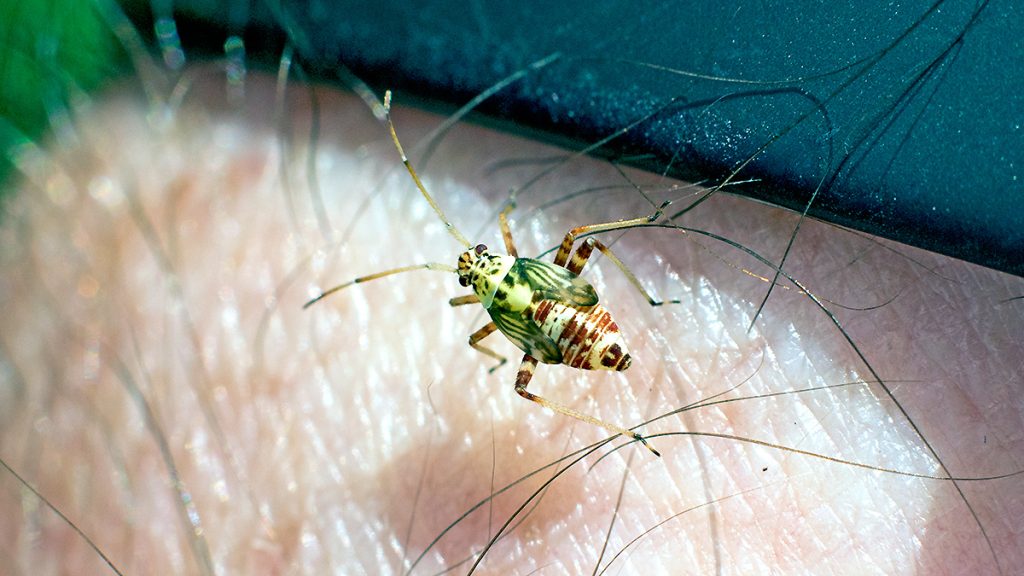
As on my last two trips I managed to transfer wildlife from one of the oaks onto my forearm. Today, not one but four Striped Oak Bug (Rhabdomiris striatellus) nymphs.
Currant galls of the spring sexual generation of the Common Spangle Gall Wasp (Neuroterus quercusbaccarum f. sexual) were located on both catkins and leaves.
![Purple Hairstreak [Favonius quercus]](https://downsdiary.uk/wp-content/gallery/apr_2026/BD2_3880_7D_TheDowns_27Apr2026.jpg "Purple Hairstreak [Favonius quercus]")
![Spring Harbinger moth [Tortricodes alternella]](https://downsdiary.uk/wp-content/gallery/apr_2026/BD2_3897_7D_TheDowns_27Apr2026.jpg "Spring Harbinger moth [Tortricodes alternella]")
![money spider [Trematocephalus cristatus]](https://downsdiary.uk/wp-content/gallery/apr_2026/BD2_3825_7D_TheDowns_27Apr2026.jpg "money spider [Trematocephalus cristatus]")
![Black Garden Ant [Lasius niger]](https://downsdiary.uk/wp-content/gallery/apr_2026/BD2_3865_7D_TheDowns_27Apr2026.jpg "Black Garden Ant [Lasius niger]")
![Hairy Shieldbug [Dolycoris baccarum]](https://downsdiary.uk/wp-content/gallery/apr_2026/NG8_7645_EOS-1D_TheDowns_27Apr2026.jpg "Hairy Shieldbug [Dolycoris baccarum]")
![Striped Oak Bug [Rhabdomiris striatellus]](https://downsdiary.uk/wp-content/gallery/apr_2026/BD2_3901_7D_TheDowns_27Apr2026.jpg "Striped Oak Bug [Rhabdomiris striatellus]")
![Common Spangle Gall Wasp [Neuroterus quercusbaccarum f. sexual]](https://downsdiary.uk/wp-content/gallery/apr_2026/NG8_7621_EOS-1D_TheDowns_27Apr2026.jpg "Common Spangle Gall Wasp [Neuroterus quercusbaccarum f. sexual]")
![Common Spangle Gall Wasp [Neuroterus quercusbaccarum f. sexual]](https://downsdiary.uk/wp-content/gallery/apr_2026/BD2_3819-3937_7D_TheDowns_27Apr2026.jpg "Common Spangle Gall Wasp [Neuroterus quercusbaccarum f. sexual]")
Some of the more advanced Norway Maple (Acer platanoides) are showing early development of their seed pods. These are ‘helicopter seeds’, which are better known from the Norway Maple’s more familiar cousin the Sycamore (Acer pseudoplatanus). For more details on which trees have ‘helicopter seeds’ and the differences between them, try this short, illustrated blog post from the Woodland Trust.
![Norway Maple [Acer platanoides]](https://downsdiary.uk/wp-content/gallery/apr_2026/NG8_7638_EOS-1D_TheDowns_27Apr2026.jpg "Norway Maple [Acer platanoides]")
<<<< Previous page | Next Page >>>>