The first day for quite a while that I have not been able to find anything new to report. So, I will have to be satisfied with posting images of species already recorded on the Downs, hopefully better than the first time.
I got the day off to a start with a male Tawny Mining Bee (Andrena fulva) resting on a Wild Cherry (Prunus avium) leaf. In the image can be seen twinned red extrafloral nectaries on the leaf stalks (petioles) of the wild cherry. I first noted these and explained their function in my post of 29th September 2025.
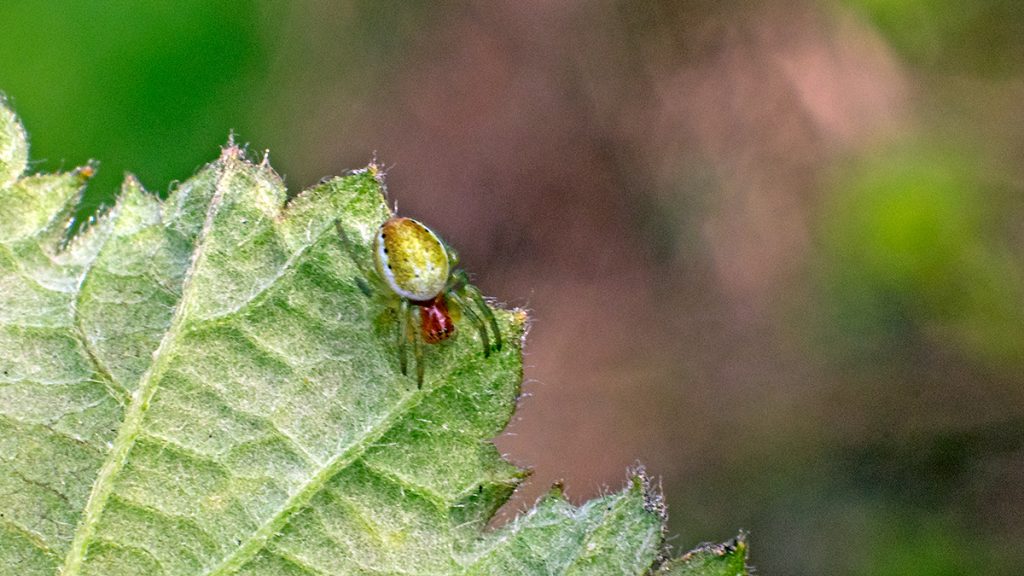
Literally behind me, on the opposite side of the path, was a patch of brambles (Rubus sp.). Some of the new leaf growth here hid a Cucumber Green Spider (Araniella cucurbitina sensu lato) under one of the leaves. I use here the term ‘sensu lato’ as part of the scientific name for the spider. It is Latin, meaning “in the broad sense”. It is used when there are similar species that are impossible to separate in the field and that would require microscopic examination to be certain of the ID (in which case it can then become “sensu strictu”). The other species involved here is Araniella opisthographa.
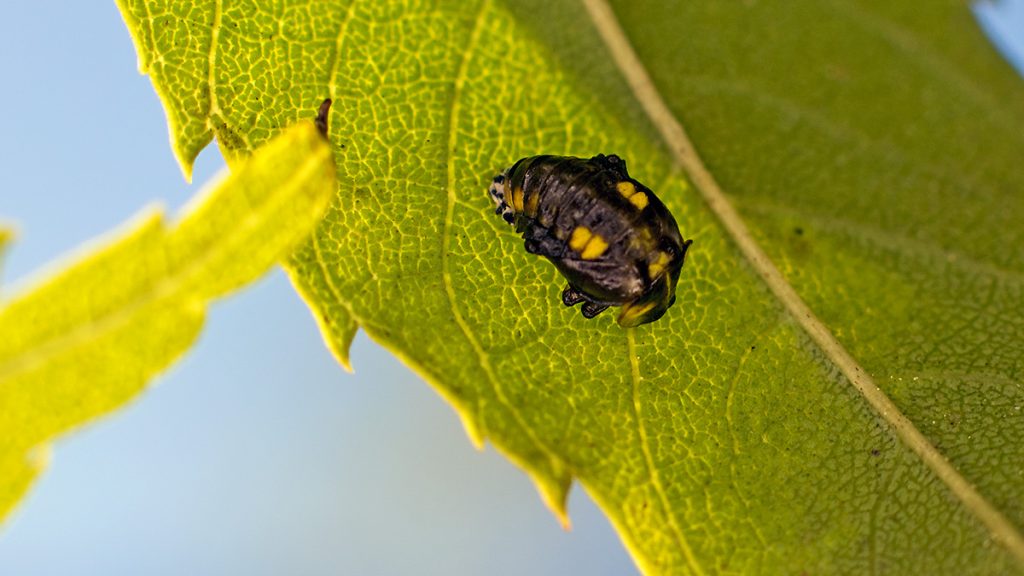
A plant growing at the base of a large tree trunk attracted my attention as it has particularly broad lanceolate leaves. Resembling a Hyacinthoides sp. such as Spanish Bluebell, the leaves seem much broader and fleshier than those of the bluebell. The tight flower buds, which also resemble those of a bluebell, are only just starting to open, while Spanish Bluebell has been flowering for a while now. I have tentatively identified this plant as Pyranean Squill (Scilla lilio-hyacinthus). Only when the flowers open fully will I be able to confirm or change the ID. Perhaps I may have a new species after all. While examining this plant I realised that there was one of our smaller ladybirds on one of the leaves, the 22-spot Ladybird (Psyllobora vigintiduopunctata).
[P.S. 9th April – the flower buds are now opening, and I find that this is nothing more than a large Spanish Bluebell. To my dismay no new species to be recorded.]
First recorded on 26th March, I found Rowan Leaf Blister Mite (Eriophyes sorbi) on another Rowan tree, but some of the leaves of this tree are very badly infested by the mite.
The early signs of Sycamore Gall Mite (Aceria cephalonea agg.) were found on a sycamore leaf, a large leaf, one of the first of the new spring growth to reach full size. The galls manifest as a red pimples on the upper surface of the leaf, essentially protective shields that the leaf forms to isolate the tiny mites (<0.2mm) and within the which the mites live and feed. On the underside of the leaf can be seen the pin-prick holes (ostioles) where adult mites that have overwintered in bark crevices have entered the leaf. The ‘agg.’, for aggregate, in the scientific name, indicates that there are other species that this could be. In this case, in spring and early summer, before the gall is fully developed, A. cephalonea is indistinguishable from A. macrorhyncha.
The flower buds of Common Laburnum (Laburnum anagyroides) are beginning to develop, and the leaf buds of English (Pedunculate) Oak (Quercus robur) are starting to open at last. One of the last trees to show new growth is the Common Beech (Fagus sylvatica), whose leaf buds remain tightly closed.
![Tawny Mining Bee [Andrena fulva]](https://downsdiary.uk/wp-content/gallery/apr_2026/NG8_6657b_EOS-1D_TheDowns_04Apr2026.jpg "Tawny Mining Bee [Andrena fulva]")
![Cucumber Green Spider [Araniella cucurbitina sensu lato]](https://downsdiary.uk/wp-content/gallery/apr_2026/BD2_2254_7D_TheDowns_04Apr2026.jpg "Cucumber Green Spider [Araniella cucurbitina sensu lato]")
![22-spot Ladybird [Psyllobora vigintiduopunctata]](https://downsdiary.uk/wp-content/gallery/apr_2026/NG8_6660-BD2_2268_EOS-1D_TheDowns_04Apr2026.jpg "22-spot Ladybird [Psyllobora vigintiduopunctata]")
![Rowan Leaf Blister Mite [Eriophyes sorbi]](https://downsdiary.uk/wp-content/gallery/apr_2026/NG8_6655_EOS-1D_TheDowns_04Apr2026.jpg "Rowan Leaf Blister Mite [Eriophyes sorbi]")
![Sycamore Gall Mite [Aceria cephalonea agg.]](https://downsdiary.uk/wp-content/gallery/apr_2026/NG8_6673_EOS-1D_TheDowns_04Apr2026.jpg "Sycamore Gall Mite [Aceria cephalonea agg.]")
![Sycamore Gall Mite [Aceria cephalonea agg.]](https://downsdiary.uk/wp-content/gallery/apr_2026/BD2_2310-14_7D_TheDowns_04Apr2026.jpg "Sycamore Gall Mite [Aceria cephalonea agg.]")
![Common Laburnum [Laburnum anagyroides]](https://downsdiary.uk/wp-content/gallery/apr_2026/NG8_6653_EOS-1D_TheDowns_04Apr2026.jpg "Common Laburnum [Laburnum anagyroides]")
![English Oak [Quercus robur]](https://downsdiary.uk/wp-content/gallery/apr_2026/NG8_6672_EOS-1D_TheDowns_04Apr2026.jpg "English Oak [Quercus robur]")
<<<< Previous page | Next Page >>>>