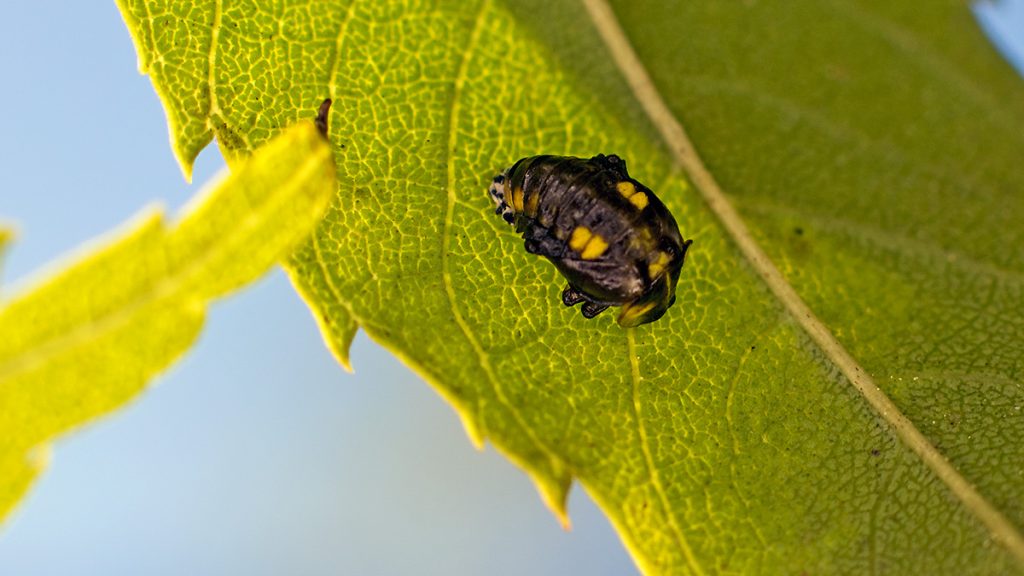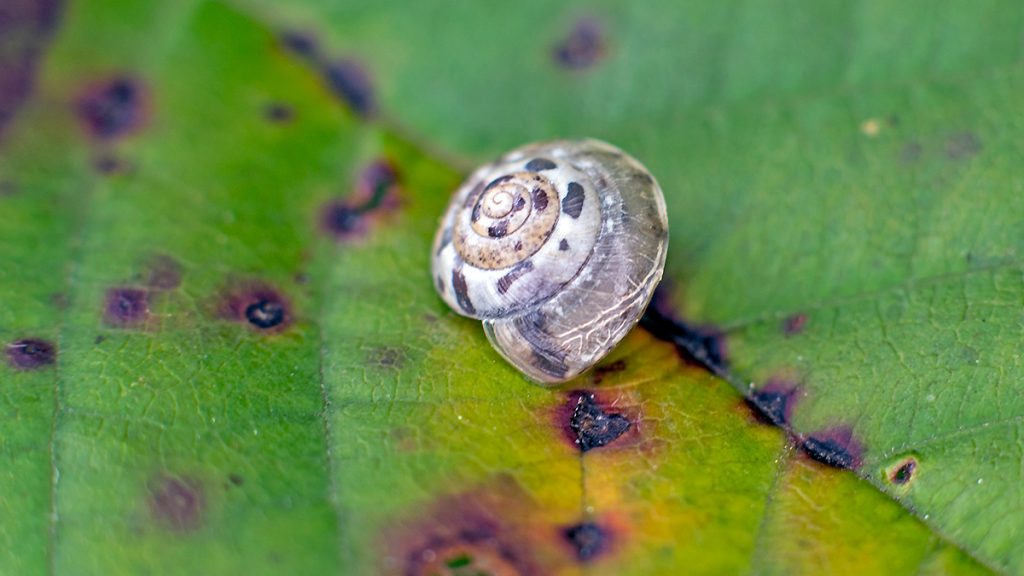
A chill wind blowing again this morning, strong enough to make close-up photography quite challenging. Usually, individual leaves can be held reasonably steady to photograph whatever little creature happens to be the subject. Today, though, even a hand-held leaf was still shaking in the stronger gusts of wind.
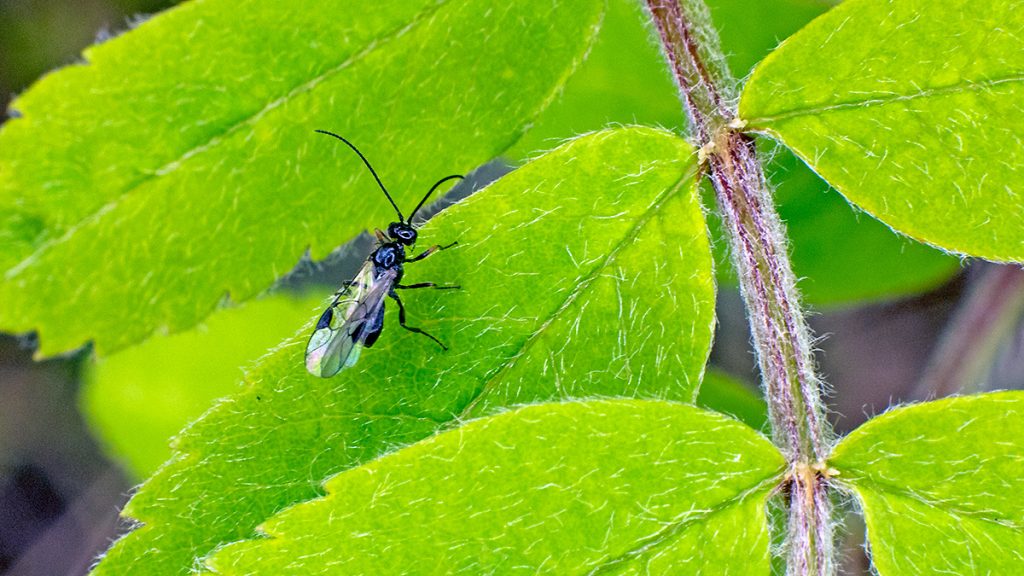
I did manage to get images of a small (4-5mm) unidentified Braconid wasp and an even smaller (+/-2.5mm) chalcidoid wasp (possibly Mesopolobus tibialis of family Pteromalidae) both on the same newly-leafing Rowan (Sorbus aucuparia).
The large evergreen leaves of Cherry Laurel (Prunus laurocerasus) are always worth a search. This morning produced Common Red Ant (Myrmica rubra), a globular springtail Dicyrtomina saundersi, and a slender springtail, the Long-horned Springtail (Pogonognathellus longicornis).
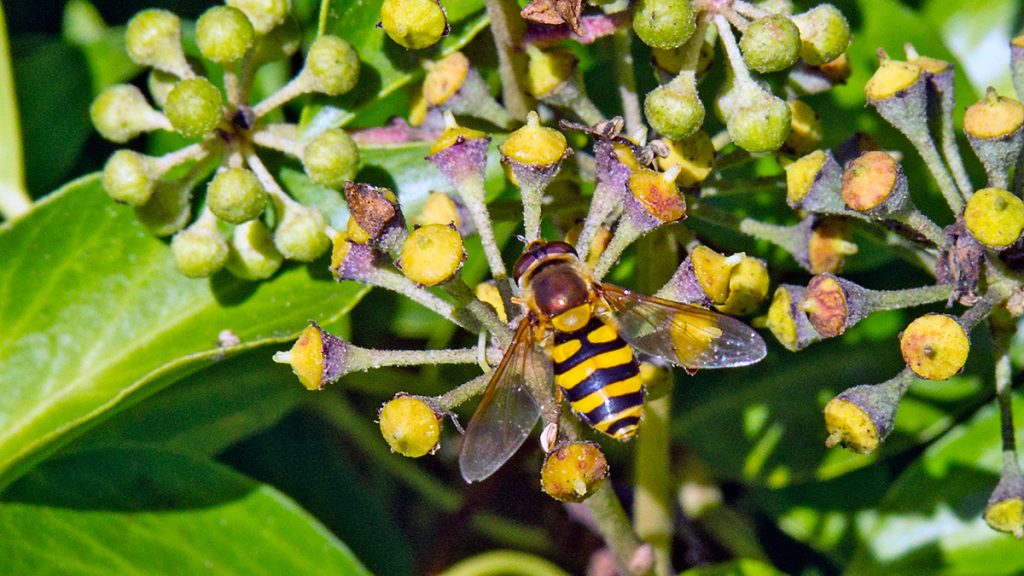
On a newly leafing lime (Tilia sp.) I found a small spider, possibly a Platform Hammock Spider (Neriene peltata), while a new bramble leaf (Rubus sp.) was the chosen resting spot for a male Spring Epistrophe (Epistrophe eligans) hoverfly.
New Sycamore (Acer pseudoplatanus) leaves are already showing signs of infestation by the Sycamore Felt Gall Mite (Aceria pseudoplatani agg.). The mites overwintered in crevices in the bark of the trees and are now moving to the newly opened leaves, where the galls they cause manifest as a blister on the upper leaf surface with a corresponding felty erineum on the underside. An erineum (pl. erinea) is an abnormal felty growth of hairs from the leaf epidermis induced by the feeding of the mites. The mites, which are microscopic in size, live among the tiny hairs of the erinea.
![Braconid wasp [unidentified]](https://downsdiary.uk/wp-content/gallery/mar_2026/BD2_1998_7D_TheDowns_30Mar2026.jpg "Braconid wasp [unidentified]")
![chalcidoid wasp [Mesopolobus tibialis ?]](https://downsdiary.uk/wp-content/gallery/mar_2026/BD2_2022_7D_TheDowns_30Mar2026.jpg "chalcidoid wasp [Mesopolobus tibialis ?]")
![Common Red Ant [Myrmica rubra]](https://downsdiary.uk/wp-content/gallery/mar_2026/BD2_1912_7D_TheDowns_30Mar2026.jpg "Common Red Ant [Myrmica rubra]")
![globular springtail [Dicyrtomina saundersi]](https://downsdiary.uk/wp-content/gallery/mar_2026/BD2_1887_7D_TheDowns_30Mar2026.jpg "globular springtail [Dicyrtomina saundersi]")
![Long-horned Springtail [Pogonognathellus longicornis]](https://downsdiary.uk/wp-content/gallery/mar_2026/BD2_1869_7D_TheDowns_30Mar2026.jpg "Long-horned Springtail [Pogonognathellus longicornis]")
![Platform Hammock Spider [Neriene peltata ?]](https://downsdiary.uk/wp-content/gallery/mar_2026/BD2_1867_7D_TheDowns_30Mar2026.jpg "Platform Hammock Spider [Neriene peltata ?]")
![Spring Epistrophe [Epistrophe eligans]](https://downsdiary.uk/wp-content/gallery/mar_2026/BD2_1937_7D_TheDowns_30Mar2026.jpg "Spring Epistrophe [Epistrophe eligans]")
![Sycamore Felt Gall Mite [Aceria pseudoplatani agg.]](https://downsdiary.uk/wp-content/gallery/mar_2026/BD2_1974-77_7D_TheDowns_30Mar2026.jpg "Sycamore Felt Gall Mite [Aceria pseudoplatani agg.]")
While crossing Sutton Lane (B2218), which crosses Banstead Downs, I noticed a large patch of Danish Scurvygrass (Cochlearia danica) on the grass verge. Although this plant is native to coastal areas, it has spread rapidly inland along major roads and motorways because it is highly salt-tolerant and thrives in the conditions created by winter road gritting. The leaves are a good source of Vitamin C and the plant supposedly gets its name from sailors chewing them to prevent scurvy.
Back on the Downs the first Spanish Bluebell (Hyacinthoides hispanica) are appearing, mainly of the predominant violet-blue form, although there are a few white ones too. In a brief interval when the wind died down I managed some close-up photos of Cowslip (Primula veris).
![Danish Scurvygrass [Cochlearia danica]](https://downsdiary.uk/wp-content/gallery/mar_2026/BD2_1923-110841_SM-A326B_7D_TheDowns_30Mar2026.jpg "Danish Scurvygrass [Cochlearia danica]")
![Spanish Bluebell [Hyacinthoides hispanica]](https://downsdiary.uk/wp-content/gallery/mar_2026/110612b_SM-A326B_TheDowns_30Mar2026.jpg "Spanish Bluebell [Hyacinthoides hispanica]")
![Spanish Bluebell [Hyacinthoides hispanica]](https://downsdiary.uk/wp-content/gallery/mar_2026/112321b-49b_SM-A326B_TheDowns_30Mar2026.jpg "Spanish Bluebell [Hyacinthoides hispanica]")
![Spanish Bluebell [Hyacinthoides hispanica]](https://downsdiary.uk/wp-content/gallery/mar_2026/110630b_SM-A326B_TheDowns_30Mar2026.jpg "Spanish Bluebell [Hyacinthoides hispanica]")
![Cowslip [Primula veris]](https://downsdiary.uk/wp-content/gallery/mar_2026/BD2_1981_7D_TheDowns_30Mar2026.jpg "Cowslip [Primula veris]")
![Cowslip [Primula veris]](https://downsdiary.uk/wp-content/gallery/mar_2026/BD2_1979_7D_TheDowns_30Mar2026.jpg "Cowslip [Primula veris]")
<<<< Previous page | Next Page >>>>