First up today, as a follow-on from yesterday’s post I have a further image showing the sepals of the Cherry Plum (Prunus cerasifera) confirming the ID. The image clearly shows that the sepals are reflexed (bent downwards), are blunt-ended and have a fimbriate margin (fringed or ragged edge), all of these factors separating Cherry Plum from the similar Blackthorn (Prunus spinosa).
![Cherry Plum [Prunus cerasifera]](https://downsdiary.uk/wp-content/gallery/feb_2026/BD2_0295_7D_TheDowns_14Feb2026.jpg "Cherry Plum [Prunus cerasifera]")
Also beginning to flower are two evergreen species, the non-native, invasive Cherry Laurel (Prunus laurocerasus) and the non-native, introduced (and a garden escapee) Holly-leaved Barberry (Berberis aquifolium).
![Holly-leaved Barberry [Berberis aquifolium]](https://downsdiary.uk/wp-content/gallery/feb_2026/NG8_5921_EOS-1D_TheDowns_14Feb2026.jpg "Holly-leaved Barberry [Berberis aquifolium]")
![Cherry Laurel [Prunus laurocerasus]](https://downsdiary.uk/wp-content/gallery/feb_2026/NG8_5933_EOS-1D_TheDowns_14Feb2026.jpg "Cherry Laurel [Prunus laurocerasus]")
On the trunk of a fallen tree I found what I believe to be Capillary Thread-moss (Bryum capillare) with sporophytes at various stage of development.
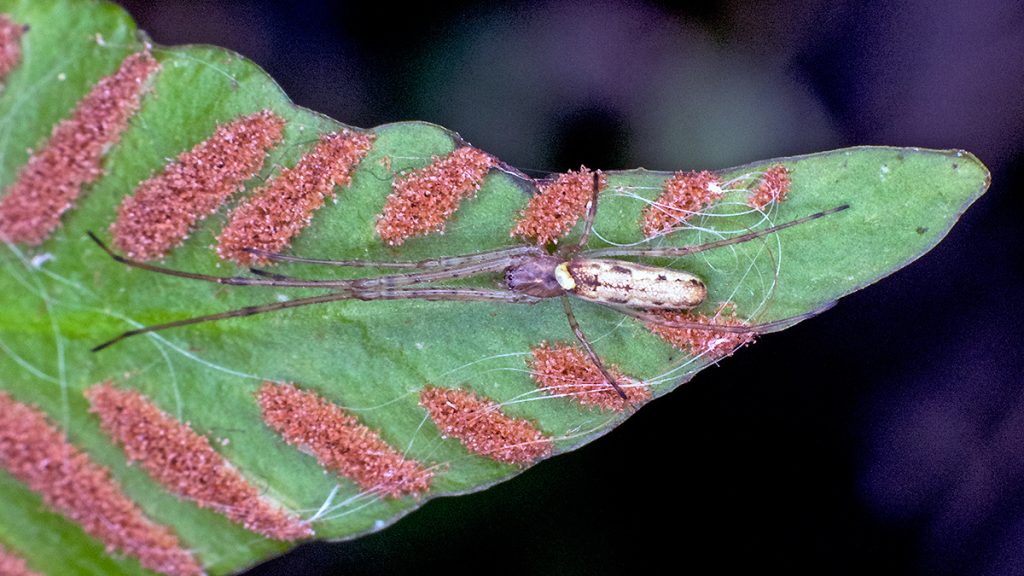
While photographing the underside of Hart’s-tongue fern (Asplenium scolopendrium) leaves to show the sori, the spore containing bodies of the fern, I discovered a long-jawed orb-weaver spider, the Common Stretch Spider (Tetragnatha extensa), at the tip of one of the leaves.
![Capillary Thread-moss [Rosulabryum capillare ?]](https://downsdiary.uk/wp-content/gallery/feb_2026/BD2_0256_7D_TheDowns_14Feb2026.jpg "Capillary Thread-moss [Rosulabryum capillare ?]")
![Hart's-tongue Fern [Asplenium scolopendrium]](https://downsdiary.uk/wp-content/gallery/feb_2026/NG8_5925_EOS-1D_TheDowns_14Feb2026.jpg "Hart's-tongue Fern [Asplenium scolopendrium]")
![Hart's-tongue Fern [Asplenium scolopendrium]](https://downsdiary.uk/wp-content/gallery/feb_2026/BD2_0279_7D_TheDowns_14Feb2026.jpg "Hart's-tongue Fern [Asplenium scolopendrium]")
![Common Stretch Spider [Tetragnatha extensa]](https://downsdiary.uk/wp-content/gallery/feb_2026/BD2_0278_7D_TheDowns_14Feb2026.jpg "Common Stretch Spider [Tetragnatha extensa]")
Some fungi and slime moulds seen today included Rosy Crust (Peniophora incarnata), Crystal Brain (Myxarium nucleatum) and Birch Woodwart (Jackrogersella multiformis) fungi, and the slime mould Badhamia panicea.
![Rosy Crust [Peniophora incarnata ?]](https://downsdiary.uk/wp-content/gallery/feb_2026/NG8_5930_EOS-1D_TheDowns_14Feb2026.jpg "Rosy Crust [Peniophora incarnata ?]")
![Rosy Crust [Peniophora incarnata ?]](https://downsdiary.uk/wp-content/gallery/feb_2026/BD2_0280_7D_TheDowns_14Feb2026.jpg "Rosy Crust [Peniophora incarnata ?]")
![Crystal Brain [Myxarium nucleatum ?]](https://downsdiary.uk/wp-content/gallery/feb_2026/BD2_0286_7D_TheDowns_14Feb2026.jpg "Crystal Brain [Myxarium nucleatum ?]")
![Birch Woodwart [Jackrogersella multiforme ?]](https://downsdiary.uk/wp-content/gallery/feb_2026/BD2_0292_7D_TheDowns_14Feb2026.jpg "Birch Woodwart [Jackrogersella multiforme ?]")
![slime mould [Badhamia panicea ?]](https://downsdiary.uk/wp-content/gallery/feb_2026/BD2_0264_7D_TheDowns_14Feb2026.jpg "slime mould [Badhamia panicea ?]")
![slime mould [Badhamia panicea ?]](https://downsdiary.uk/wp-content/gallery/feb_2026/BD2_0263_7D_TheDowns_14Feb2026.jpg "slime mould [Badhamia panicea ?]")
Nature Note for the Day
For weeks I have been aware of the worm casts all over the Downs, whether on the grass verges along the footpaths and bridleways, in the open grassland areas or amongst the leaf litter in the woodland. It is simply because of the winter grass conditions that you can see them. In the summer months they would be totally hidden in the long grass.
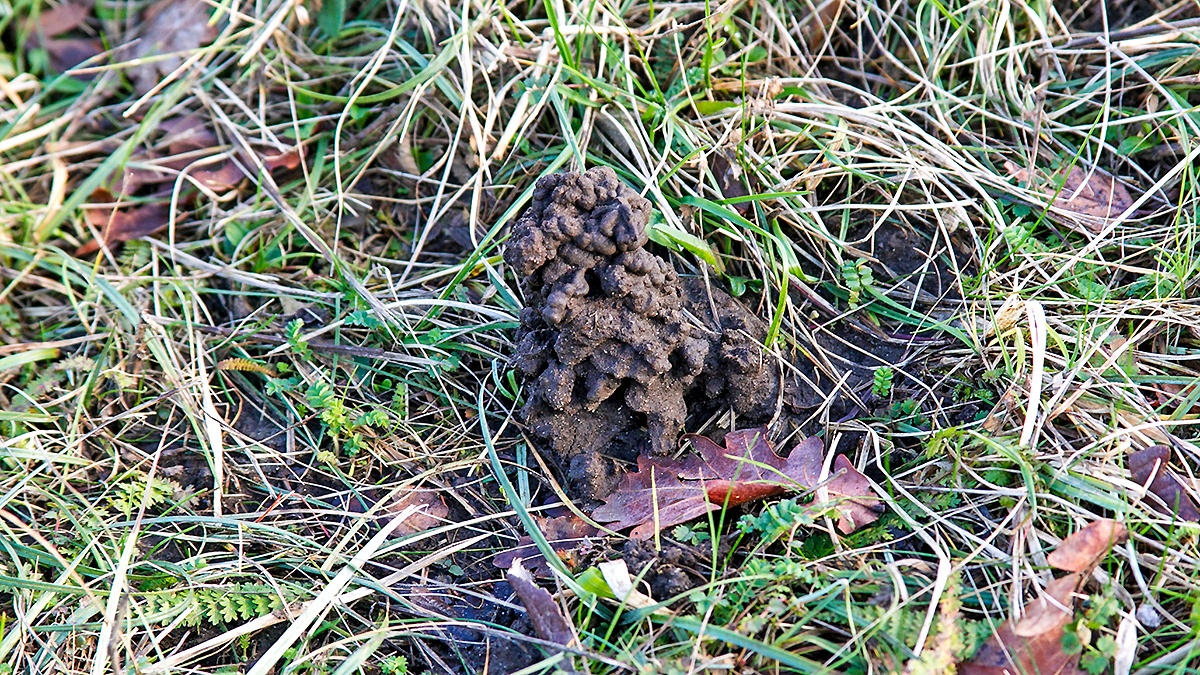
Earthworms are generally considered to be beneficial organisms as their burrowing activity enhances water and air movement through the soil (i.e. drainage and aeration). In the UK there are 25 species of earthworm, but only 3 deposit casts on the surface (Allolobophora nocturna, Allolobophora longa, and Lumbricus terrestris). It is estimated that these earthworms bring to the surface 40-50 tonnes of soil per hectare (18-22 tons per acre) per year. Earthworms also move organic matter into the soil profile. They feed on dead plant matter (they are known as ‘detrivores’) mixed with soil particles and then excrete a fine paste as casts, which can be up to 40% richer in humus than the top 230 mm (9 inches) of the soil in which they live, as well as significantly enriched in nitrogen, potassium and phosphorus, the three most essential elements for plant nutrition.
<<<< Previous page | Next Page >>>>