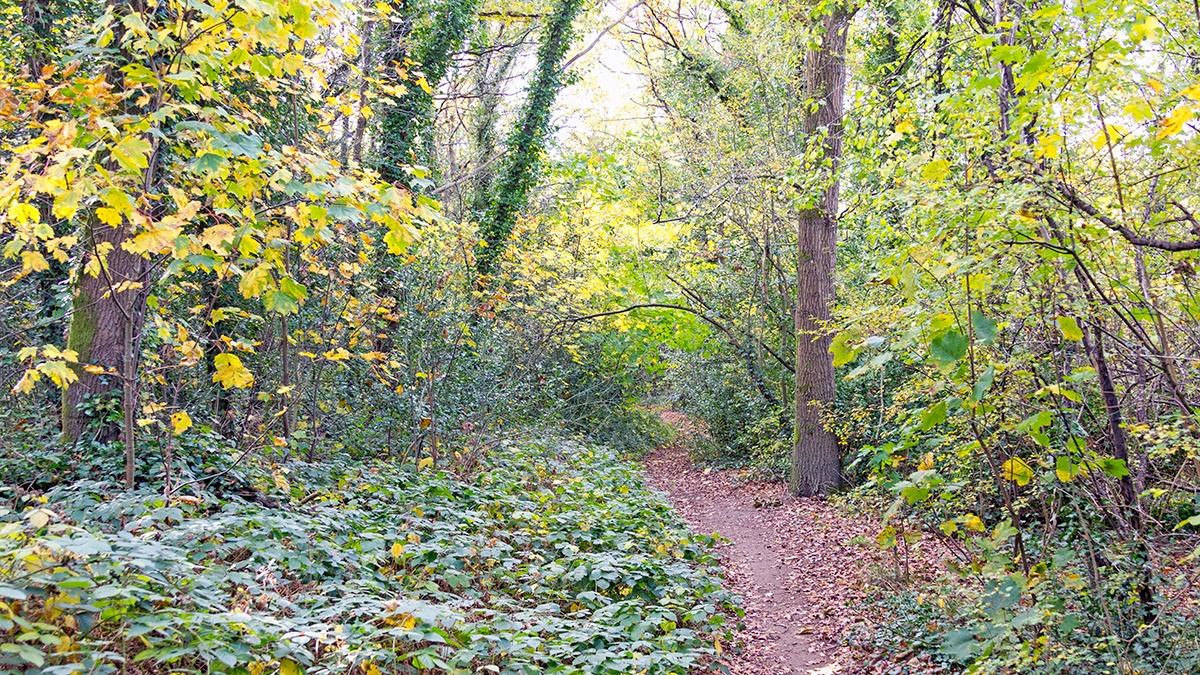
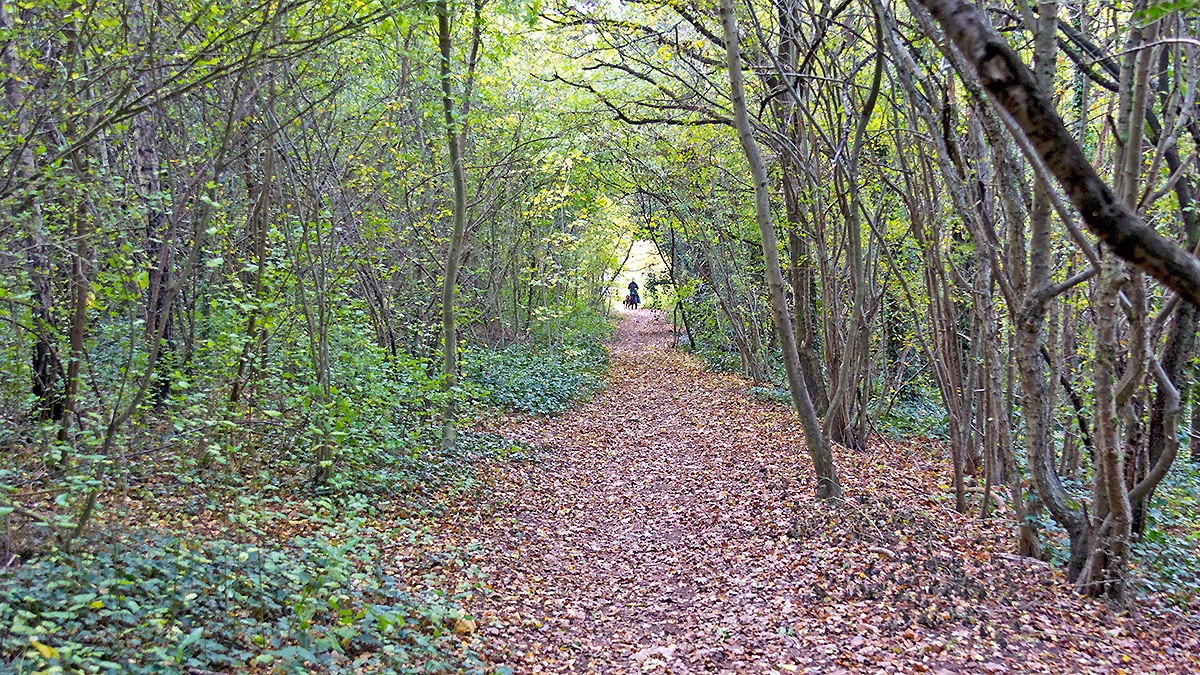
Leaves are getting yellower and the carpet of fallen leaves is getting thicker.
Another bird foraging party today, but this time Goldcrest (Regulus regulus). Unfortunately, I needed my 300 mm lens as the 28 – 135 mm zoom was hopelessly inadequate. I’ll post the image anyway as it the first time I have seen the Goldcrest on the Downs in my 11 years of walking here regularly.
![Goldcrest [Regulus regulus]](https://downsdiary.uk/wp-content/gallery/oct_2025/NG8_5011_EOS-1D_TheDowns_28Oct2025.jpg "Goldcrest [Regulus regulus]")
A Sweet Chestnut tree provided a sighting of a root-maggot fly of the family Anthomyiidae.
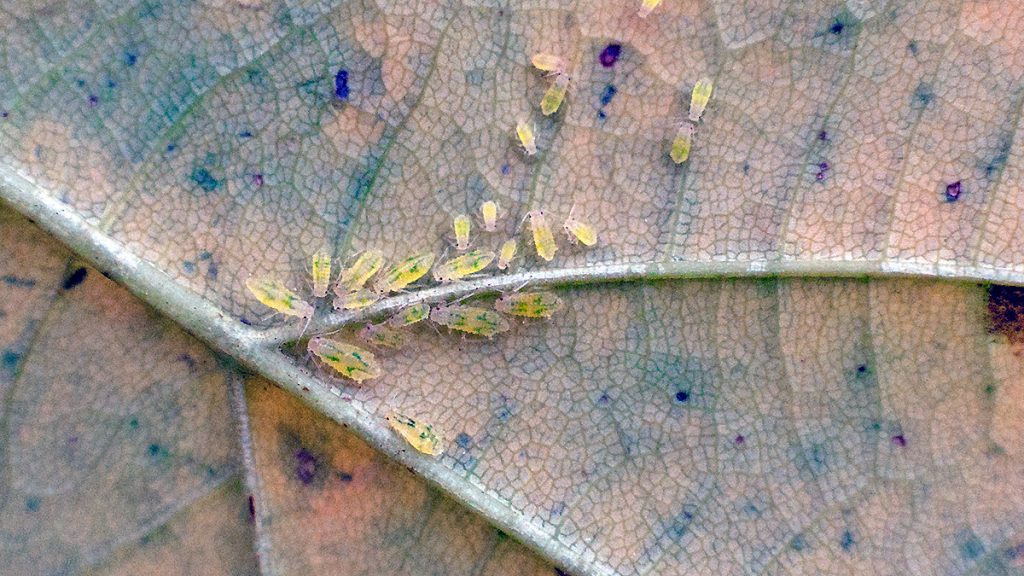
On one sycamore tree I discovered three different aphid species. These were Sycamore Periphyllus Aphid (Periphyllus acericola) oviparae, a Common Sycamore Aphid (Drepanosiphum platanoidis) male alate and a Common Periphyllus Aphid (Periphyllus testudinaceus) ovipara. Autumn is the season for the sexual generation of aphids. In spring the asexual females give birth to live nymphs, but in autumn the female (ovipara) mates with a male alate and lays eggs, usually in crevices in the bark of the tree, where they remain until spring when the asexual generation emerges.
On a Common Hazel (Corylus avellana) leaf I found the leaf mine of the larva of a Hazel Leaf Miner moth (Stigmella microtheriella).
![root-maggot fly [unidentified]](https://downsdiary.uk/wp-content/gallery/oct_2025/NG8_4998_EOS-1D_TheDowns_28Oct2025_Anthomyiidae-sp.jpg "root-maggot fly [unidentified]")
![Sycamore Periphyllus Aphid [Periphyllus acericola]](https://downsdiary.uk/wp-content/gallery/oct_2025/JO8V4357_EOS-1D_TheDowns_28Oct2025.jpg "Sycamore Periphyllus Aphid [Periphyllus acericola]")
![Common Sycamore Aphid [Drepanosiphum platanoidis]](https://downsdiary.uk/wp-content/gallery/oct_2025/JO8V4355_EOS-1D_TheDowns_28Oct2025.jpg "Common Sycamore Aphid [Drepanosiphum platanoidis]")
![Common Periphyllus Aphid [Periphyllus testudinaceus?]](https://downsdiary.uk/wp-content/gallery/oct_2025/JO8V4319_EOS-1D_TheDowns_28Oct2025.jpg "Common Periphyllus Aphid [Periphyllus testudinaceus?]")
![Hazel Leaf Miner moth [Stigmella microtheriella]](https://downsdiary.uk/wp-content/gallery/oct_2025/NG8_4979b_EOS-1D_TheDowns_28Oct2025.jpg "Hazel Leaf Miner moth [Stigmella microtheriella]")
In the old sheep enclosure latest plants to join the late-flowering numbers are Common Gorse (Ulex europaeus) and Wild Carrot (Daucus carota). Although on such a small plant it is difficult to separate U. europaeus from U. minor (Dwarf Gorse), its deeply grooved stem and spines make U. europaeus more probable. Similarly, it is difficult to separate Wild Carrot (Daucus carota) and Fool’s Parsley (Aethusa cynapium), but given that Wild Carrot is so common on the Downs and I’ve not yet seen Fool’s Parsley I opt for the former.
One Sycamore (Acer pseudoplatanus) stump, cut off flush at ground level, is beginning to regenerate.
![Common Gorse [Ulex europaeus]](https://downsdiary.uk/wp-content/gallery/oct_2025/NG8_4989_EOS-1D_TheDowns_28Oct2025.jpg "Common Gorse [Ulex europaeus]")
![Wild Carrot [Daucus carota]](https://downsdiary.uk/wp-content/gallery/oct_2025/NG8_4984_EOS-1D_TheDowns_28Oct2025.jpg "Wild Carrot [Daucus carota]")
![Sycamore [Acer pseudoplatanus]](https://downsdiary.uk/wp-content/gallery/oct_2025/NG8_4982_EOS-1D_TheDowns_28Oct2025.jpg "Sycamore [Acer pseudoplatanus]")
<<<< Previous page | Next Page >>>>