The temperature dipping, with the first single digit overnight temperature of the autumn.
ZERO butterflies, but…
Something much more interesting. I came across a huge Ivy Bee (Colletes hederae) colony, which was found because it straddled a path in one of the clearings making the entrances to the hundreds of nests more visible. A search of the grassland on either side of the path revealed that the nesting site covered some 40-50 m².
Ivy bees are solitary and each nest contains only one bee but can form these very large colonies when conditions are right. They do feed on and collect pollen from plants other than ivy, especially at the start of the season when they first emerge in early September. However, their emergence is timed to coincide with the ivy flowering, the last of the major flowers to do so, lasting well into November. It is only in October and November when there is no other food and pollen source and very few other bees on the wing that the Ivy Bees become much more obvious. This year, which has been a very good one for insect numbers generally, they are very apparent simply through sheer numbers.
I positioned myself on the path and waited. The bees came back one at a time but never straight to the entrance to their nest. They would always appear to be searching for the right one, or perhaps this was a tactic so as not to give away the nest location to a few opportunistic predators that could also be seen – a few spiders and Common Wasp (Vespula vulgaris). I managed to get some reasonable images of the bees on the ground in the final few inches to their nest entrances.
![Ivy Bee [Colletes hederae]](https://downsdiary.uk/wp-content/gallery/sep-2025/NG8_3991_EOS-1D_TheDowns_23Sep2025.jpg "Ivy Bee [Colletes hederae]")
![Ivy Bee [Colletes hederae]](https://downsdiary.uk/wp-content/gallery/sep-2025/NG8_3995_EOS-1D_TheDowns_23Sep2025.jpg "Ivy Bee [Colletes hederae]")
![Ivy Bee [Colletes hederae]](https://downsdiary.uk/wp-content/gallery/sep-2025/NG8_4002_EOS-1D_TheDowns_23Sep2025.jpg "Ivy Bee [Colletes hederae]")
![Ivy Bee [Colletes hederae]](https://downsdiary.uk/wp-content/gallery/sep-2025/NG8_4035_EOS-1D_TheDowns_23Sep2025.jpg "Ivy Bee [Colletes hederae]")
![Ivy Bee [Colletes hederae]](https://downsdiary.uk/wp-content/gallery/sep-2025/NG8_3981_EOS-1D_TheDowns_23Sep2025.jpg "Ivy Bee [Colletes hederae]")
![Ivy Bee [Colletes hederae]](https://downsdiary.uk/wp-content/gallery/sep-2025/NG8_4039_EOS-1D_TheDowns_23Sep2025.jpg "Ivy Bee [Colletes hederae]")
![Common Wasp [Vespula vulgaris]](https://downsdiary.uk/wp-content/gallery/sep-2025/NG8_4044_EOS-1D_TheDowns_23Sep2025.jpg "Common Wasp [Vespula vulgaris]")
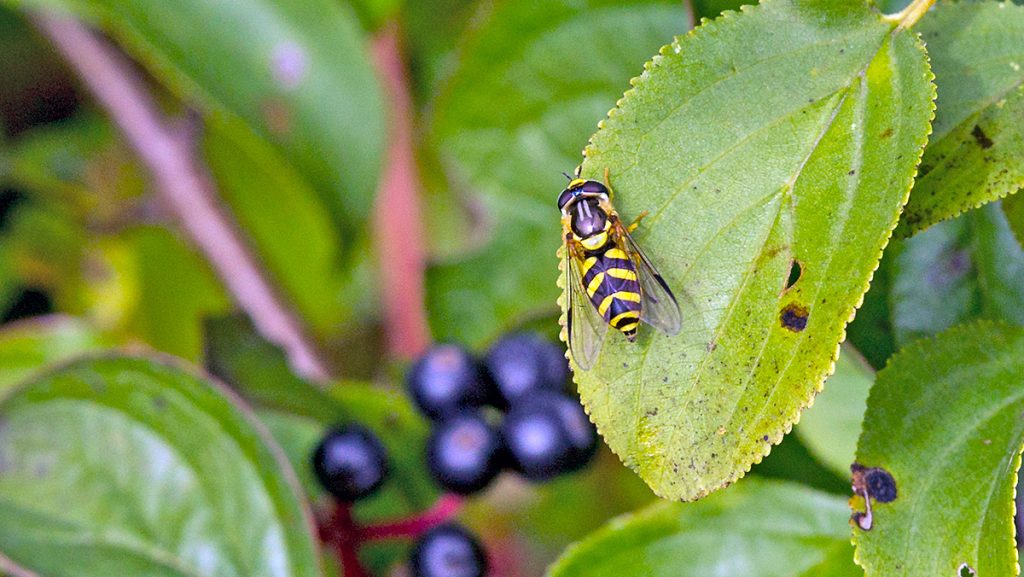
Added a new hoverfly too, the Stripe-backed Brusheye (Dasysyrphus albostriatus) as well as a Blue Blowfly (Calliphora vicina).
![Stripe-backed Brusheye [Dasysyrphus albostriatus]](https://downsdiary.uk/wp-content/gallery/sep-2025/NG8_4049_EOS-1D_TheDowns_23Sep2025.jpg "Stripe-backed Brusheye [Dasysyrphus albostriatus]")
![Blue Blowfly [Calliphora vicina]](https://downsdiary.uk/wp-content/gallery/sep-2025/NG8_4057_EOS-1D_TheDowns_23Sep2025.jpg "Blue Blowfly [Calliphora vicina]")
Large patches of Stinging Nettle (Urtica dioica) have now gone to seed.
![Stinging Nettle [Urtica dioica]](https://downsdiary.uk/wp-content/gallery/sep-2025/NG8_3978_EOS-1D_TheDowns_23Sep2025.jpg "Stinging Nettle [Urtica dioica]")
<<<< Previous page | Next Page >>>>