Butterfly numbers are increasing. Good variety today, too. Brimstone (Gonepteryx rhamni) is still the dominant species, but several Peacock (Aglais io), Speckled Wood (Pararge aegeria) and Holly Blue (Celastrina argiolus) were seen, as well as single Green Hairstreak (Callophrys rubi), Orange Tip (Anthocharis cardamines) and a first of the season Small White (Pieris rapae). Doing my usual search of the underside of leaves I came across one Brimstone with perfect camouflage.
There are still a lot of Green Longhorn (Adela reaumurella) moths about, to be found at rest on the leaves of many of the deciduous trees, but especially Silver Birch and Common Lime. Females now seem more numerous, too.
A male Flavous Nomad Bee (Nomada flava) was seen resting on a Silver Birch (Betula pendula) leaf and a male Tawny Mining Bee (Andrea fulva) on an English Oak (Quercus robur) leaf.
On the same oak tree an Orb-weaver spider (Araniella sp.) was beginning to wrap its prey in silk thread.
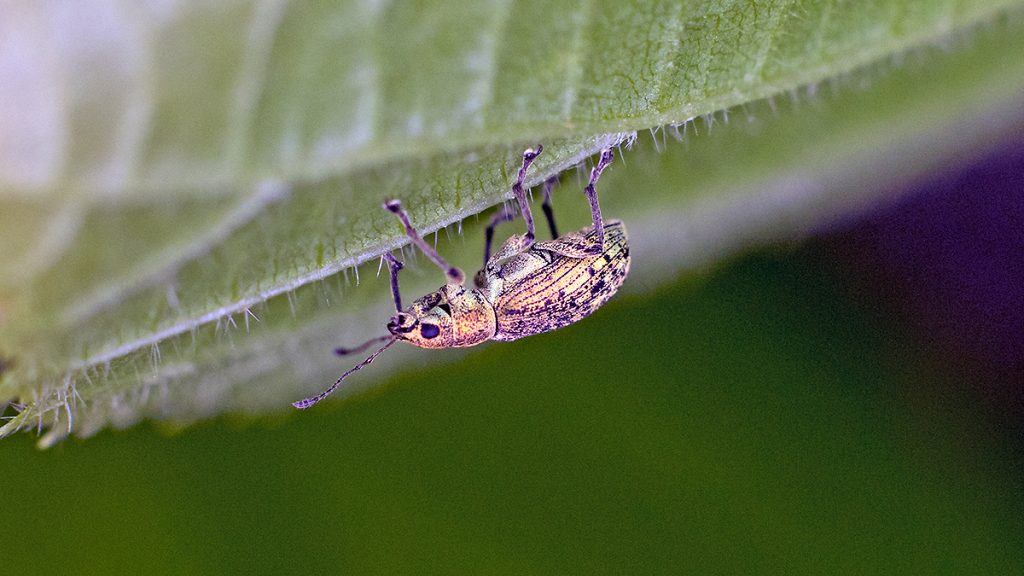
One Common Lime (Tilia × europaea) that is not yet fully in leaf is already showing the red nail galls of an infestation by the Lime Nail Gall Mite (Eriophyes tiliae). I found a Deer Broad-nosed Weevil (Polydrusus cervinus) on the upper surface of a leaf of this tree. It took exception to being photographed and scuttled onto the underside of the leaf, where I managed an even better photo. Only because I was photographing the weevil did I see a 2mm long Hemipteran nymph, still unidentified (possibly a Rhopalid bug ?), on the same leaf.
Another insect that remains unidentified is a parasitic wasp located on a sycamore leaf.
![Orange Tip [Anthocharis cardamines]](https://downsdiary.uk/wp-content/gallery/apr_2026/NG8_6999_EOS-1D_TheDowns_14Apr2026.jpg "Orange Tip [Anthocharis cardamines]")
![Small White [Pieris rapae]](https://downsdiary.uk/wp-content/gallery/apr_2026/NG8_6963-67_EOS-1D_TheDowns_14Apr2026.jpg "Small White [Pieris rapae]")
![Brimstone [Gonepteryx rhamni]](https://downsdiary.uk/wp-content/gallery/apr_2026/NG8_6956_EOS-1D_TheDowns_14Apr2026.jpg "Brimstone [Gonepteryx rhamni]")
![Flavous Nomad Bee [Nomada flava]](https://downsdiary.uk/wp-content/gallery/apr_2026/NG8_6978_EOS-1D_TheDowns_14Apr2026.jpg "Flavous Nomad Bee [Nomada flava]")
![Tawny Mining Bee [Andrena fulva]](https://downsdiary.uk/wp-content/gallery/apr_2026/BD2_2636_7D_TheDowns_14Apr2026.jpg "Tawny Mining Bee [Andrena fulva]")
![Orb-weaver spider [Araniella sp.]](https://downsdiary.uk/wp-content/gallery/apr_2026/BD2_2640_7D_TheDowns_14Apr2026.jpg "Orb-weaver spider [Araniella sp.]")
![Lime Nail Gall Mite [Eriophyes tiliae]](https://downsdiary.uk/wp-content/gallery/apr_2026/NG8_6988-BD2_2670_EOS-1D_TheDowns_14Apr2026.jpg "Lime Nail Gall Mite [Eriophyes tiliae]")
![Deer Broad-nosed Weevil [Polydrusus cervinus]](https://downsdiary.uk/wp-content/gallery/apr_2026/BD2_2674_7D_TheDowns_14Apr2026.jpg "Deer Broad-nosed Weevil [Polydrusus cervinus]")
![Deer Broad-nosed Weevil [Polydrusus cervinus]](https://downsdiary.uk/wp-content/gallery/apr_2026/BD2_2685_7D_TheDowns_14Apr2026.jpg "Deer Broad-nosed Weevil [Polydrusus cervinus]")
![Hemipteran nymph [unidentified]](https://downsdiary.uk/wp-content/gallery/apr_2026/BD2_2664_7D_TheDowns_14Apr2026.jpg "Hemipteran nymph [unidentified]")
![Parasitic wasp [unidentified]](https://downsdiary.uk/wp-content/gallery/apr_2026/BD2_2689_7D_TheDowns_14Apr2026.jpg "Parasitic wasp [unidentified]")
As for plants, the first Rowan (Sorbus aucuparia) is now flowering. The second member of the buttercup family has now put in appearance. Lesser Celandine is the early flowering buttercup each spring, while the second, seen today, is the Bulbous Buttercup (Ranunculus bulbosus). The Bulbous Buttercup can be separated from at least two other species of Ranunculus that are present on the Downs, but which won’t appear for another month yet, by its reflexed (bent back along the flower stem) sepals and very hairy stem.
![Rowan [Sorbus aucuparia]](https://downsdiary.uk/wp-content/gallery/apr_2026/NG8_6980_EOS-1D_TheDowns_14Apr2026.jpg "Rowan [Sorbus aucuparia]")
![Bulbous Buttercup [Ranunculus bulbosus]](https://downsdiary.uk/wp-content/gallery/apr_2026/NG8_6981-BD2_2649_EOS-1D_TheDowns_14Apr2026.jpg "Bulbous Buttercup [Ranunculus bulbosus]")
<<<< Previous page | Next Page >>>>