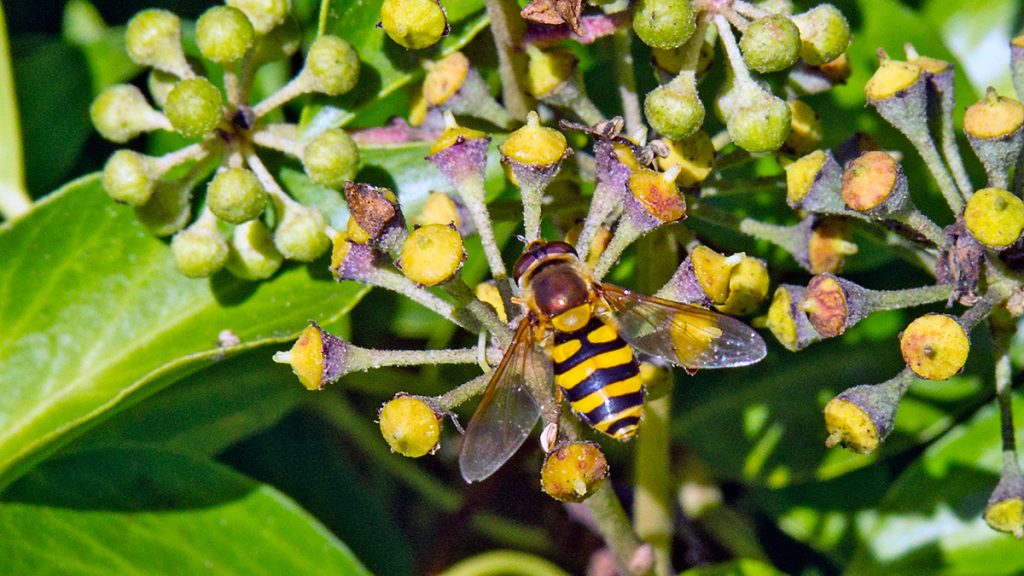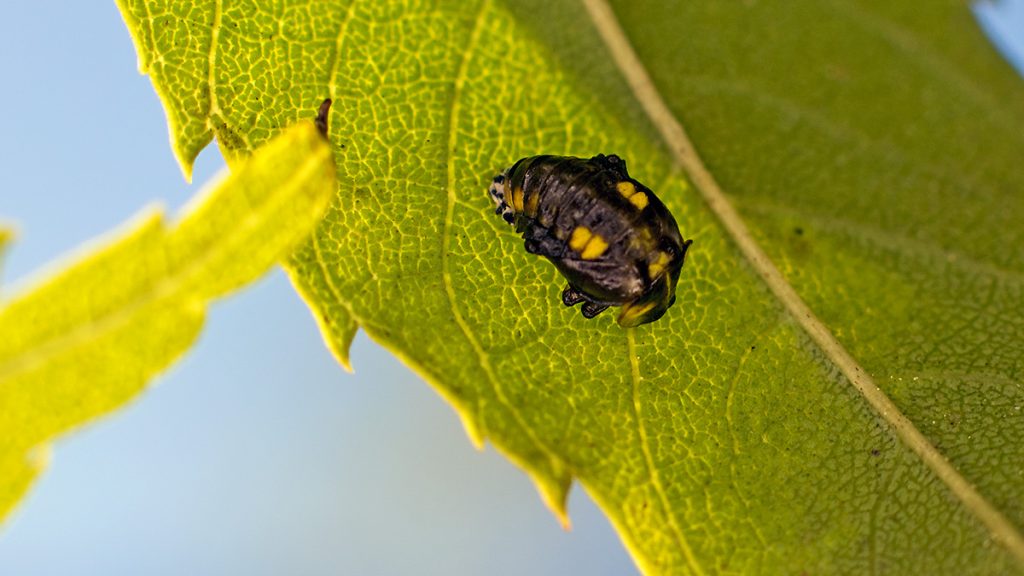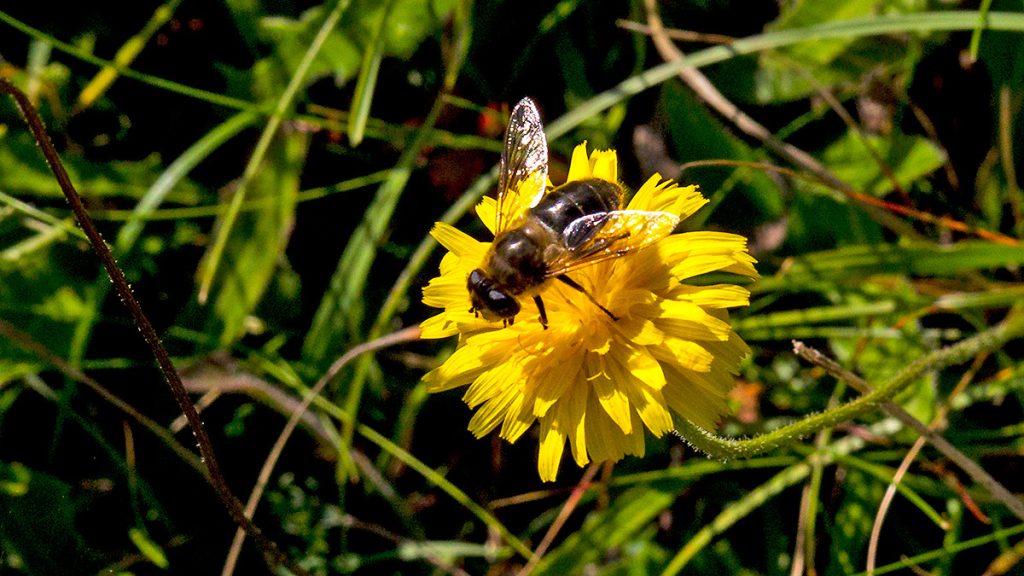
Common Banded Hoverfly (Syrphus ribesii) and Batman Hoverfly (Myathropa florea) are still the most numerous hoverflies, but I managed to pick out a Plain-faced Drone Fly (Eristalis arbustorum). Both Harlequin Ladybird (Harmonia axyridis) and Seven-spot Ladybird (Coccinella septempunctata) are about in good numbers, particularly on sycamore and dogwood leaves.
I also found a Cucumber Green Spider (Araniella cucurbitina) on her web on a sycamore tree.
![Batman Hoverfly [Myathropa florea]](https://downsdiary.uk/wp-content/gallery/oct_2025/NG8_4472_EOS-1D_TheDowns_09Oct2025.jpg "Batman Hoverfly [Myathropa florea]")
![Plain-faced Drone Fly [Eristalis arbustorum]](https://downsdiary.uk/wp-content/gallery/oct_2025/NG8_4510_EOS-1D_TheDowns_09Oct2025.jpg "Plain-faced Drone Fly [Eristalis arbustorum]")
![Harlequin Ladybird [Harmonia axyridis]](https://downsdiary.uk/wp-content/gallery/oct_2025/JO8V3904_EOS-1D_TheDowns_09Oct2025.jpg "Harlequin Ladybird [Harmonia axyridis]")
![Seven-spot Ladybird [Coccinella septempunctata]](https://downsdiary.uk/wp-content/gallery/oct_2025/NG8_4479_EOS-1D_TheDowns_09Oct2025.jpg "Seven-spot Ladybird [Coccinella septempunctata]")
![Cucumber Green Spider [Araniella cucurbitina]](https://downsdiary.uk/wp-content/gallery/oct_2025/JO8V3886_EOS-1D_TheDowns_09Oct2025.jpg "Cucumber Green Spider [Araniella cucurbitina]")
On a single buckthorn leaf I photographed both the leaf edge gall of the Jumping Plant Louse (Trichochermes walkeri) and the active leaf mine of a Buckthorn Dot (Stigmella catharticella) moth larva, in which the larva is still mining the gallery.
On oak leaves on the same twig, I found an Oyster Gall caused by the gall wasp Neuroterus anthracinus f. agamic and a leaf edge fold secured by silk threads that contains the pupa of either the Oak Stilt or Shaded Oak Stilt moth (referred to as the aggregate Caloptilia alchimiella/robustella agg).
![Jumping Plant Louse [Trichochermes walkeri]](https://downsdiary.uk/wp-content/gallery/oct_2025/JO8V3897_EOS-1D_TheDowns_09Oct2025.jpg "Jumping Plant Louse [Trichochermes walkeri]")
![Buckthorn Dot moth [Stigmella catharticella]](https://downsdiary.uk/wp-content/gallery/oct_2025/NG8_4499-4500_EOS-1D_TheDowns_09Oct2025.jpg "Buckthorn Dot moth [Stigmella catharticella]")
![Oyster Gall [Neuroterus anthracinus]](https://downsdiary.uk/wp-content/gallery/oct_2025/NG8_4472b_EOS-1D_TheDowns_09Oct2025.jpg "Oyster Gall [Neuroterus anthracinus]")
![Oak Stilt/Shaded Oak Stilt [Caloptilia alchimiella/robustella agg.]](https://downsdiary.uk/wp-content/gallery/oct_2025/NG8_4472c_EOS-1D_TheDowns_09Oct2025.jpg "Oak Stilt/Shaded Oak Stilt [Caloptilia alchimiella/robustella agg.]")
In a different part of the old sheep enclosure to that of 3 days ago I came across more mushrooms on old tree stumps, which I believe may also be Sulphur Tuft (Hypholoma fasciculare) mushrooms.
Bright red berries were the order of the day with Guelder-rose (Viburnum opulus) berries (drupes), Tree Cotoneaster (Cotoneaster frigidus) berries (pomes), and the highly poisonous Black Bryony (Dioscorea communis) berries (drupes) all prominent.
![Sulphur Tuft [Hypholoma fasciculare?]](https://downsdiary.uk/wp-content/gallery/oct_2025/NG8_4474_EOS-1D_TheDowns_09Oct2025.jpg "Sulphur Tuft [Hypholoma fasciculare?]")
![Guelder-rose [Viburnum opulus]](https://downsdiary.uk/wp-content/gallery/oct_2025/NG8_4493_EOS-1D_TheDowns_09Oct2025.jpg "Guelder-rose [Viburnum opulus]")
![Tree Cotoneaster [Cotoneaster frigidus]](https://downsdiary.uk/wp-content/gallery/oct_2025/NG8_4484_EOS-1D_TheDowns_09Oct2025.jpg "Tree Cotoneaster [Cotoneaster frigidus]")
![Black Bryony [Dioscorea communis]](https://downsdiary.uk/wp-content/gallery/oct_2025/NG8_4483_EOS-1D_TheDowns_09Oct2025.jpg "Black Bryony [Dioscorea communis]")
![Black Bryony [Dioscorea communis]](https://downsdiary.uk/wp-content/gallery/oct_2025/NG8_4480_EOS-1D_TheDowns_09Oct2025.jpg "Black Bryony [Dioscorea communis]")
<<<< Previous page | Next Page >>>>