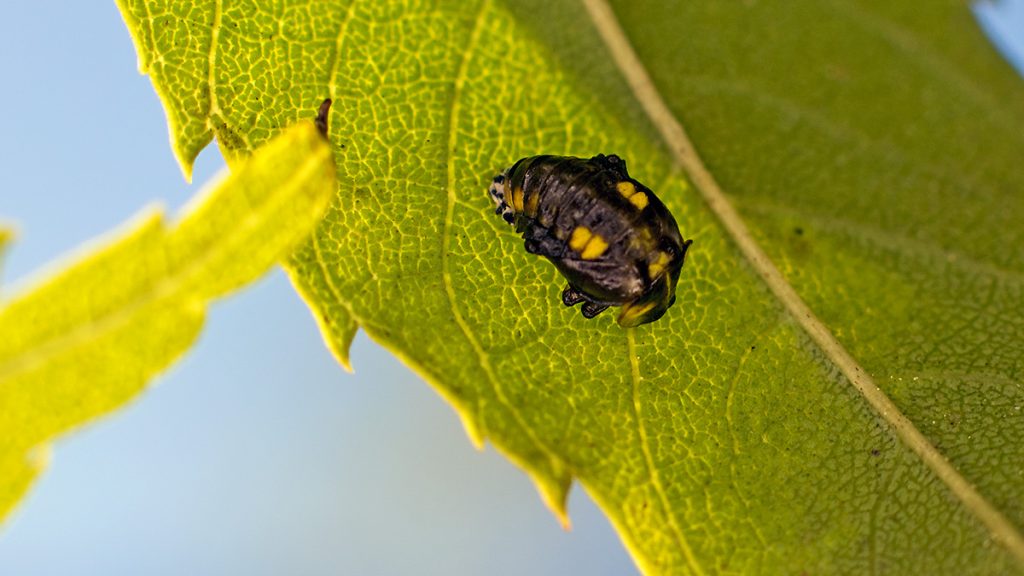
Another new species for me this morning on an Ash (Fraxinus excelsior) leaf, the Ash Whitefly (Siphoninus phillyreae). I located a single adult and puparia on the underside of a leaf.
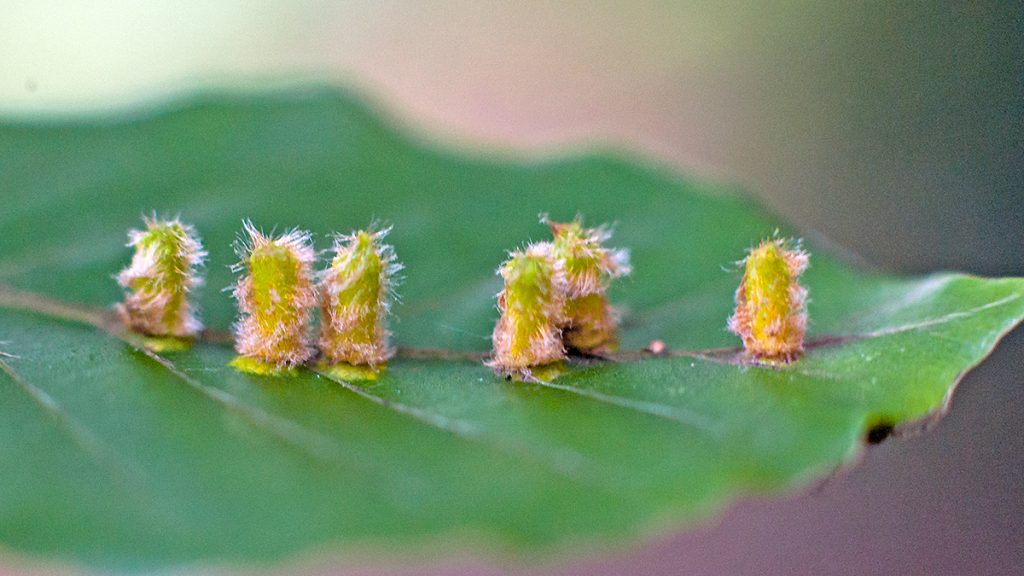
Several leaf mines and galls were photographed. These included the hairy galls of the Hairy Beech Gall Midge (Hartigiola annulipes) on Common Beech (Fagus sylvatica) leaves, the larval mine of the Small Beech Dot moth (Stigmella tityrella) also on Beech, the larval mine of the Hawthorn Leaf-miner moth (Phyllonorycter corylifoliella) this time on a Common Hawthorn (Crataegus monogyna) leaf and mines on Old Man’s Beard/Traveller’s Joy (Clematis vitalba) leaves formed by the larvae of a Phytomyza sp. leaf miner fly. Due to the similarity between the two, these last mines will be either P. vitalbae or P. fulgens. Also found was the larval case of a Coleophora sp. moth on a Common Dogwood leaf. The mature larvae of Coleophora moths feed externally on plants, usually on their leaves, constructing distinctive protective silken cases often with plant material woven in. While there are many Coleophora that are plant specific there are also many that are polyphagous (i.e. feeding on various plants), which is why it is difficult to identify the species of this one.
![Ash Whitefly [Siphoninus phillyreae]](https://downsdiary.uk/wp-content/gallery/oct_2025/JO8V4035_EOS-1D_TheDowns_16Oct2025.jpg "Ash Whitefly [Siphoninus phillyreae]")
![Hairy Beech Gall Midge [Hartigiola annulipes]](https://downsdiary.uk/wp-content/gallery/oct_2025/JO8V4064_EOS-1D_TheDowns_16Oct2025.jpg "Hairy Beech Gall Midge [Hartigiola annulipes]")
![Hairy Beech Gall Midge [Hartigiola annulipes]](https://downsdiary.uk/wp-content/gallery/oct_2025/JO8V4059_EOS-1D_TheDowns_16Oct2025.jpg "Hairy Beech Gall Midge [Hartigiola annulipes]")
![Small Beech Dot moth [Stigmella tityrella]](https://downsdiary.uk/wp-content/gallery/oct_2025/NG8_4819-JO8V4048_EOS-1D_TheDowns_16Oct2025.jpg "Small Beech Dot moth [Stigmella tityrella]")
![Hawthorn Leaf-miner [Phyllonorycter corylifoliella]](https://downsdiary.uk/wp-content/gallery/oct_2025/NG8_4841_EOS-1D_TheDowns_16Oct2025.jpg "Hawthorn Leaf-miner [Phyllonorycter corylifoliella]")
![leaf miner fly [Phytomyza sp.]](https://downsdiary.uk/wp-content/gallery/oct_2025/NG8_4836-7_EOS-1D_TheDowns_16Oct2025.jpg "leaf miner fly [Phytomyza sp.]")
![larval case [Coleophora sp.]](https://downsdiary.uk/wp-content/gallery/oct_2025/NG8_4813_EOS-1D_TheDowns_16Oct2025.jpg "larval case [Coleophora sp.]")
In the old sheep enclosure the Honey Fungus (Armillaria mellea) first seen five days ago has begun releasing its white spores, while a Harebell (Campanula rotundifolia) joins the list of flowers coming into late bloom.
![Honey Fungus [Armillaria mellea]](https://downsdiary.uk/wp-content/gallery/oct_2025/NG8_4842_EOS-1D_TheDowns_16Oct2025.jpg "Honey Fungus [Armillaria mellea]")
![Honey Fungus [Armillaria mellea]](https://downsdiary.uk/wp-content/gallery/oct_2025/NG8_4843_EOS-1D_TheDowns_16Oct2025.jpg "Honey Fungus [Armillaria mellea]")
![Harebell [Campanula rotundifolia]](https://downsdiary.uk/wp-content/gallery/oct_2025/NG8_4851_EOS-1D_TheDowns_16Oct2025.jpg "Harebell [Campanula rotundifolia]")
Nature Note for the Day
The whitefly is not, as the name might suggest, a fly. It belongs to the order Hemiptera that contains, among others, shield bugs, aphids, froghoppers and leafhoppers. Unlike the nymphs of the shieldbugs which are mobile feeders throughout their growth stages, whitefly larvae attach their mouthparts to the underside of a leaf to suck in nutrients and remain fixed to the same spot during their moults, eventually pupating inside the final exoskeleton. The pupa develops into an adult, which is visible inside that final exoskelton before it splits open to allow the new imago (adult) to emerge.
Wikipedia provide a fuller explanation of the whitefly life cycle.
<<<< Previous page | Next Page >>>>