Another scorcher, but a steady breeze just to take the edge off the heat. Not a cloud in the sky except for a criss-cross of aircraft contrails. I set off early to beat the ramping up of the heat and was home by 10:30.
There were plenty of butterflies around, but not quite in the numbers of two days ago. Dozens of Marbled White, which still dominated, good numbers of Meadow Brown, Ringlet, and Dark Green Fritillary, with a few Small Heath and Small Skipper, and a single Holly Blue. The Holly Blue was a very tatty-looking specimen, no doubt the tail end of the spring generation. This year’s conditions may well give us a second generation starting in mid-July.
Apart from the butterflies I disturbed a few Brown Oak Tortrix (Archips crataegana) moths walking through long grass (this one was first recorded 3 weeks ago today).
It seems that the heat has caused most of the rest of the insects to seek shelter under leaves or deeper inside bushes as there were not many to be seen out in the open other than the ubiquitous Trivial Plant Bug (Closterotomus trivialis) on Hogweed flowers. They were joined by the first flush of this summer’s Common Red Soldier Beetle (Rhagonycha fulva), which first appeared in the same week last year (27th June) too.
I did manage to find one new insect on the underside of a Horse Chestnut leaf, a nymph of the Oak Bush-cricket (Meconema thalassinum).
First noted on 5th June I located another active leaf mine of a larva of the leaf-miner fly Agromyza myosotidis on a Common Comfrey leaf.
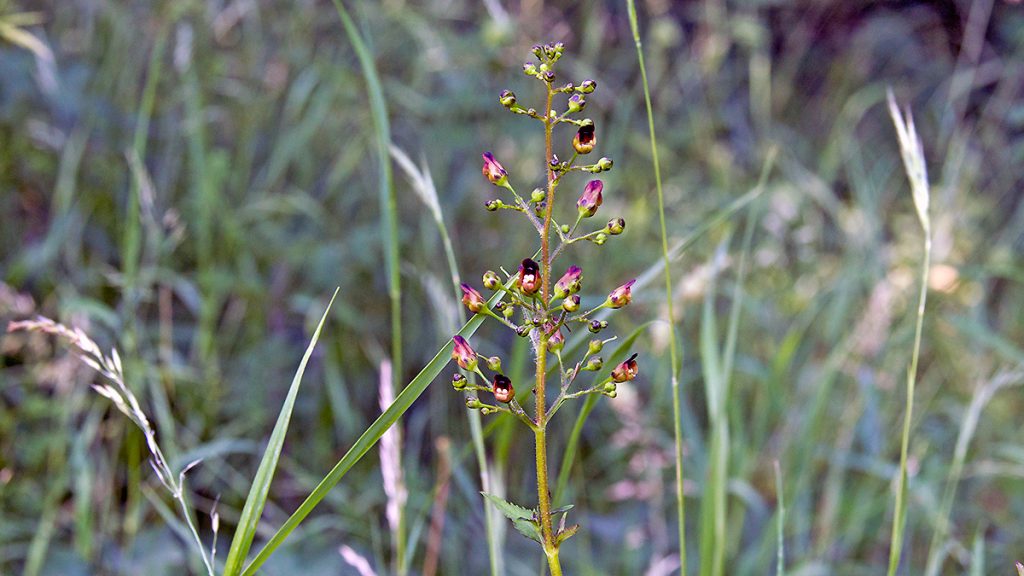
It is almost 2 months since I first noted the presence of a single Woodland Figwort (Scrophularia nodosa) plant – I have found no others since. It has finally flowered. The white Hedge Bedstraw (Galium album) has now been joined by its yellow cousin Lady’s Bedstraw (Galium verum). A few early Wild Marjoram (Origanum vulgare) are appearing and Prickly Sow-thistle (Sonchus asper) is also flowering.
Some Sweet Chestnut (Castanea sativa) trees are also flowering, the flowers borne in long catkins, with both male and female flowers in the same catkin. Sweet Chestnut is, however, self-incompatible. This means that the female flowers on the catkins cannot pollinate the male flowers on catkins of the same tree. Cross-pollination with another tree is required.

![Common Red Soldier Beetle [Rhagonycha fulva]](https://downsdiary.uk/wp-content/gallery/june_2025/NG8_1738_EOS-1D_TheDowns_27Jun2025.jpg "Common Red Soldier Beetle [Rhagonycha fulva]")
![Oak Bush-cricket [Meconema thalassinum]](https://downsdiary.uk/wp-content/gallery/jun_2026/NG8_9925-7_EOS-1D_TheDowns_22Jun2026.jpg "Oak Bush-cricket [Meconema thalassinum]")
![leaf-miner fly [Agromyza myosotidis]](https://downsdiary.uk/wp-content/gallery/jun_2026/NG8_9922-4_EOS-1D_TheDowns_22Jun2026.jpg "leaf-miner fly [Agromyza myosotidis]")
![Woodland Figwort [Scrophularia nodosa]](https://downsdiary.uk/wp-content/gallery/jun_2026/NG8_9918_EOS-1D_TheDowns_22Jun2026.jpg "Woodland Figwort [Scrophularia nodosa]")
![Lady’s Bedstraw [Galium verum]](https://downsdiary.uk/wp-content/gallery/jun_2026/NG8_9907_EOS-1D_TheDowns_22Jun2026.jpg "Lady’s Bedstraw [Galium verum]")
![Wild Marjoram [Origanum vulgare]](https://downsdiary.uk/wp-content/gallery/june_2025/NG8_1592_EOS-1D_TheDowns_25Jun2025.jpg "Wild Marjoram [Origanum vulgare]")
![Sweet Chestnut [Castanea sativa]](https://downsdiary.uk/wp-content/gallery/jun_2026/NG8_9932_EOS-1D_TheDowns_22Jun2026.jpg "Sweet Chestnut [Castanea sativa]")
<<<< Previous page | Next Page >>>>