In the past week I have come across many small groups of Birch Catkin Bugs (Kleidocerys resedae) huddled together overwintering on either large leaf buds of sycamore or on holly and ivy. They seem more numerous on the latter two, as these evergreen plants must provide more protection for them.
![Birch Catkin Bug [Kleidocerys resedae]](https://downsdiary.uk/wp-content/gallery/dec_2025/NG8_5493-5608_EOS-1D_TheDowns_13-19Dec2025.jpg "Birch Catkin Bug [Kleidocerys resedae]")
I know of only one Scots Pine (Pinus sylvestris) on the Downs, so I thought that now is the appropriate time of year to post a few images. The Scots Pine is the only native pine species in Britain, although there are several introduced species mainly in landscaped gardens or plantations. It is a ‘two-needle’ pine, with the needles (basically long thin leaves) spirally arranged along the shoots in bunches of two (the botanical term for these bunches is fascicles). The female flowers once pollenated become immature cones, which only mature after a second summer. Even when mature it can take up to 5 years for the cone to release its seeds, so you can see cones of several different ages on one tree.
In keeping with the ‘time of year’ theme, it is now very easy to pick out the evergreen trees from a distance, particularly mature holly trees. Most of us probably think of holly as bushes but there are some striking examples of mature holly trees on the Downs. I noted in a previous post that not all holly leaves have spikes. As these are mature trees almost all of the leaves are spikeless.
![Scots Pine [Pinus sylvestris]](https://downsdiary.uk/wp-content/gallery/dec_2025/JO8V5126_EOS-1D_TheDowns_19Dec2025.jpg "Scots Pine [Pinus sylvestris]")
![Scots Pine [Pinus sylvestris]](https://downsdiary.uk/wp-content/gallery/dec_2025/JO8V5118_EOS-1D_TheDowns_19Dec2025.jpg "Scots Pine [Pinus sylvestris]")
![Scots Pine [Pinus sylvestris]](https://downsdiary.uk/wp-content/gallery/dec_2025/JO8V5124_EOS-1D_TheDowns_19Dec2025.jpg "Scots Pine [Pinus sylvestris]")
![Holly trees [Ilex aquifolium]](https://downsdiary.uk/wp-content/gallery/dec_2025/JO8V5128_EOS-1D_TheDowns_19Dec2025.jpg "Holly trees [Ilex aquifolium]")
![Holly [Ilex aquifolium]](https://downsdiary.uk/wp-content/gallery/dec_2025/JO8V5129_EOS-1D_TheDowns_19Dec2025.jpg "Holly [Ilex aquifolium]")
![Holly [Ilex aquifolium]](https://downsdiary.uk/wp-content/gallery/dec_2025/JO8V5130_EOS-1D_TheDowns_19Dec2025.jpg "Holly [Ilex aquifolium]")
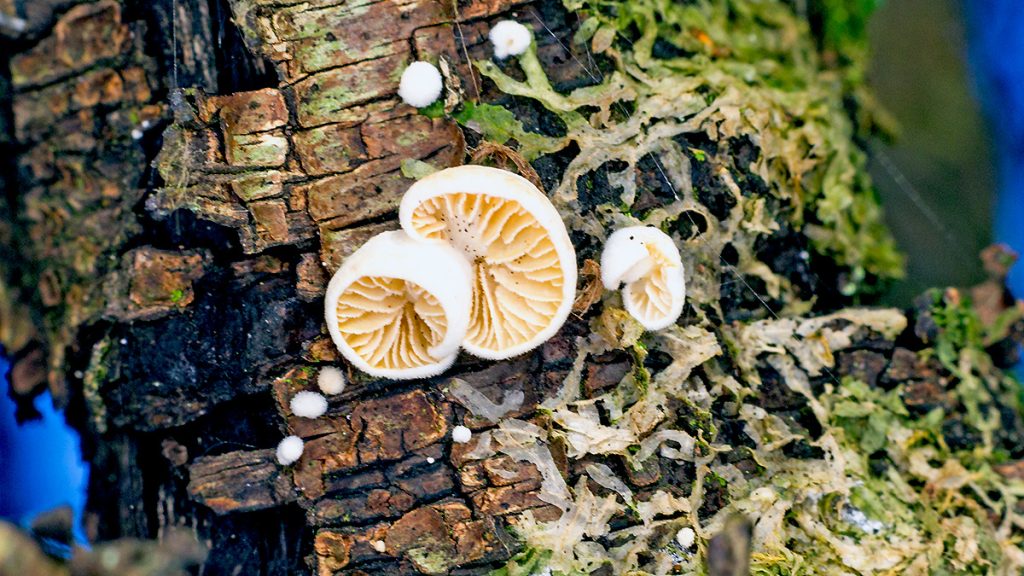
Another excursion into the currently easily accessible woodland turned up a different species of globular springtail, possibly Dicyrtoma fusca, only found when I was processing the image of the fungus it was beneath, which I believe may be Crimped Gill (Plicaturopsis crispa).
On a dead Silver Birch trunk I located some Oysterling mushrooms (Crepidotus sp.).
The ground in this area, as well as dead branches and fallen trees, is covered in moss, possibly Common Tamarisk-moss (Thuidium tamariscinum ?).
![Crimped Gill [Plicaturopsis crispa ?]](https://downsdiary.uk/wp-content/gallery/dec_2025/NG8_5618_EOS-1D_TheDowns_19Dec2025.jpg "Crimped Gill [Plicaturopsis crispa ?]")
![globular springtail [Dicyrtoma fusca ?]](https://downsdiary.uk/wp-content/gallery/dec_2025/NG8_5622_EOS-1D_TheDowns_19Dec2025.jpg "globular springtail [Dicyrtoma fusca ?]")
![an Oysterling mushroom [Crepidotus sp.]](https://downsdiary.uk/wp-content/gallery/dec_2025/NG8_5628_EOS-1D_TheDowns_19Dec2025.jpg "an Oysterling mushroom [Crepidotus sp.]")
![Common Tamarisk-moss [Thuidium tamariscinum ?]](https://downsdiary.uk/wp-content/gallery/dec_2025/JO8V5114_EOS-1D_TheDowns_19Dec2025.jpg "Common Tamarisk-moss [Thuidium tamariscinum ?]")
<<<< Previous page | Next Page >>>>