A much hotter day today, increasingly sunny through the morning, but still very windy. While still not present in large numbers there was a noticeable increase in butterflies on the wing. Brimstone, Speckled Wood, Brown Argus, Holly Blue and Common Blue made up today’s sightings.
It was a good day for new sightings of other insects, with a first of the year sighting of Black-striped Longhorn Beetle (Stenurella melanura) on a bramble flower and the cocoon of a Sycamore Aphid Parasitoid Wasp (Dyscritulus planiceps) with its associated mummified Common Sycamore Aphid (Drepanosiphum platanoidis). I first described these in my post of 17 Aug 2025.
First ever sightings too of three insects.
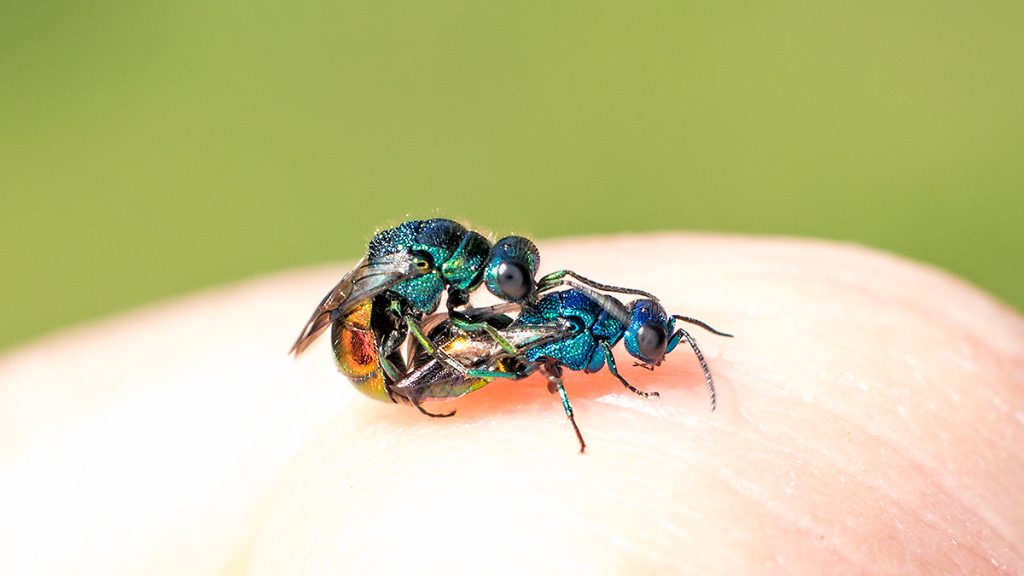
While moving aside a branch of a Scots Pine to take a better look at some insect eggs that I had spotted, I managed to transfer onto the back of a finger a pair of mating ruby-tailed wasps (Chrysidids), possibly Pseudomalus auratus.
Next was a Vernal Shieldbug (Peribalus strictus) on Common Comfrey (Symphytum officinale). According to the britishbugs.org website “This species has always been rare and many historic records probably relate to migrants, although the bug seems to have been established in Kent and Sussex at several sites. All recent records are from the southern coastal counties of England between Devon and Kent.”
Last was an Ornate Shieldbug (Eurydema ornata) on Horseradish (Armoracia rusticana). For this one britishbugs.org states “A fairly recent arrival in the UK, but now established in some coastal areas between Devon and Sussex, with scattered records from other parts of southern England and East Anglia.”
So that was two apparently rare species within 30 minutes. What is even more surprising is that the Ornate Shieldbug was found at the same spot that I have seen Yellow Weevil, Striped Shieldbug and White-shouldered Shieldbug – so 4 rarities in the same place.
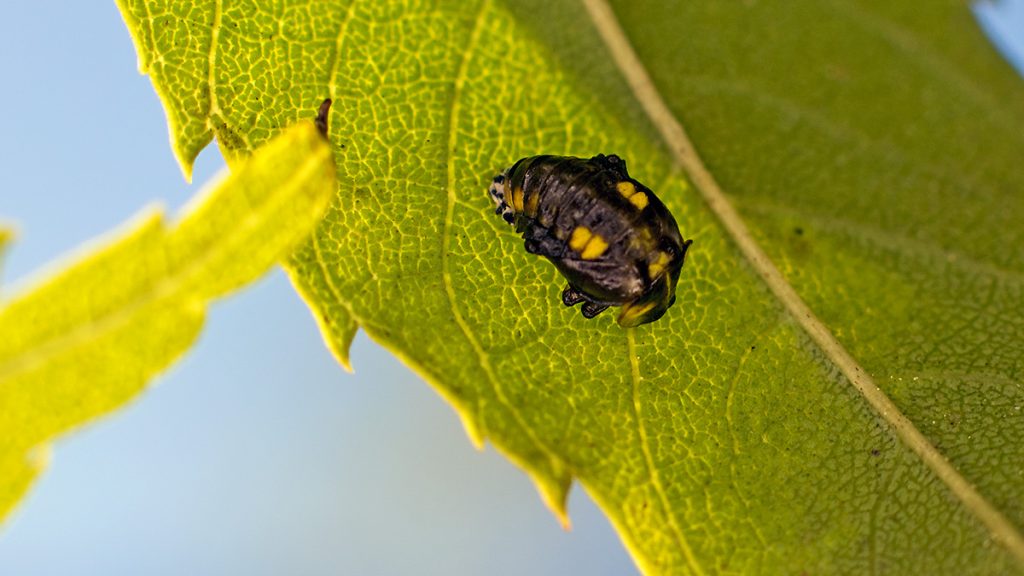
Other insects photographed were Red-tipped Flower Beetle (Malachius bipustulatus) on a Salad Burnet (Sanguisorba minor) flower, Common Carder Bee (Bombus pascuorum) on a Dog Rose (Rosa Canina) flower, Birch Catkin Bug (Kleidocerys resedae), which is a very common species on the Downs, on a Whitebeam (Aria edulis) leaf and a 22-spot ladybird (Psyllobora vigintiduopunctata) on a Buckthorn (Rhamnus cathartica) leaf.
![Black-striped Longhorn Beetle [Stenurella melanura]](https://downsdiary.uk/wp-content/gallery/may_2026/NG8_8511_EOS-1D_TheDowns_21May2026.jpg "Black-striped Longhorn Beetle [Stenurella melanura]")
![Sycamore Aphid Parasitoid Wasp [Dyscritulus planiceps]](https://downsdiary.uk/wp-content/gallery/may_2026/BD2_5507_7D_TheDowns_21May2026.jpg "Sycamore Aphid Parasitoid Wasp [Dyscritulus planiceps]")
![ruby-tailed wasp [Pseudomalus auratus?]](https://downsdiary.uk/wp-content/gallery/may_2026/BD2_5531_7D_TheDowns_21May2026.jpg "ruby-tailed wasp [Pseudomalus auratus?]")
![Vernal Shieldbug [Peribalus strictus]](https://downsdiary.uk/wp-content/gallery/may_2026/BD2_5497_7D_TheDowns_21May2026.jpg "Vernal Shieldbug [Peribalus strictus]")
![Ornate Shieldbug [Eurydema ornata]](https://downsdiary.uk/wp-content/gallery/may_2026/NG8_8577_EOS-1D_TheDowns_21May2026.jpg "Ornate Shieldbug [Eurydema ornata]")
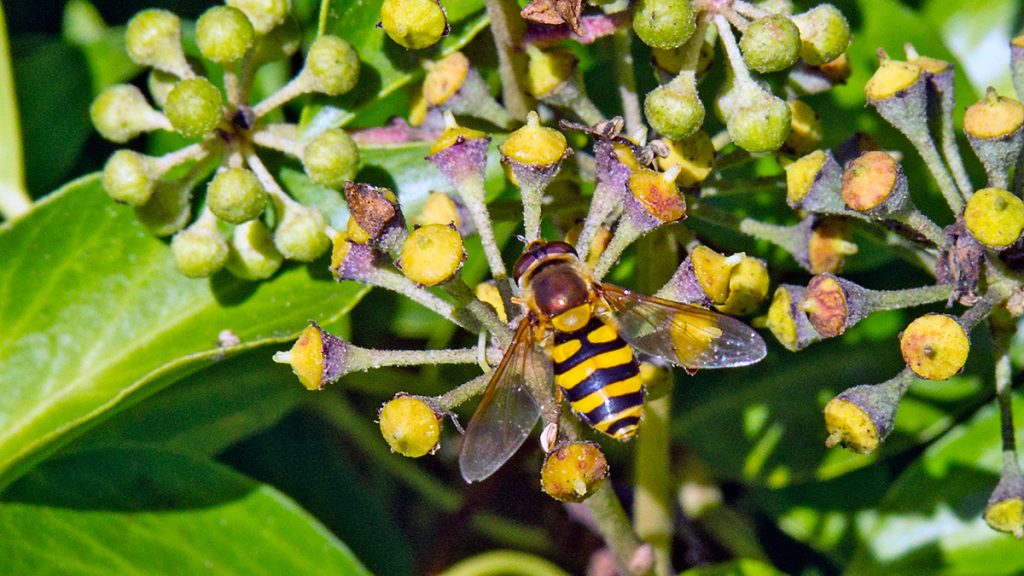
![Common Carder Bee [Bombus pascuorum] and Red-tipped Flower Beetle [Malachius bipustulatus]](https://downsdiary.uk/wp-content/gallery/may_2026/NG8_8525-45_EOS-1D_TheDowns_21May2026.jpg "Common Carder Bee [Bombus pascuorum] and Red-tipped Flower Beetle [Malachius bipustulatus]")
![Birch Catkin Bug [Kleidocerys resedae] and 22-spot ladybird [Psyllobora vigintiduopunctata]](https://downsdiary.uk/wp-content/gallery/may_2026/BD2_5514-42_7D_TheDowns_21May2026.jpg "Birch Catkin Bug [Kleidocerys resedae] and 22-spot ladybird [Psyllobora vigintiduopunctata]")
New wildflower for the season was Bladder Campion (Silene vulgaris), while a completely new record for me, and a plant I had never even heard of before, was Common Gromwell (Lithospermum officinale). You will see in one of my images that this year’s growth is flanked by dry stems from last summer still bearing some of their distinctive seeds. Indeed, It was these rather unusual white ‘nutlets’, that made me take a closer look.
![Common Gromwell [Lithospermum officinale]](https://downsdiary.uk/wp-content/gallery/may_2026/BD2_5521_7D_TheDowns_21May2026.jpg "Common Gromwell [Lithospermum officinale]")
![Bladder Campion [Silene vulgaris]](https://downsdiary.uk/wp-content/gallery/may_2026/NG8_8515_EOS-1D_TheDowns_21May2026.jpg "Bladder Campion [Silene vulgaris]")
![Common Gromwell [Lithospermum officinale]](https://downsdiary.uk/wp-content/gallery/may_2026/NG8_8582_EOS-1D_TheDowns_21May2026.jpg "Common Gromwell [Lithospermum officinale]")
Nature Note for the Day
Common Gromwell (Lithospermum officinale), that is not at all common on the Downs, is a flowering plant of the family Boraginaceae, related to several much more common plants such as Green Alkanet (Pentaglottis sempervirens), Common Comfrey (Symphytum officinale) and Wood Forget-me-not (Myosotis sylvatica). It is a plant of rough grassland and woodland margins but favours chalk downland and limestone locations.
Gromwell’s fruits, also known as nutlets, are formed within the calyx of the flower in a distinctive cluster of 2-4 tiny lemon-shaped porcelain-white ‘billiard balls’.
These nutlets, which range from white to greyish white in colour, are thought to provide the derivation of the English name Gromwell (also Graymile). The Old French name ‘Gromil’ (now ‘Grémil’) was corrupted to the English ‘Gromwell’ and is a combination of the two words ‘gré’ (grey – the colour) and mil (for millet seed) to give ‘grey millet’ referring to the colour of the nutlets.
The botanical name for the plant also derives from words referring to the fruits. Lithospermum literally means stone-seed, and Stoneseed is an alternative name for the plant.
The following notes on traditional uses of the plant were found on Wild Flower Web.
Gromwell has been used in traditional medicine for centuries due to its various medicinal properties. The plant contains a range of biologically active compounds, including lithospermic acid, which is known to have anti-inflammatory, antioxidant, and antimicrobial properties. These properties make the plant useful in treating a range of ailments such as sore throats, skin irritations, and digestive issues.
Apart from its medicinal uses, the plant has been used for dying textiles due to the presence of a red dye that is obtained from its roots. The dye was traditionally used to colour wool, silk, and cotton.
<<<< Previous page | Next Page >>>>