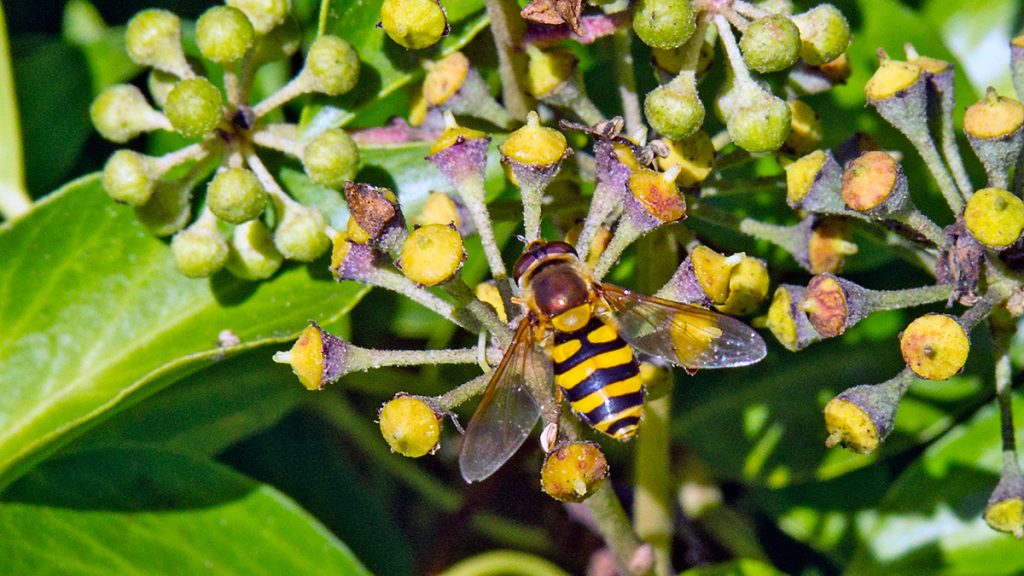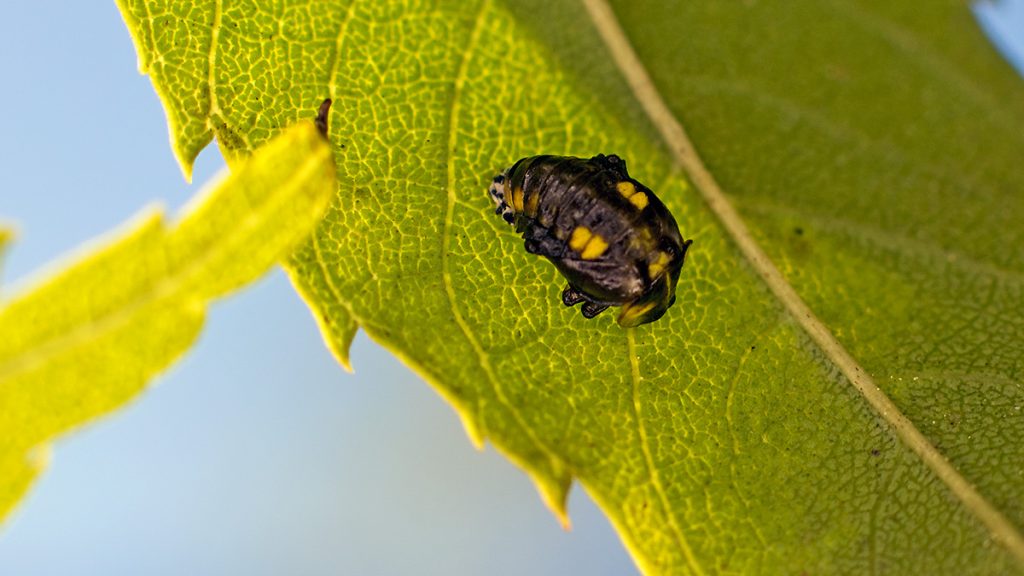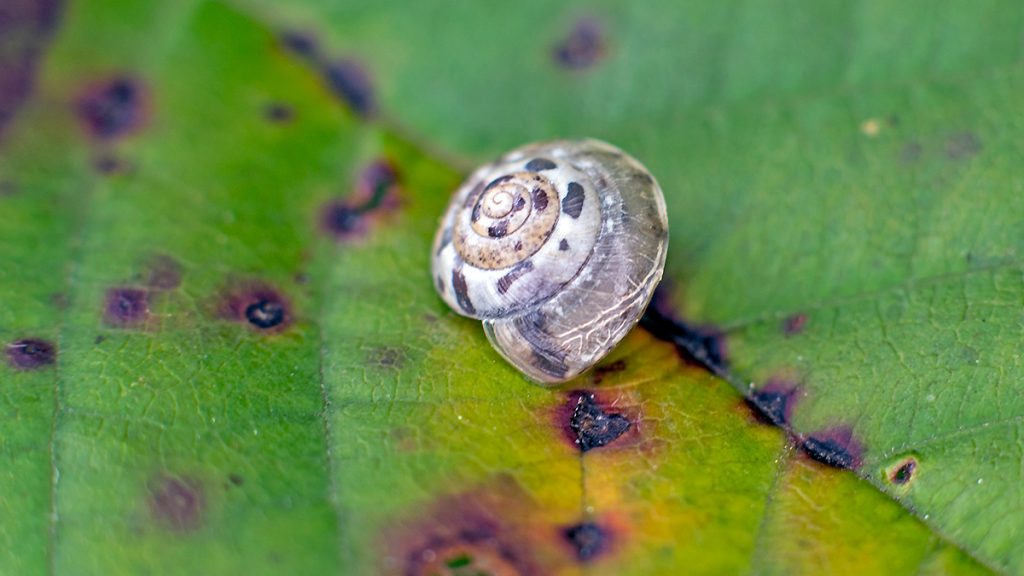
Rain was forecast for lunchtime, so I headed for the Downs early. Perhaps too early. Another cool morning, largely cloudy and yet again some gusty wind. Total butterfly count was 4, with 3 Common Blue and a single Brimstone, all disturbed from their place of rest. The rest of the insects were also mainly at rest on leaves.
This may be why I paid more attention than usual to the bird calls, as I’m usually too focused on the insects to really notice. With the summer migrants having arrived in good numbers I could pick out several Eurasian Blackcap (Sylvia atricapilla) and a Greater Whitethroat (Curruca communis). Chiffchaff (Phylloscopus collybita), which I hear mostly at this time of year although it is a localised resident species in southern England, was also prominent. These are probably true migrants swelling the low resident numbers.
It was a good morning for Coleoptera. While I have seen a lot of Swollen-thighed Beetle (Oedemera nobilis) recently, they have all been females. Finally, I found a male on a buttercup. Another false blister beetle, Oedemera lurida, was seen on Cat’s-ear (Hypochaeris radicata). Several Common Grammoptera (Grammoptera ruficornis) beetles had descended upon the flowers of one Dog Rose (Rosa canina) bush, where I also found a mating pair of the Green Immigrant Leaf Weevil (Polydrusus formosus). Another weevil, Strawberry Rhynchites (Neocoenorrhinus germanicus), was seen on Common Whitebeam (Aria edulis). One young Wayfaring Tree (Viburnum lantana) was looking particularly the worse for wear with its leaves half-eaten by several Viburnum Beetle (Pyrrhalta viburni) larvae.
![Swollen-thighed Beetle [Oedemera nobilis]](https://downsdiary.uk/wp-content/gallery/may_2026/NG8_8446_EOS-1D_TheDowns_18May2026.jpg "Swollen-thighed Beetle [Oedemera nobilis]")
![false blister beetle [Oedemera lurida]](https://downsdiary.uk/wp-content/gallery/may_2026/BD2_5383_7D_TheDowns_18May2026.jpg "false blister beetle [Oedemera lurida]")
![Common Grammoptera [Grammoptera ruficornis]](https://downsdiary.uk/wp-content/gallery/may_2026/BD2_5338_7D_TheDowns_18May2026.jpg "Common Grammoptera [Grammoptera ruficornis]")
![Green Immigrant Leaf Weevil [Polydrusus formosus]](https://downsdiary.uk/wp-content/gallery/may_2026/BD2_5344_7D_TheDowns_18May2026.jpg "Green Immigrant Leaf Weevil [Polydrusus formosus]")
![Strawberry Rhynchites [Neocoenorrhinus germanicus]](https://downsdiary.uk/wp-content/gallery/may_2026/BD2_5375_7D_TheDowns_18May2026.jpg "Strawberry Rhynchites [Neocoenorrhinus germanicus]")
![Viburnum Beetle [Pyrrhalta viburni]](https://downsdiary.uk/wp-content/gallery/may_2026/NG8_8463_EOS-1D_TheDowns_18May2026.jpg "Viburnum Beetle [Pyrrhalta viburni]")
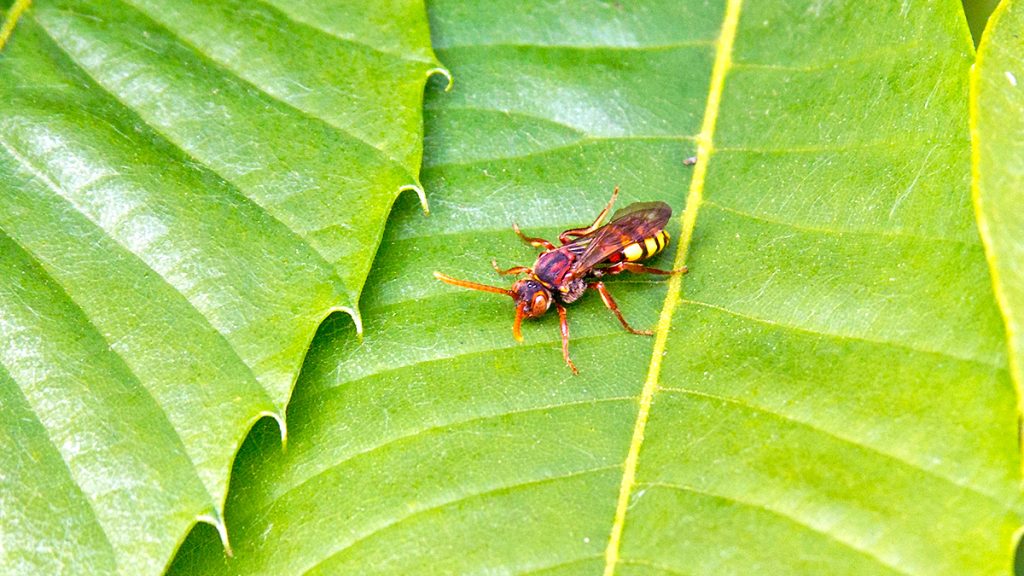
Other species photographed were a Brindled Tortrix (Ptycholoma lecheana) moth on Horse Chestnut (Aesculus hippocastanum), a female Flavous Nomad Bee (Nomada flava) on Sweet Chestnut (Castanea sativa), a female Dimorphic Strider (Macrophya montana) sawfly on Sycamore (Acer pseudoplatanus), Rose Aphid (Macrosiphum rosae) on Dog Rose (Rosa canina), a female root maggot fly (Anthomyiidae sp.) and a spider (not a particularly great image) tentatively identified as a Cricket Bat Spider (Mangora acalypha) on Hemp-agrimony (Eupatorium cannabinum).
Also seen were Black Bean Aphid (Aphis fabae) on Goosegrass (Galium aparine). Of interest here is that some of the adult apterae (wingless adults) appear to be giving birth to nymphs.
![Brindled Tortrix [Ptycholoma lecheana]](https://downsdiary.uk/wp-content/gallery/may_2026/BD2_5423-NG8_8498_7D_TheDowns_18May2026.jpg "Brindled Tortrix [Ptycholoma lecheana]")
![Flavous Nomad Bee [Nomada flava]](https://downsdiary.uk/wp-content/gallery/may_2026/NG8_8503_EOS-1D_TheDowns_18May2026.jpg "Flavous Nomad Bee [Nomada flava]")
![Dimorphic Strider [Macrophya montana]](https://downsdiary.uk/wp-content/gallery/may_2026/NG8_8482_EOS-1D_TheDowns_18May2026.jpg "Dimorphic Strider [Macrophya montana]")
![Rose Aphid [Macrosiphum rosae]](https://downsdiary.uk/wp-content/gallery/may_2026/BD2_5359_7D_TheDowns_18May2026.jpg "Rose Aphid [Macrosiphum rosae]")
![root maggot fly [Anthomyiidae sp.]](https://downsdiary.uk/wp-content/gallery/may_2026/BD2_5429_7D_TheDowns_18May2026.jpg "root maggot fly [Anthomyiidae sp.]")
![Cricket Bat Spider [Mangora acalypha?]](https://downsdiary.uk/wp-content/gallery/may_2026/NG8_8448_EOS-1D_TheDowns_18May2026.jpg "Cricket Bat Spider [Mangora acalypha?]")
![Black Bean Aphid [Aphis fabae]](https://downsdiary.uk/wp-content/gallery/may_2026/BD2_5332_7D_TheDowns_18May2026.jpg "Black Bean Aphid [Aphis fabae]")
Wildflowers added today were Bittersweet (Solanum dulcamara), two leguminous plants, White Clover (Trifolium repens) and Horseshoe Vetch (Hippocrepis comosa), and two of those similar-looking yellow composites, Cat’s-ear (Hypochaeris radicata) and Mouse-ear Hawkweed (Pilosella officinarum).
![Bittersweet [Solanum dulcamara]](https://downsdiary.uk/wp-content/gallery/may_2026/NG8_8451_EOS-1D_TheDowns_18May2026.jpg "Bittersweet [Solanum dulcamara]")
![White Clover [Trifolium repens]](https://downsdiary.uk/wp-content/gallery/may_2026/NG8_8490_EOS-1D_TheDowns_18May2026.jpg "White Clover [Trifolium repens]")
![Horseshoe Vetch [Hippocrepis comosa]](https://downsdiary.uk/wp-content/gallery/may_2026/NG8_8461_EOS-1D_TheDowns_18May2026.jpg "Horseshoe Vetch [Hippocrepis comosa]")
![Cat’s-ear [Hypochaeris radicata]](https://downsdiary.uk/wp-content/gallery/may_2026/NG8_8458_EOS-1D_TheDowns_18May2026.jpg "Cat’s-ear [Hypochaeris radicata]")
![Mouse-ear Hawkweed [Pilosella officinarum]](https://downsdiary.uk/wp-content/gallery/may_2026/NG8_8469_EOS-1D_TheDowns_18May2026.jpg "Mouse-ear Hawkweed [Pilosella officinarum]")
<<<< Previous page | Next Page >>>>