Another day of glorious sunshine, but the temperature yet another 1° cooler. While butterflies were all but absent again it was a good day for flies and bees.
I had to look no further than the now fully developed catkins of the Goat Willow (Salix caprea). This was where I found the only butterfly of the day, a Peacock (Aglais io). Having recorded my first Dark-edged Bee-fly (Bombylius major) just two days ago there were literally dozens around today, probing the flowers of the male catkins with their long proboscides (the accepted plural of proboscis in a scientific context). The bee-fly doesn’t land to feed like other flies do, but hovers somewhat like a hummingbird, while keeping at least its two front legs touching the plant to assist with balance.
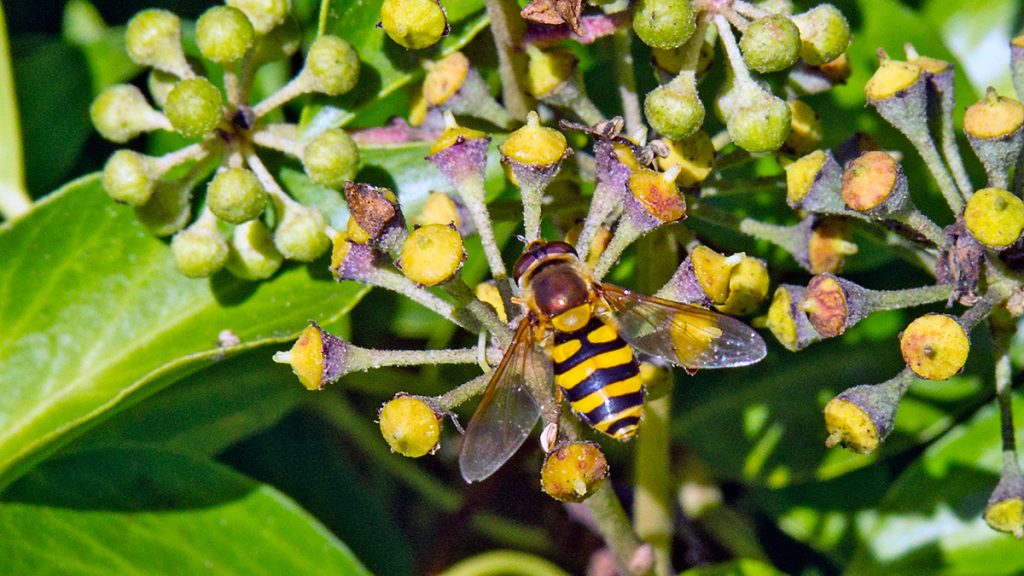
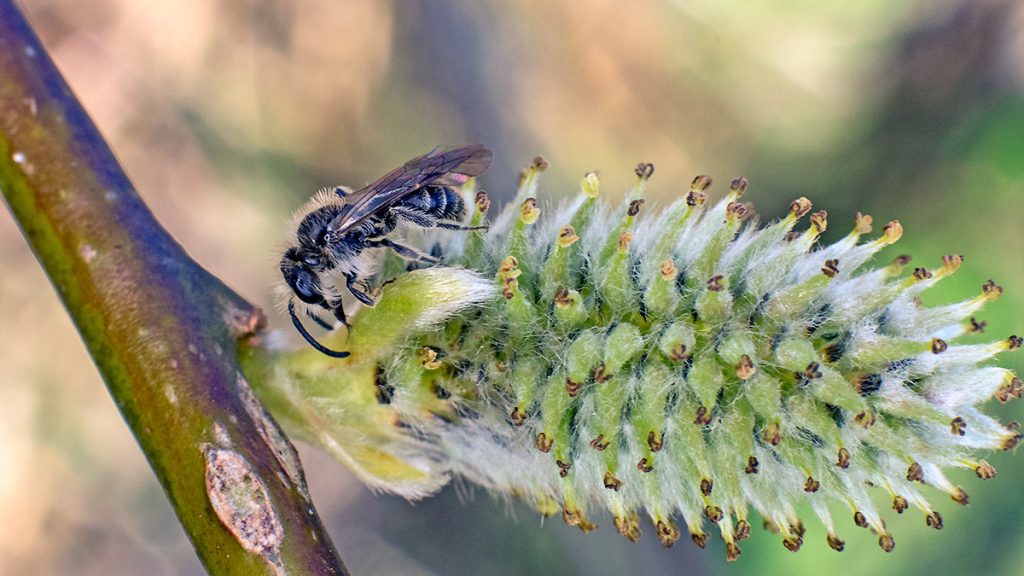
The supporting cast included two hoverflies, the Common Drone Fly (Eristalis tenax), a bee mimic, and the Black-tailed Aphideater (Eupeodes luniger), as well as four bee species, Tree Bumblebee (Bombus hypnorum), Western Honey Bee (Apis mellifera), Small Sallow Mining Bee (Andrena praecox) and Chocolate Mining Bee (Andrena scotica).
Another bee, the Buff-tailed Bumblebee (Bombus terrestris), was found on Gorse (Ulex europaeus) flowers.
![Peacock [Aglais io]](https://downsdiary.uk/wp-content/gallery/mar_2026/NG8_6372_EOS-1D_TheDowns_21Mar2026.jpg "Peacock [Aglais io]")
![Dark-edged Bee-fly [Bombylius major]](https://downsdiary.uk/wp-content/gallery/mar_2026/NG8_6361_EOS-1D_TheDowns_21Mar2026.jpg "Dark-edged Bee-fly [Bombylius major]")
![Dark-edged Bee-fly [Bombylius major]](https://downsdiary.uk/wp-content/gallery/mar_2026/NG8_6355_EOS-1D_TheDowns_21Mar2026.jpg "Dark-edged Bee-fly [Bombylius major]")
![Common Drone Fly [Eristalis tenax]](https://downsdiary.uk/wp-content/gallery/mar_2026/NG8_6383_EOS-1D_TheDowns_21Mar2026.jpg "Common Drone Fly [Eristalis tenax]")
![Western Honey Bee [Apis mellifera]](https://downsdiary.uk/wp-content/gallery/mar_2026/NG8_6344_EOS-1D_TheDowns_21Mar2026.jpg "Western Honey Bee [Apis mellifera]")
![Tree Bumblebee [Bombus hypnorum]](https://downsdiary.uk/wp-content/gallery/mar_2026/NG8_6333_EOS-1D_TheDowns_21Mar2026.jpg "Tree Bumblebee [Bombus hypnorum]")
![Black-tailed Aphideater [Eupeodes luniger]](https://downsdiary.uk/wp-content/gallery/mar_2026/NG8_6371_EOS-1D_TheDowns_21Mar2026.jpg "Black-tailed Aphideater [Eupeodes luniger]")
![Small Sallow Mining Bee [Andrena praecox]](https://downsdiary.uk/wp-content/gallery/mar_2026/BD2_1581_7D_TheDowns_21Mar2026.jpg "Small Sallow Mining Bee [Andrena praecox]")
![Buff-tailed Bumblebee [Bombus terrestris]](https://downsdiary.uk/wp-content/gallery/mar_2026/NG8_6335_EOS-1D_TheDowns_21Mar2026.jpg "Buff-tailed Bumblebee [Bombus terrestris]")
Having found my first Spring Epistrophe (Epistrophe eligans), a male, just two days ago, I found a female today. Other finds were a Yellow Dung Fly (Scathophaga stercoraria) on the new leaves of a Rubus sp., which could well be European Red Raspberry (Rubus idaeus), a Woodland Lypha (Lypha dubia) on a sycamore leaf, a Woodland Red Ant (Myrmica ruginodis) and some globular springtails (Dicyrtomina saundersi) on the underside of a Cherry Laurel (Prunus laurocerasus) leaf, a Black Garden Ant (Lasius niger) on Blackthorn (Prunus spinosa) blossom and another Platform Hammock Spider (Neriene peltata), first seen just three days ago, on the underside of a Cuckoo-pint (Arum maculatum) leaf.
I also came across my first Hemiptera nymph of the year (not a great image), possibly the newly hatched first stage nymph of a Mirid plant bug, the Common Green Capsid (Lygocoris pabulinus).
While walking along one of the woodland edge paths I became aware of a tiny (+/-3mm) insect on my left hand. Using my camera to get a closer look it was revealed as a Small Nettle Weevil (Nedyus quadrimaculatus).
![Spring Epistrophe [Epistrophe eligans]](https://downsdiary.uk/wp-content/gallery/mar_2026/BD2_1639_7D_TheDowns_21Mar2026.jpg "Spring Epistrophe [Epistrophe eligans]")
![Yellow Dung Fly [Scathophaga stercoraria]](https://downsdiary.uk/wp-content/gallery/mar_2026/NG8_6332_EOS-1D_TheDowns_21Mar2026.jpg "Yellow Dung Fly [Scathophaga stercoraria]")
![Woodland Lypha [Lypha dubia]](https://downsdiary.uk/wp-content/gallery/mar_2026/NG8_6339_EOS-1D_TheDowns_21Mar2026.jpg "Woodland Lypha [Lypha dubia]")
![Woodland Red Ant [Myrmica ruginodis]](https://downsdiary.uk/wp-content/gallery/mar_2026/BD2_1568_7D_TheDowns_21Mar2026.jpg "Woodland Red Ant [Myrmica ruginodis]")
![Black Garden Ant [Lasius niger]](https://downsdiary.uk/wp-content/gallery/mar_2026/BD2_1636_7D_TheDowns_21Mar2026.jpg "Black Garden Ant [Lasius niger]")
![Platform Hammock Spider [Neriene peltata]](https://downsdiary.uk/wp-content/gallery/mar_2026/BD2_1607_7D_TheDowns_21Mar2026.jpg "Platform Hammock Spider [Neriene peltata]")
![Platform Hammock Spider [Neriene peltata ?]](https://downsdiary.uk/wp-content/gallery/mar_2026/BD2_1612_7D_TheDowns_21Mar2026.jpg "Platform Hammock Spider [Neriene peltata ?]")
![Common Green Capsid [Lygocoris pabulinus ?]](https://downsdiary.uk/wp-content/gallery/mar_2026/BD2_1638_7D_TheDowns_21Mar2026.jpg "Common Green Capsid [Lygocoris pabulinus ?]")
![Small Nettle Weevil [Nedyus quadrimaculatus]](https://downsdiary.uk/wp-content/gallery/mar_2026/BD2_1626_7D_TheDowns_21Mar2026.jpg "Small Nettle Weevil [Nedyus quadrimaculatus]")
![Small Nettle Weevil [Nedyus quadrimaculatus]](https://downsdiary.uk/wp-content/gallery/mar_2026/BD2_1620_7D_TheDowns_21Mar2026.jpg "Small Nettle Weevil [Nedyus quadrimaculatus]")
<<<< Previous page | Next Page >>>>